Roseate Spoonbill
Platalea ajaja
 AI-generated
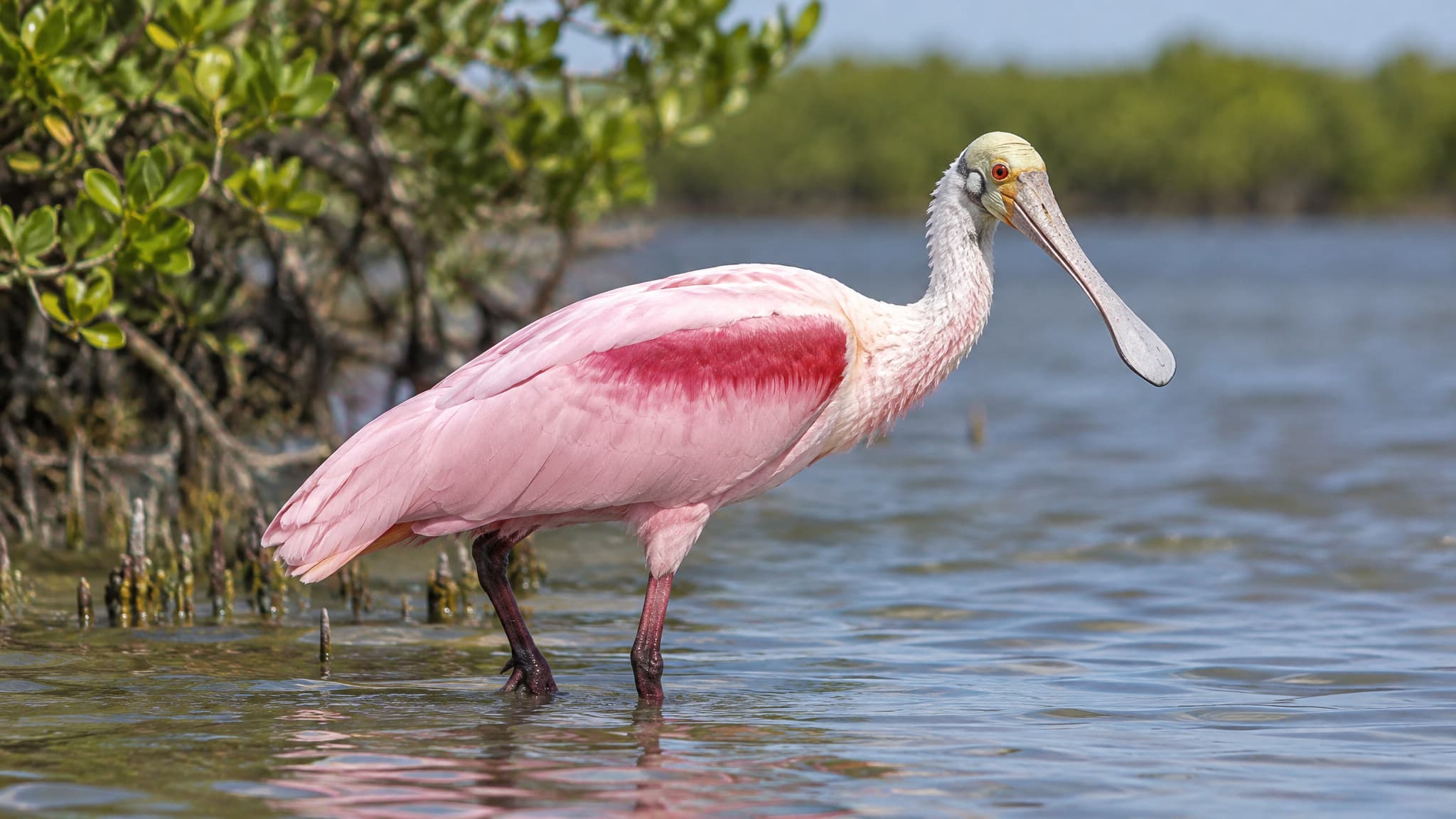
A Roseate Spoonbill (Platalea ajaja) stands in shallow coastal water beside mangrove vegetation, showing its pink plumage, long dark legs, and broad, flattened spoon-shaped bill.
The roseate spoonbill (Platalea ajaja) is a large wading bird in the ibis and spoonbill family, Threskiornithidae. It is the only spoonbill native to the Western Hemisphere. Adults are 71–86 cm long and have a wingspan of about 120–133 cm. They are easy to recognize by their pink wings and underparts, the deeper red on top of the wings, a white neck and back, and a long, flat bill that widens into a spoon shape at the tip. The head is partly bare and the eye is red. Males and females look alike, while juveniles are paler.
The species breeds in South America, mostly east of the Andes, and along the coasts of the Caribbean, Central America, Mexico and the US Gulf Coast, including Florida, Texas and Louisiana. In Brazil it is known as the colhereiro and is found in wetlands such as the Pantanal. It uses fresh, brackish and salt water, including marshes, mangroves, estuaries, lagoons and tidal flats.
Spoonbills feed by sweeping their partly open bill from side to side in water usually less than about 13 cm deep. Sensitive nerve endings in the bill let them snap shut on prey they touch. They eat crayfish, shrimp, crabs, aquatic insects, small fish and some plant material. Their pink color is thought to come from pigments in the crustaceans they eat. These social birds feed, roost and fly in groups, often in the early morning and evening, and fly with their necks stretched out.
Roseate spoonbills nest in colonies alongside egrets, herons and ibises, usually in mangroves or trees on islands or over standing water. The male brings sticks and the female builds a bulky nest. A clutch has one to five eggs, and both parents feed the chicks, which stay in the nest for about 35–42 days. Birds usually start breeding in their third year. The longest recorded lifespan is about 28 years.
In Florida Bay, the species is used as an indicator of wetland health because it responds to changes in water levels, salinity and prey supply. Between the late 1800s and early 1900s, plume hunting caused a steep decline. By the 1930s only a few dozen pairs were left in Florida. Populations recovered under protection, and the species is now listed as Least Concern globally. Habitat loss and changes in water management remain threats.