Rufous-bellied Thrush
Turdus rufiventris
 AI-generated
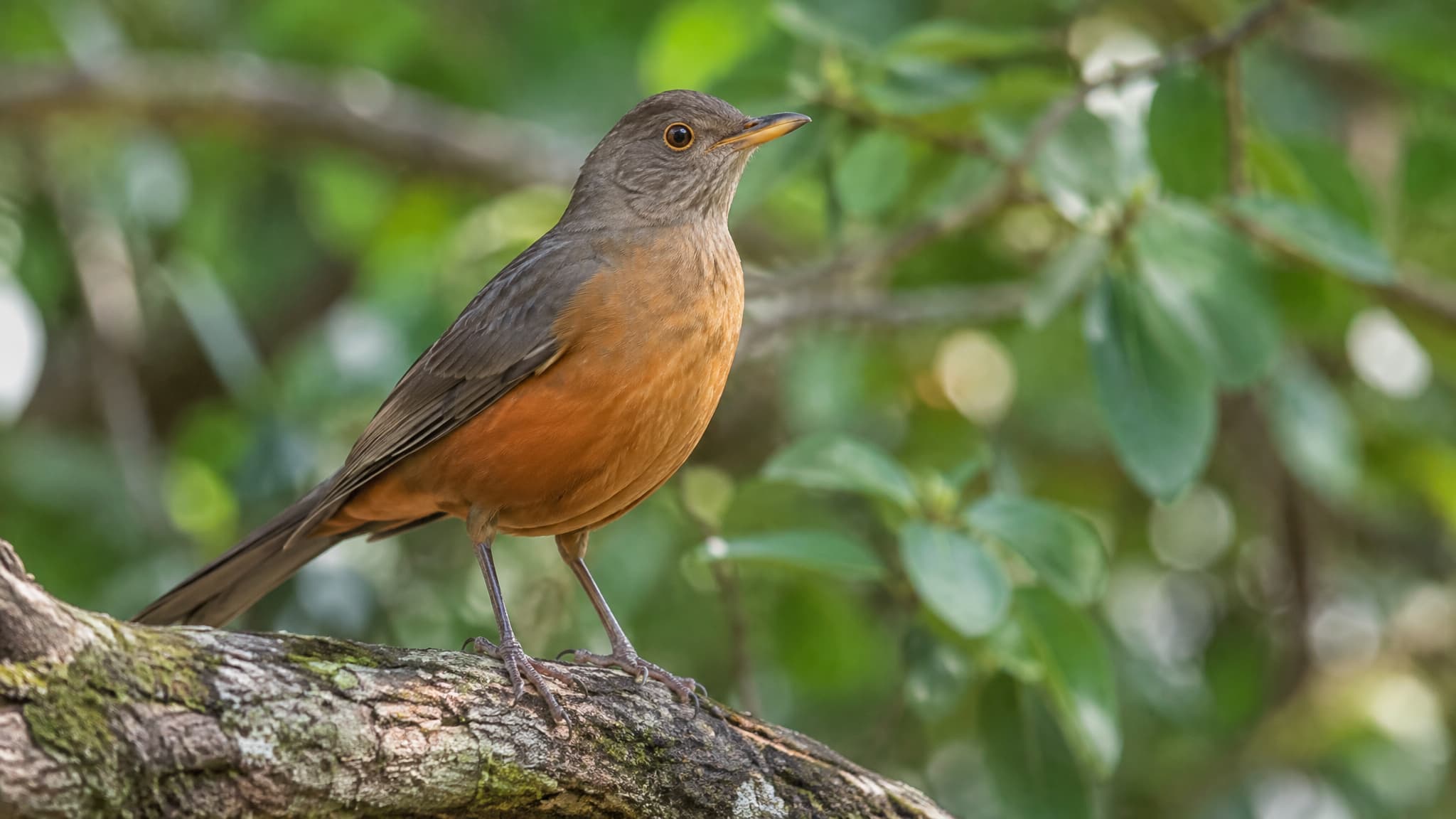
A Rufous-bellied Thrush faces right while standing on a moss-covered branch, showing brown upperparts, a warm rufous-orange belly, a long tail, and a yellowish bill with a bright eye-ring.
The Rufous-bellied Thrush is a medium-sized South American songbird, usually about 20–25 cm long. Its gray-brown head, back, wings, and tail contrast with a white, dark-streaked throat and a conspicuous rusty-orange to rufous belly. The bill is dark yellowish and a bright yellow orbital ring is often visible. Males and females are broadly alike in plumage.
Known in Brazil as the sabiá-laranjeira, it occurs across much of eastern and central South America, including Brazil, Paraguay, eastern Bolivia, Uruguay, and northern to central Argentina. It uses forest, forest edge, open woodland, scrub, and savanna, and adapts especially well to parks, gardens, orchards, and tree-lined urban neighborhoods.
It forages mainly on or near the ground, taking fleshy fruits as well as insects, earthworms, and other invertebrates. Its varied fruit diet makes it an important seed disperser, including in city landscapes. Individuals are often solitary or in pairs, though small groups may gather where food is plentiful. Its clear, flute-like song is especially familiar around dawn and late afternoon and is used in territorial and breeding contexts.
Breeding timing varies with locality; Argentine populations have been recorded breeding mainly from October into January. The female incubates a small clutch—commonly three to four eggs—in a cup nest made with plant fibers and mud, while the male may sing frequently nearby. The species is assessed as Least Concern, owing to its broad range and adaptability, although retaining native vegetation, fruiting trees, and safe urban green spaces remains valuable. A reliable maximum lifespan in the wild was not found in the consulted sources.