Rufous Hornero
Furnarius rufus
 AI-generated
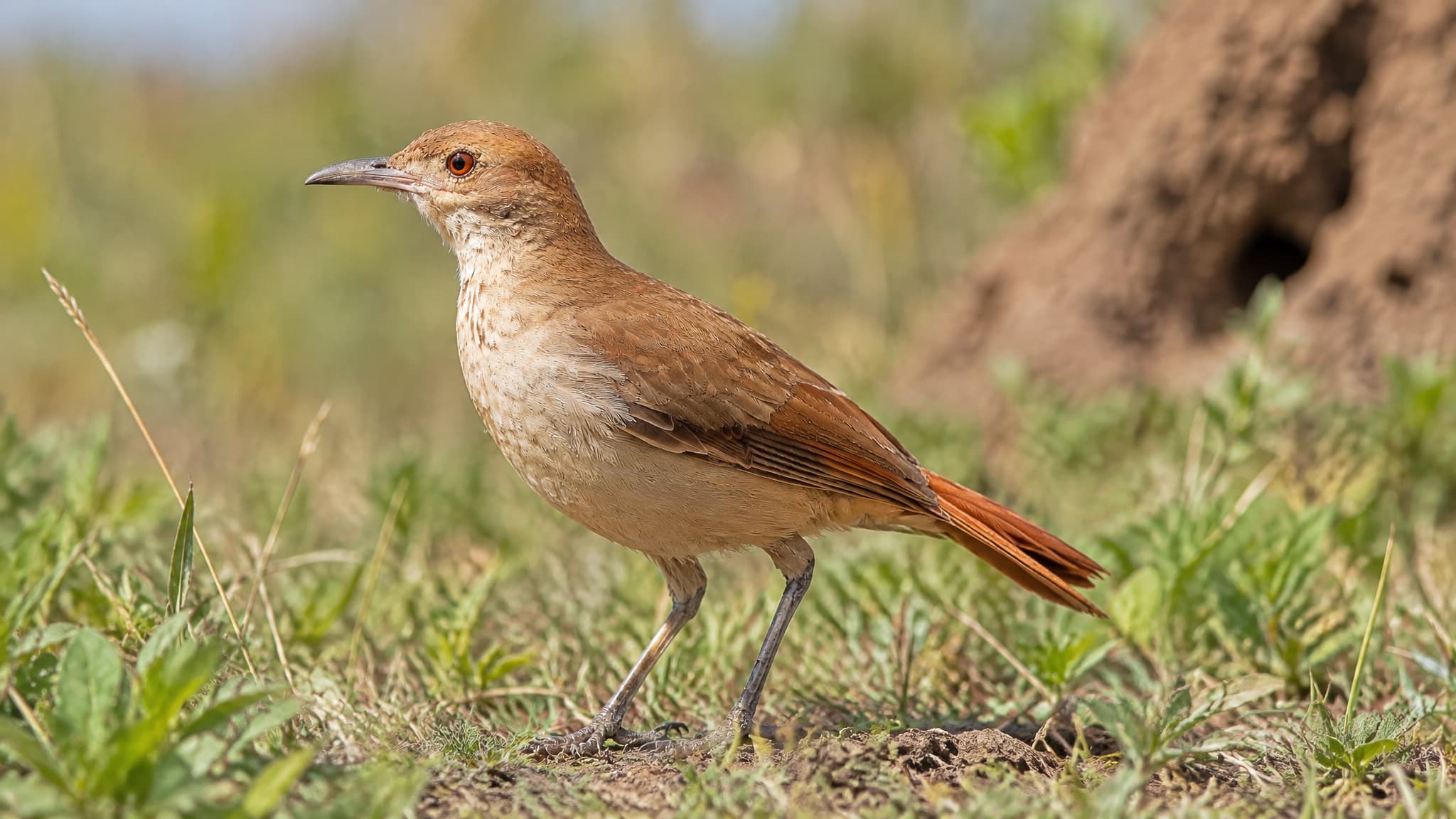
A Rufous Hornero stands in profile on the ground among grasses beside a tree trunk, showing a long straight bill, warm brown plumage, pale streaked underparts, and a rufous tail.
The rufous hornero is a medium-sized South American ovenbird, about 18 to 20 cm long and weighing roughly 31 to 58 g, with males slightly larger than females. Its back is warm reddish brown, the tail is rufous, the underparts are pale buffy brown and the throat is whitish, set off by a dull brown crown and a faint pale eyebrow. The slender, slightly curved bill is horn-coloured. Males and females look alike, and juveniles are a little paler below. Five subspecies are recognized.
It lives in eastern South America, from central, southeastern and southern Brazil through Bolivia, Paraguay and Uruguay to northern and central Argentina. It favours open country such as savanna, cerrado, grassland, scrub, pasture and farmland, and it adapts readily to people, nesting on fence posts, utility poles and buildings in towns and gardens. In Brazil it is spreading into newly cleared areas.
Horneros forage mostly on the ground, walking in short runs and probing under leaves and fallen wood for insects and other arthropods such as ants, termites, larvae and spiders. They occasionally take earthworms, seeds or bread scraps. Pairs are monogamous, stay together year-round and often for several years, and sing loud duets in which the male's trill is faster than the female's while both beat their wings in time.
The species is famous for its nest: a thick dome of mud, straw and dung shaped like an old clay oven, which gives the bird its Spanish name, meaning baker. An inner wall separates the entrance from the egg chamber, and a finished nest can weigh around 4 kg. Breeding takes place in the austral spring and summer. The female lays usually 2 to 4 eggs, both parents incubate for about 14 to 18 days and feed the chicks, which fledge after 23 to 26 days and may remain in the parents' territory for about six months. Lifespan in the wild is not well documented.
Abandoned ovens become homes for many other animals, including saffron finches, swallows, martins, sparrows and even lizards, so horneros shape the nesting opportunities of their neighbours. Horneros can also recognize and eject eggs laid by brood-parasitic cowbirds. The rufous hornero is the national bird of Argentina and is rated Least Concern by the IUCN, as it benefits from many human-made habitats and is expanding its range.