Scarlet Ibis
Eudocimus ruber
 AI-generated
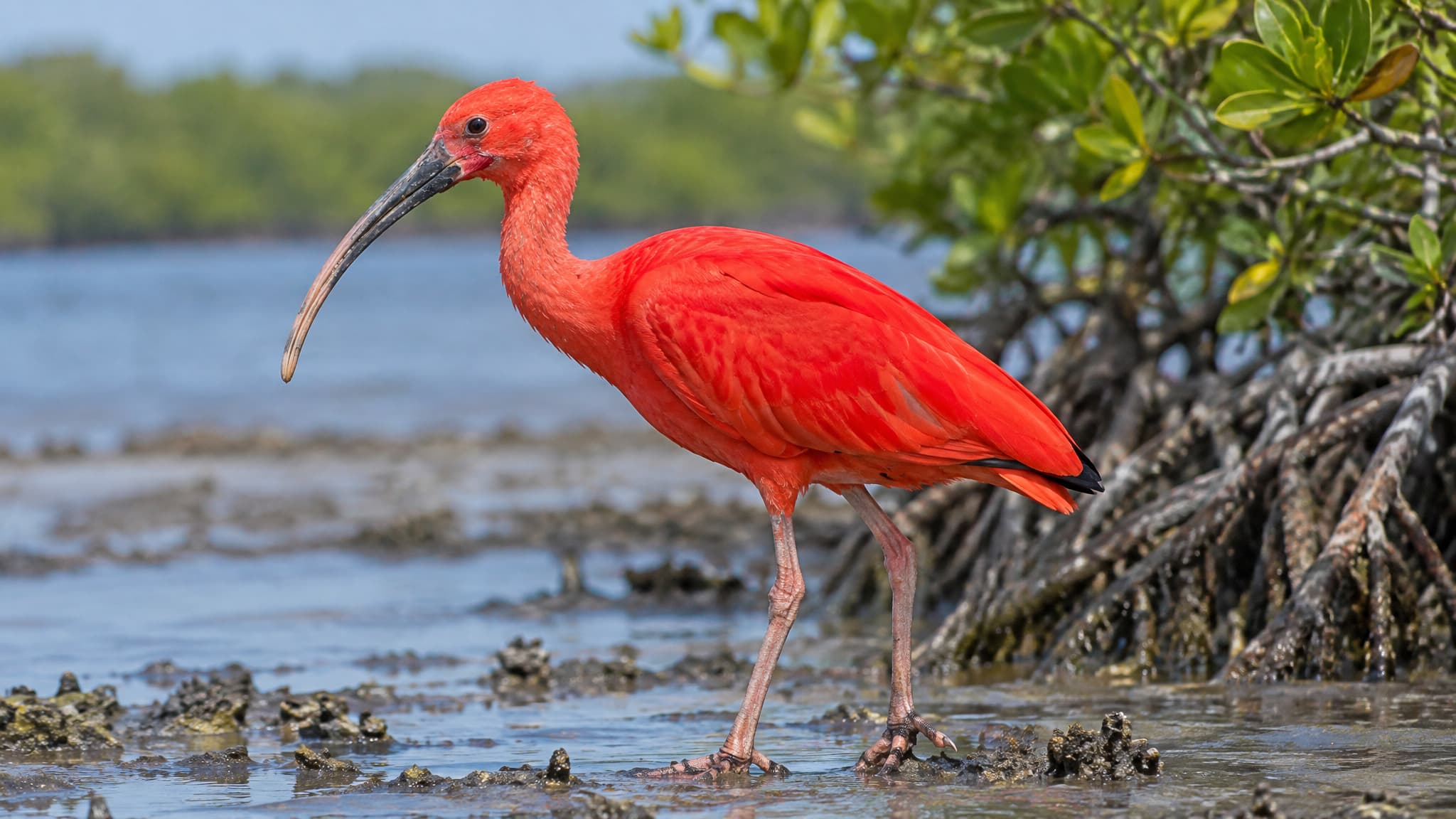
A scarlet ibis stands in shallow water beside mangrove roots, shown in side profile with vivid red plumage, long legs, and a long, curved bill.
The scarlet ibis (Eudocimus ruber) is a wading bird of the ibis and spoonbill family, Threskiornithidae, and one of the most vividly colored birds in the Americas. Adults are covered in bright red plumage set off by glossy blue-black wingtips, with a long neck, long legs, slightly webbed feet and a long, slender, downcurved bill. Total length runs from roughly 55 to 75 cm, and Animal Diversity Web gives an average mass of about 615 g. Males and females look alike, although males tend to be larger and longer-billed. Young birds are a dull grayish brown with white underparts and redden gradually as they mature.
That famous color comes from food. Carotenoid pigments in the small crabs and other crustaceans the bird eats are deposited in its feathers, and the red deepens with age. In captivity, birds fed without enough of these pigments fade to a pale pink.
The species lives in northern South America, from Venezuela to eastern Brazil, and is the national bird of Trinidad and Tobago. It favors mangroves, coastal mudflats, estuaries and shallow bays, and it also moves nomadically between the coast and interior wetlands. In Brazil it occurs on the northern coast and in the southeast, where it was long thought to have disappeared before reappearing in the mangroves of Cubatão in the 1980s.
Scarlet ibises feed by day, probing soft mud and shallow water with their bills or pecking at the ground. Crustaceans such as fiddler crabs and crayfish make up most of the diet, supplemented by aquatic insects, mollusks, frogs, small fish and small snakes. The birds are highly social, flying and foraging in large flocks, often alongside storks and spoonbills; dense groups help each bird spot predators.
Breeding takes place in colonies of hundreds or even thousands of birds, with stick nests placed in mangrove trees or on brushy islands near river mouths. Sexual maturity comes at four to five years. The female lays about three to five greenish eggs, and both parents incubate them for 19 to 23 days and then feed and guard the chicks. Lifespan in the wild is reported at up to about 20 years, and captive birds have lived for more than three decades.
The IUCN lists the scarlet ibis as Least Concern, and international trade is regulated under CITES Appendix II. Local pressures remain, including hunting, egg collecting, capture of young for the pet trade, habitat loss, pollution and disturbance at colonies; a road built through Trinidad's Caroni Swamp disrupted breeding there for years. Eggs and chicks are taken by cats, monkeys and birds of prey, while caimans, turtles and snakes threaten adults.