Secretarybird
Sagittarius serpentarius
 AI-generated
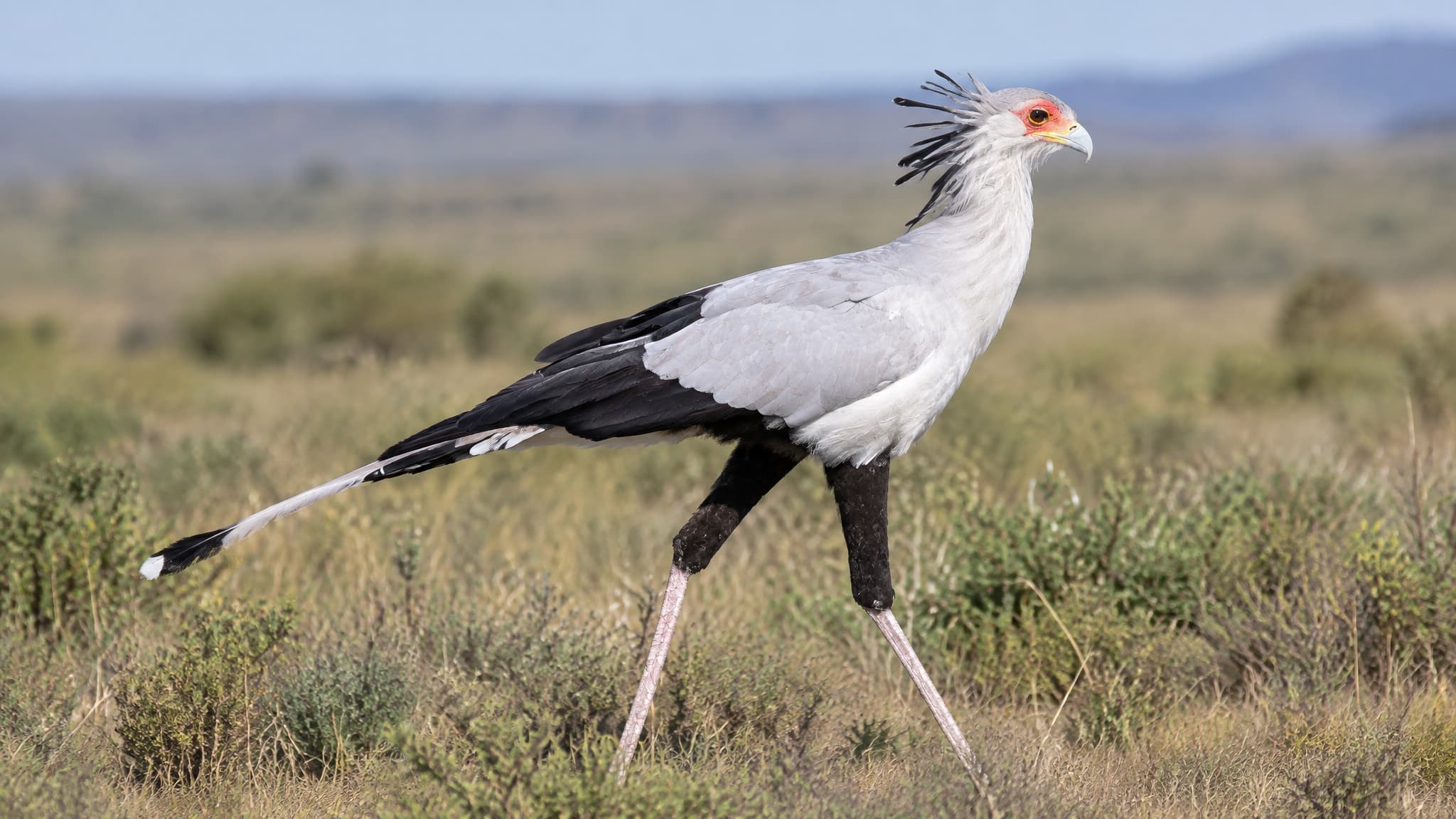
A Secretarybird stands in open grassland in side profile, showing its long bare legs, black flight feathers, elongated tail, crest, and hooked bill.
The secretarybird (Sagittarius serpentarius) is a large, mostly ground-dwelling bird of prey that looks like an eagle set on the legs of a crane. It stands about 1.3 m tall, measures 1.1 to 1.5 m in length and has a wingspan of 1.9 to 2.1 m. Its plumage is mainly grey, with a bare red-orange face and a crest of long black feathers at the back of the head. Its legs are nearly twice as long as those of other ground birds of similar mass. Males and females look alike. It is the only living member of the family Sagittariidae, within the order Accipitriformes.
The species is endemic to sub-Saharan Africa, from Senegal to Somalia and south to the Western Cape of South Africa. It lives in open grassland, savanna and Karoo shrubland, from sea level to around 3,000 m, and prefers places where the grass is short. It avoids forests and true deserts. It is mostly non-migratory, though it may move locally after rain and prey.
The secretarybird hunts on foot, walking about 20 to 30 km a day, alone or with its mate. It is an opportunistic carnivore: insects such as grasshoppers and locusts, scorpions, rodents, lizards, frogs, birds, eggs, small tortoises and snakes, including adders and cobras, are all taken. It flushes prey from the grass and kills it with fast, hard stamps of its feet. In a test, a male struck a rubber snake with a force about five times its body weight, in a contact lasting only 10 to 15 milliseconds.
Pairs are monogamous and defend territories of about 50 km². They build a flat platform of sticks on top of a thorny tree, often an acacia. The female lays 1 to 3 eggs, two to three days apart, and both parents incubate them for 42 to 46 days. The young leave the nest at 64 to 106 days old. Wild birds are thought to live about 10 to 15 years, and captive birds have reached 19 years.
By eating rodents and insects that damage crops, the secretarybird helps farmers, and it also hunts snakes drawn to fields by rodents. Crows, ravens, ground hornbills, kites and eagle-owls prey on its nestlings.
The IUCN lists the species as Endangered since 2020, after rapid declines across its range. The main threats are habitat loss to farms, settlements and roads, overgrazing by livestock and the spread of woody plants into open grassland. Long-term monitoring in South Africa found declines even inside protected areas.