Shoebill
Balaeniceps rex
 AI-generated
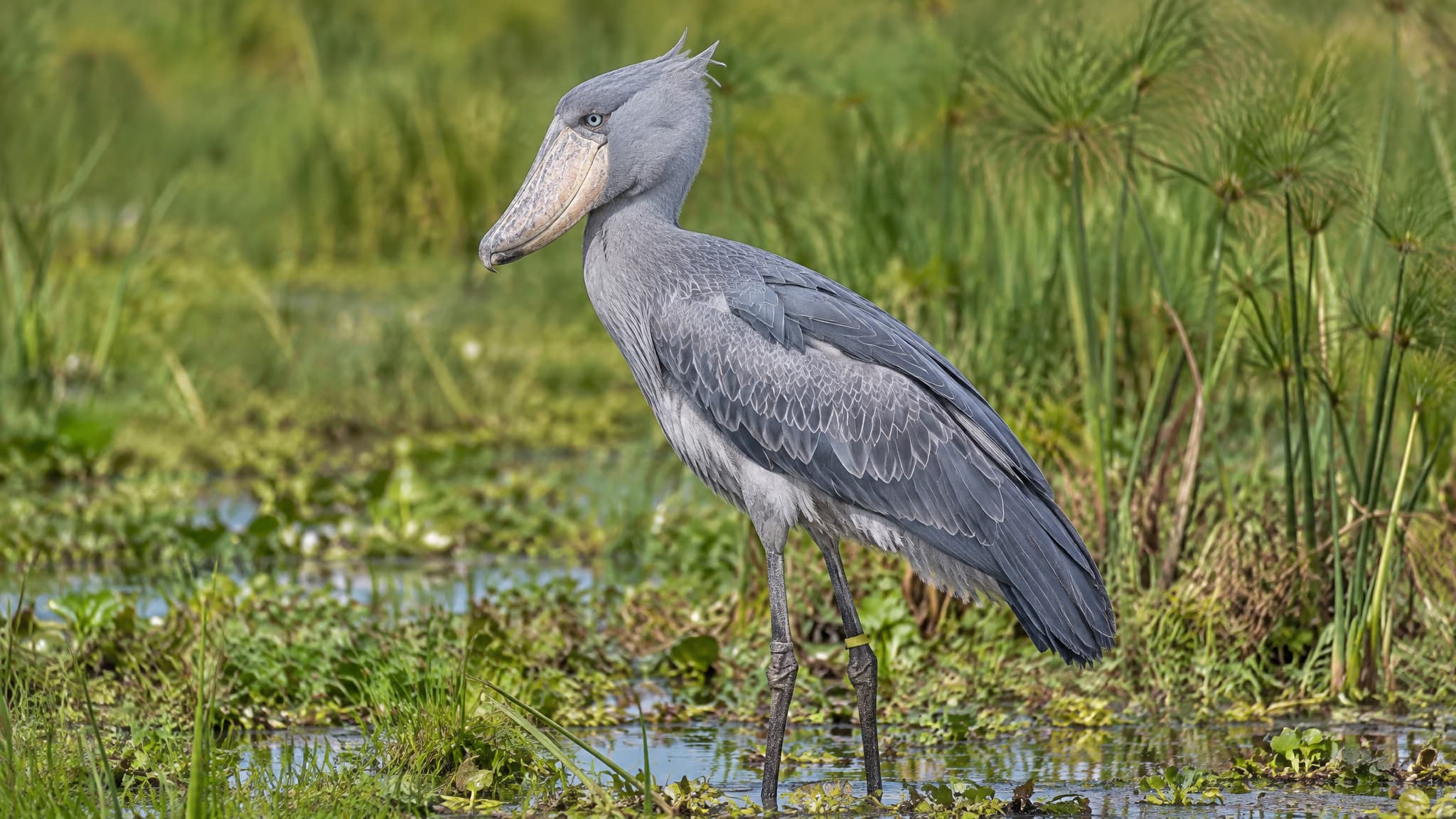
A Shoebill stands in shallow, plant-filled wetland water in side profile, showing its enormous shoe-shaped bill, pale eye, shaggy crest, and gray plumage. Reeds and papyrus-like vegetation surround the bird.
The shoebill (Balaeniceps rex) is a towering wading bird of African swamps and the only living member of the family Balaenicipitidae; its closest living relative is the hamerkop. It stands 110 to 140 cm tall, has a wingspan of 230 to 260 cm and weighs 4 to 7 kg, with males averaging slightly heavier than females. Its plumage is slate grey with a paler belly and a small crest at the back of the head, and its eyes are yellow. The most striking feature is the huge, bulbous bill, shaped like a clog, with an exposed culmen of 18.8 to 24 cm ending in a sharp, curved hook.
The species lives in the freshwater swamps of east-central tropical Africa, from South Sudan through Uganda, eastern DR Congo, Rwanda and western Tanzania to northern Zambia, with major strongholds in the Sudd and the Bangweulu swamps. It favours dense marshes and flood plains with undisturbed papyrus, reed beds and cattails, and in deeper water it needs floating vegetation to stand on.
Shoebills are mostly fish eaters, taking lungfish, bichirs, catfish and tilapia, along with water snakes, frogs, Nile monitors and young crocodiles. They hunt by sight, standing motionless or wading very slowly, then lunging or collapsing forward onto the prey; about 60% of strikes succeed. The prey is often decapitated before it is swallowed. The birds are largely solitary and mostly silent, but they clatter their bills as a greeting and around the nest, and they shed heat by vibrating the throat.
Pairs are monogamous and defend a territory of about 3 km2. The large nest sits on water or on floating plants, and the female lays 1 to 3 eggs, usually two. Both parents incubate for about 30 days and may carry water in the bill to cool the eggs. Usually only one chick survives. The young can fly at about 105 to 112 days and become independent at about 125 days, and adults reach maturity at about three years. Shoebills can live about 35 years in the wild.
The shoebill is an important predator in the swamps and marshes where it lives. It is listed as Vulnerable on the IUCN Red List and on CITES Appendix II. The main threats are drainage and conversion of swamps for farming and cattle grazing, burning, disturbance by fishing, hunting, collection of eggs and chicks, and capture for the live-bird trade.