Saffron Finch
Sicalis flaveola
 AI-generated
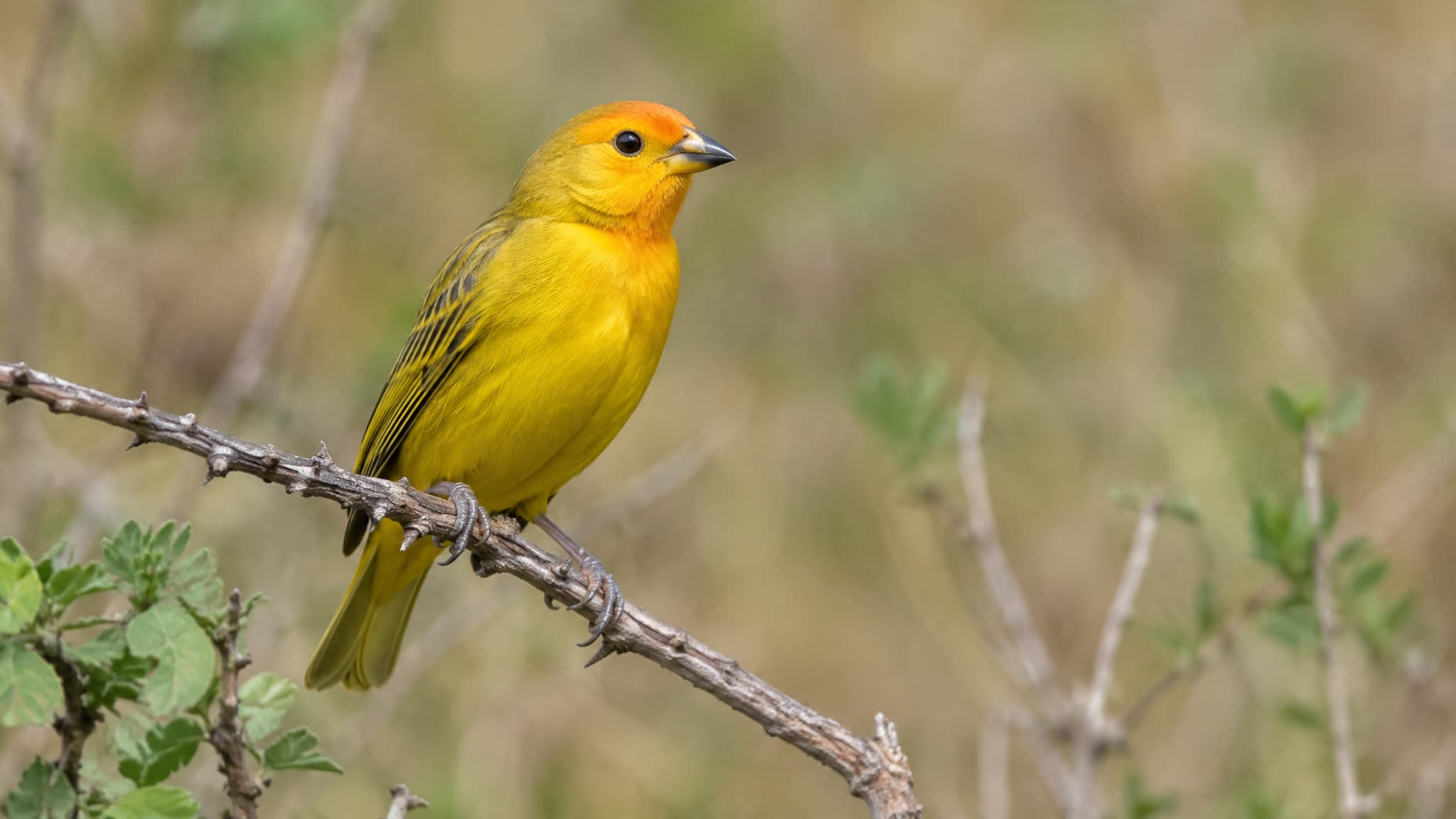
A bright yellow saffron finch perches side-on on a thorny branch, showing an orange forehead, dark streaked wings, a long tail, and a stout conical bill against a softly blurred natural background.
The Saffron Finch is a small South American songbird in the tanager family, Thraupidae—not a member of the true finch family. Adult males are strikingly yellow, usually with rich orange concentrated on the forehead and face. Females and young birds are much duller: olive-brown above, more heavily streaked, and with only limited yellow. This marked difference between the sexes and ages is an important identification feature.
It occurs naturally across broad parts of South America, including Brazil, and is also established outside its native range in places such as Hawaiʻi and parts of the Caribbean. It favors open, relatively dry settings: grasslands, savannas, agricultural fields, pastures, scrubby edges, gardens, city parks, and towns. Rather than being a forest-interior bird, it often benefits from open ground and scattered vegetation associated with people.
Saffron Finches are social and conspicuous, commonly feeding on the ground in pairs or flocks. Their sturdy, conical bill is adapted for cracking seeds, which make up most of the diet; insects are taken occasionally. By consuming seeds and small invertebrates, the species participates in open-habitat food webs, although it is primarily a seed predator rather than an effective seed disperser. Males use a melodic song and courtship display during breeding.
The species makes a covered, basket-like nest and may use sheltered cavities, roof spaces, vegetation, or abandoned nests. Typical clutches average about four eggs, with incubation reported at roughly 14–15 days. Captive birds have been reported to live about 15–20 years; a comparable wild lifespan is not established here. Globally it is assessed as Least Concern, but trapping for the cage-bird trade is a documented welfare and conservation concern in Brazil.