Snowy owl
Bubo scandiacus
 AI-generated
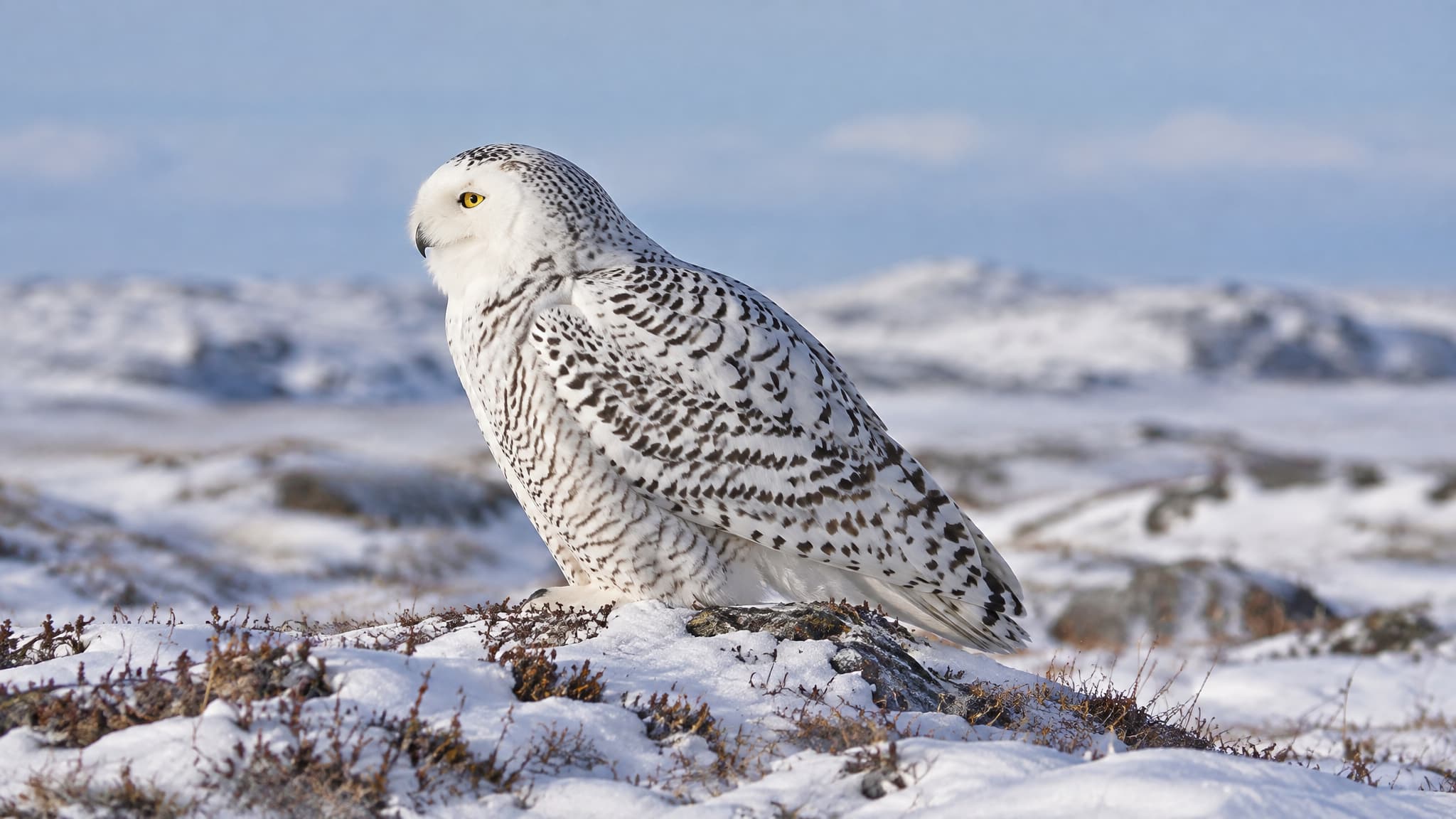
A snowy owl sits in profile on a rocky, snow-covered tundra, facing left. Its white plumage is marked with dark barring and spotting, and its yellow eye and hooked bill are visible.
The snowy owl is a large, heavy owl of the Arctic, instantly recognized by its white plumage and yellow eyes. Females are larger and usually more heavily marked with dark brown bars and spots, while adult males are paler and can become almost entirely white with age. Young birds are darker than adults. Males measure about 52.5 to 64 cm and females about 54 to 71 cm, with a wingspan that reaches 183 cm in large females. Its legs and feet are feathered in white.
The species has a circumpolar range. It breeds on open tundra in northern Alaska, northern Canada, Greenland and northern Eurasia, favoring raised ground such as ridges and hummocks that give a wide view. In winter many birds move south into grasslands, farm fields, coasts, marshes and dunes, and they often turn up at airports. Movements are nomadic and track prey, and in some winters large numbers irrupt far beyond the usual range.
Unlike most owls, the snowy owl is largely active by day. It hunts from a raised perch and is a carnivore whose breeding diet centers on lemmings; a single owl may eat more than 1,600 lemmings in a year. It also takes mice, rabbits, waterbirds and other birds, occasionally fish, and will scavenge carrion.
Breeding is tightly linked to lemming numbers. Instead of building a nest, the female digs a hollow in a mound and lays typically 3 to 11 eggs, and up to 16 when prey is extremely abundant. She alone incubates, for an average of 31.6 days, and chicks leave the nest at about 18 to 28 days, before they can fly. Young fly well and hunt by about 50 to 60 days. In poor lemming years many pairs do not nest at all. Wild birds commonly live about 10 years, and one banded owl was recovered 23 years and 10 months later.
As a top predator of the tundra, the snowy owl helps regulate rodent populations, and snow geese that nest close to its territory benefit from the owls driving away competing predators. The IUCN moved the species to Vulnerable in 2017 because its population is smaller and declining faster than once thought: recent estimates suggest fewer than 100,000 birds, and the North American population is inferred to have fallen by 52% since the 1960s. Collisions with vehicles and other structures, electrocution and shooting are major causes of death in winter.