Southern Lapwing
Vanellus chilensis
 AI-generated
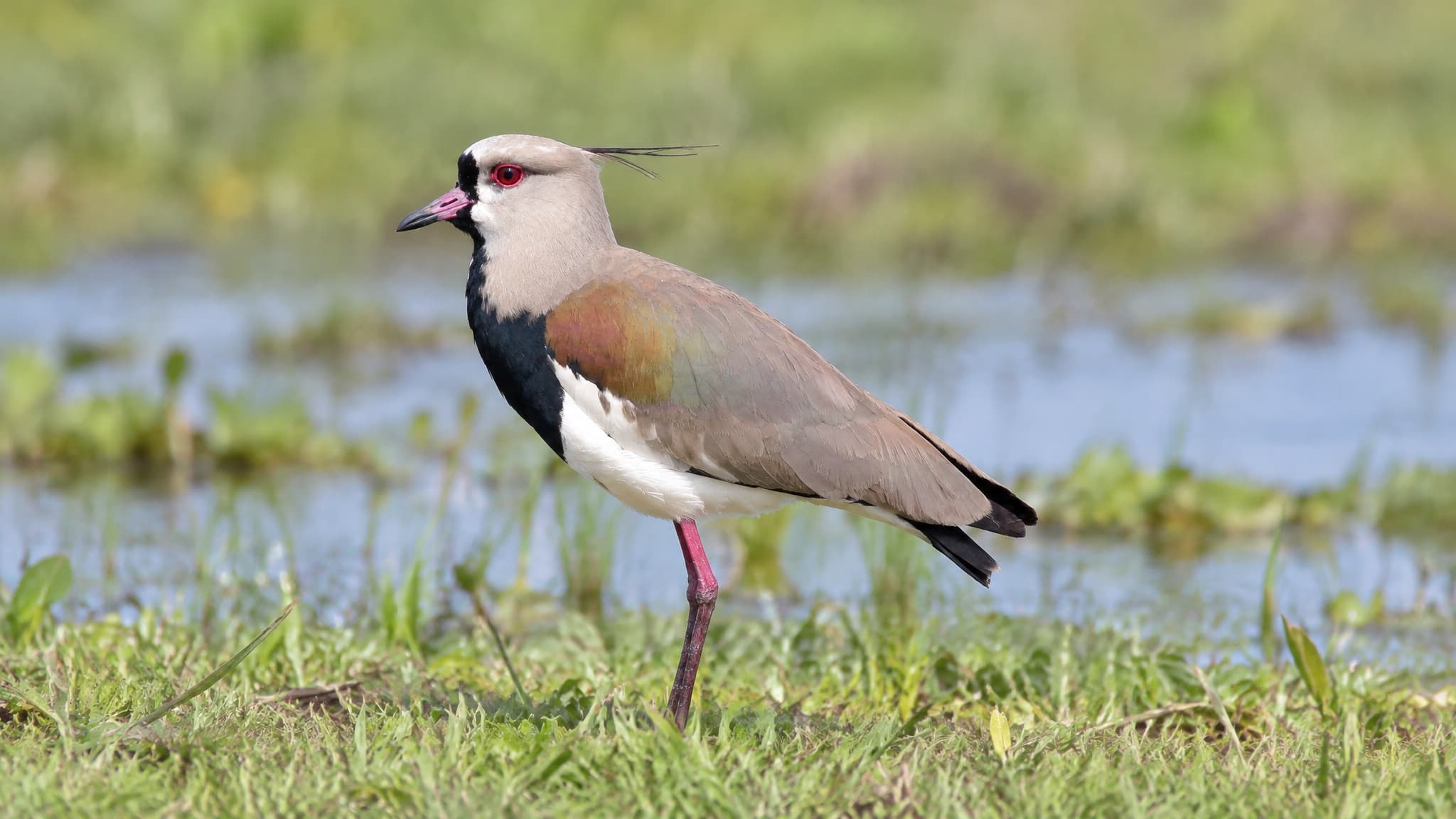
A Southern Lapwing stands in profile on grassy ground beside shallow water, with one long pinkish leg visible. Its black throat and breast, white belly, brown iridescent wing, red eye, pink-and-black bill, and small head crest are clearly visible.
The southern lapwing (Vanellus chilensis) is a noisy, conspicuous wader of the plover and lapwing family, Charadriidae. Adults measure roughly 32 to 38 cm and weigh about 250 to 425 g. The upperparts are brownish grey with a bronze sheen on the shoulders, the head is grey with a thin dark crest, and a black forehead and throat patch runs down into a black breast band above white underparts. The eye ring, legs and much of the bill are pink to reddish. Males and females look alike. A sharp bony spur about 1 cm long sits at the bend of each wing, and in flight the bird shows a broad white wing bar, a white rump and a black tail.
This lapwing is a common resident across most of South America, absent mainly from dense forest such as much of the Amazon, the high Andes and the arid western coast. It is especially abundant in the Río de la Plata basin. Its range has been expanding: it reached Trinidad in 1961 and Tobago in 1974, has spread into Central America, and a pair bred in Barbados in 2007. It favors open land such as wet grasslands, marshes, lake and river banks, and pastures, and it has benefited from cattle ranching. It is also a familiar sight on roadsides, sports fields and city parks, often far from water.
The southern lapwing feeds mainly on insects such as grasshoppers, along with earthworms, cutworms, other invertebrates and the occasional small fish. It forages with a run-and-pause technique, sometimes stirring mud with its feet, and often feeds at night, including on floodlit football pitches. Its loud, harsh call, heard day and night, often makes it the first animal to raise the alarm when an intruder approaches.
Breeding pairs nest in a bare scrape on open ground, laying usually two to four spotted, olive-brown eggs that blend with the soil. Pairs are often helped by one or two young from the previous season, a form of cooperative breeding. Adults defend eggs and chicks fiercely with calls, threat displays, low swooping flights and wing raises that expose the spurs, and they may feign injury to lead predators away. The chicks leave the nest soon after hatching. Reliable lifespan figures were not found in the sources consulted.
Because it lives in open, often human-altered landscapes and has a wide, growing range, the southern lapwing is listed as Least Concern by the IUCN. Its habit of nesting near airfields can pose a risk to air traffic. In Brazil it is known as quero-quero and is a symbol of the state of Rio Grande do Sul.