Sunbittern
Eurypyga helias
 AI-generated
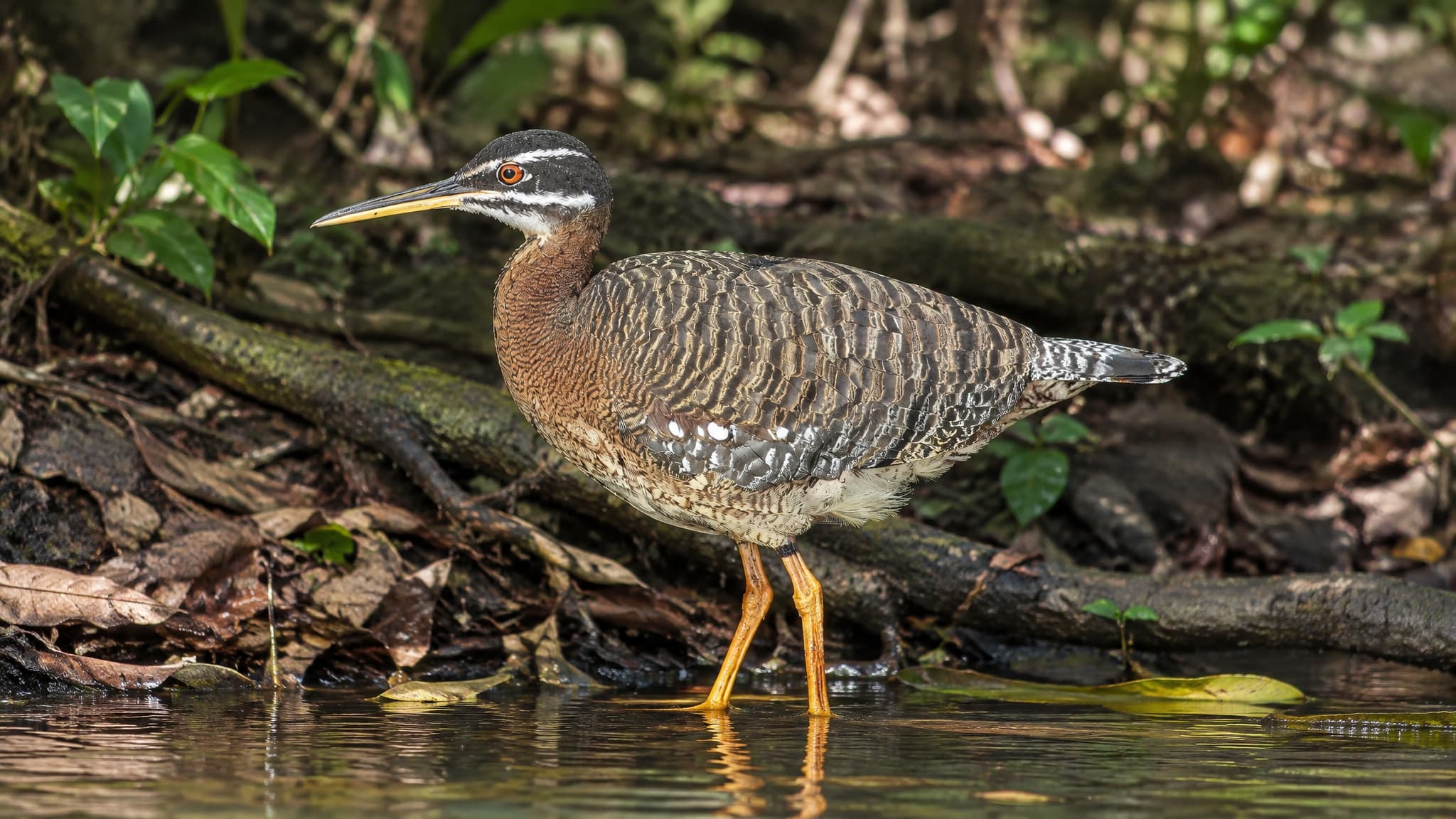
A Sunbittern stands in shallow forest water beside mossy logs, facing left with its long pointed bill, patterned body, and slender orange legs visible.
The sunbittern (Eurypyga helias) is a heron-like bird of the American tropics. It is the only living member of its genus and of the family Eurypygidae. It measures about 43–48 cm long and weighs roughly 170–215 g. It has a slender neck, a long pointed bill, a relatively small head and a long tail. Most of its plumage is finely barred brown, grey and black. The head is mostly black with bold white stripes above and below the red eyes. The lower bill and the legs are orange. Males and females look alike.
The bird's most striking feature only shows when it opens its wings. Each spread wing displays a pattern of chestnut, orange, yellow and black that looks like a pair of large eyes. The bird uses this display to look bigger and to scare off predators or rivals. It is not mainly a courtship display.
Sunbitterns live from southern Mexico and Central America through much of tropical South America, including the Amazon basin and the Brazilian Pantanal. They prefer heavily forested country near water, such as shaded streams, river edges and swampy forest. They are not migratory.
This species usually lives alone or in pairs and seldom flies. It walks slowly along stream banks and among rocks, bobbing its head as it searches for prey. Its long toes help it walk on soft mud. Its diet includes fish, amphibians, crustaceans and insects. Its cryptic plumage keeps it hard to spot when it is not displaying.
Pairs usually lay two or three eggs. To protect the nest, adults may pretend to have a broken wing and lead predators away. Young birds can mature in about a year. Sunbitterns have lived about 15 years in human care. As a predator of small aquatic animals, the sunbittern is part of the food web along tropical streams. DNA studies show that its closest living relative is the kagu of New Caledonia.
The IUCN lists the sunbittern as Least Concern because it has a very large range. Even so, it depends on wooded waterways, so losing forest along rivers and streams can reduce local populations.