Toco Toucan
Ramphastos toco
 AI-generated
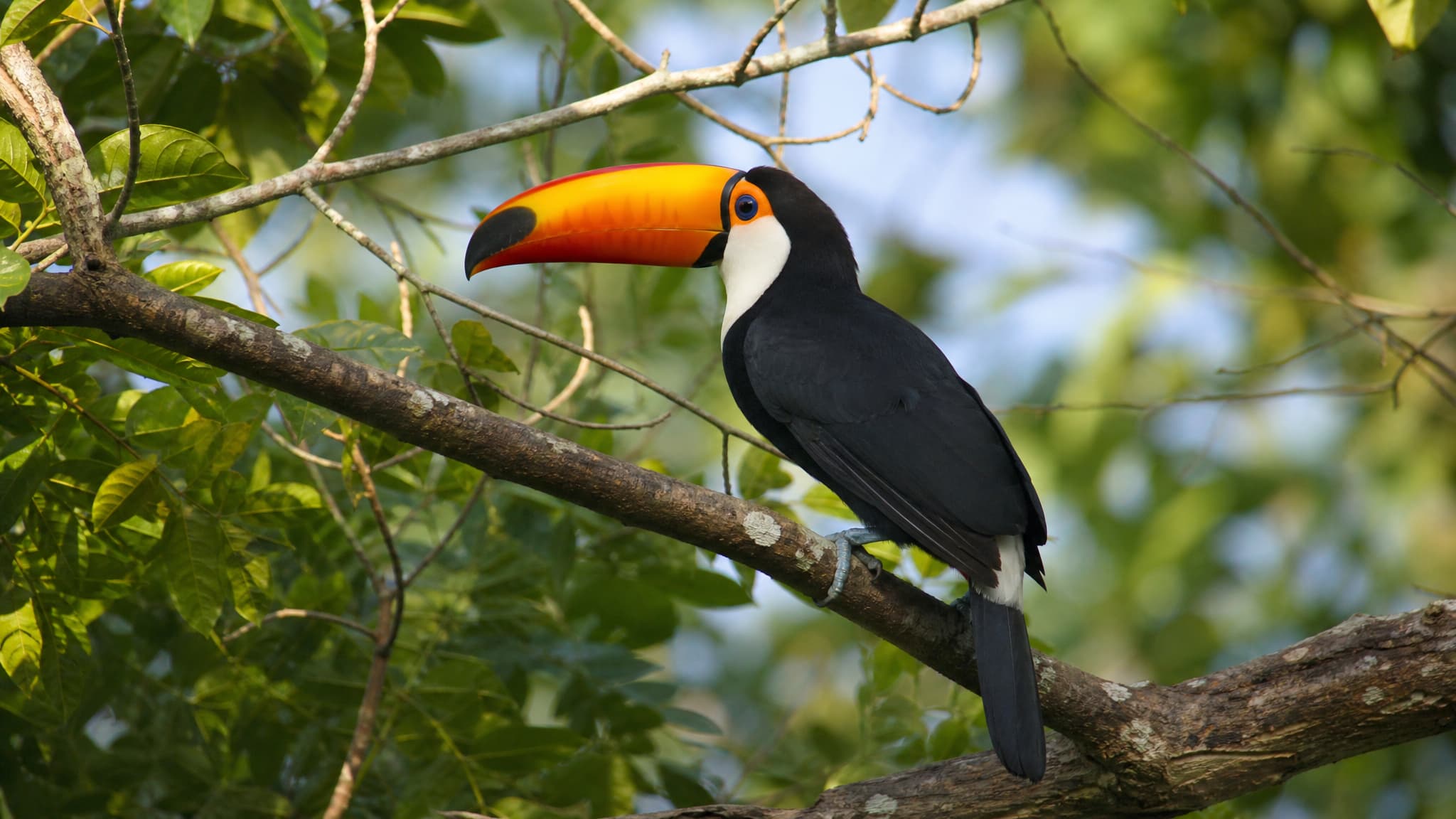
A Toco Toucan perches side-on on a tree branch amid leafy forest vegetation, showing its large orange bill with a black tip, black plumage, white throat, and long dark tail.
The toco toucan is the largest member of the toucan family and one of South America’s most recognizable birds. Its plumage is largely black, set off by a white throat and upper breast, red undertail coverts, blue skin around the eye, and bare orange facial skin. The immense yellow-orange bill, capped with black at the base and tip, is striking but relatively light because its interior is built with a spongy, hollow framework. Adults average about 61 cm in length; males are generally larger than females.
It occurs across central and eastern South America, including Brazil, Bolivia, Paraguay, northern Argentina, Peru, Suriname, and French Guiana. Unlike many forest-associated toucans, it favors semi-open landscapes: Cerrado, savanna, gallery forest, woodland, forest edges, plantations, and scattered trees near waterways. It is chiefly a lowland bird, though it can occur at elevations of roughly 1,750 m near the Andes.
Fruit makes up most of its diet, and the long bill allows it to pluck food from branches or cavities beyond easy reach. It also opportunistically takes insects, small vertebrates, and eggs. Toco toucans are active by day and often travel in pairs or small social groups, giving deep croaks, rattling calls, and bill-clacking sounds. By carrying and consuming fruits, they disperse seeds and contribute to the regeneration of fruiting plants; this role can indirectly support other wildlife that depends on trees they help propagate.
Breeding is seasonal. A pair uses a tree cavity for a nest, where the female usually lays two to four eggs. Both parents incubate the clutch and feed the helpless young, which remain in the nest for roughly six to eight weeks. Sexual maturity is reached at about three to four years. Wild birds commonly live around 20 years, with a recorded maximum of 26 years.
The species is assessed as Least Concern because of its broad distribution and continued occurrence in suitable habitat. Nevertheless, loss and fragmentation of wooded habitat, along with capture for trade in some areas, can create local pressures. Protecting fruiting trees, nest cavities, and connected semi-open landscapes is important for maintaining its populations.