Western Rockhopper Penguin
Eudyptes chrysocome
 AI-generated
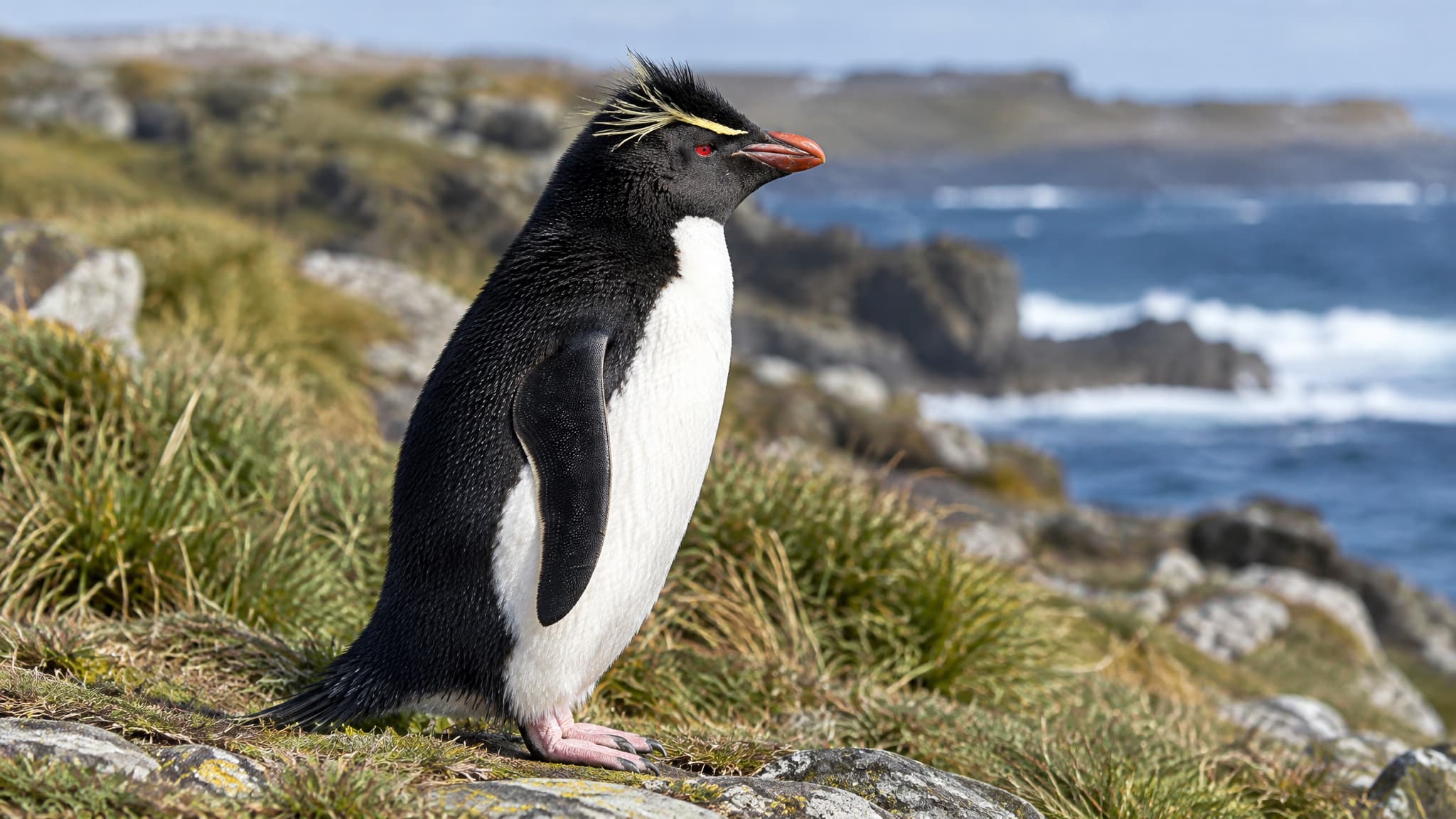
A Western Rockhopper Penguin stands upright on a grassy, rocky coastal ledge, facing right. Its black-and-white plumage, yellow crest feathers, red eye, orange-red bill, and pink feet are clearly visible against the ocean.
The western rockhopper penguin is the smallest of the black-and-white penguins with yellow crests in the genus Eudyptes. Adults measure 45–58 cm and usually weigh 2–3.4 kg, with males heavier than females. The upperparts are slate grey. A thin, straight, bright yellow eyebrow runs above each red eye and ends in long yellowish plumes that stick out sideways behind the head.
The species lives in subantarctic waters off southern South America. It breeds on the Falkland Islands and on islands off Patagonia and around Cape Horn, nesting in colonies that range from sea level to cliff tops, among rocks and tussock grass. Between April and September birds leave the Falklands and disperse across the Patagonian Shelf, from the Strait of Magellan and Cape Horn north to about 41°S. In Brazil it is a vagrant known from a single record: a dead female found on Mostardas beach, Rio Grande do Sul, in 1980.
Rockhoppers feed mainly on crustaceans, especially krill such as Euphausia lucens and E. vallentini, the amphipod Themisto gaudichaudi and the squat lobster Munida gregaria, and also take squid, octopus and fish. They are sociable but aggressive colonial birds that defend small territories inside their colonies and forage at sea on daily trips while raising chicks. Sea lions hunt them at sea, while skuas and striated caracaras take eggs and small chicks at the colonies.
Males return to the colonies in early October and females about a week later. Two eggs are laid in early November; the first weighs about 80 g and the second, larger egg about 110 g. Both parents incubate in turns for 32–34 days. Usually only one chick, from the second egg, is raised. The male guards the chicks for about 24 days while the female brings food, chicks gather in crèches in January and fledge by February. Birds start breeding at about 4 years and live 10–15 years in the wild.
As a predator of krill and other swarming crustaceans, and as prey for sea lions and colony scavengers, the rockhopper links the Patagonian Shelf food web to its breeding islands. The IUCN lists it as Vulnerable because of rapid population declines. The Falklands held about 320,000 pairs in 2010, roughly 36% of the world population, after mass starvation events and a harmful algal bloom in 2002/03. Commercial fishing that reduces prey and oil spills are further threats.