Common midwife toad
Alytes obstetricans
 AI-generated
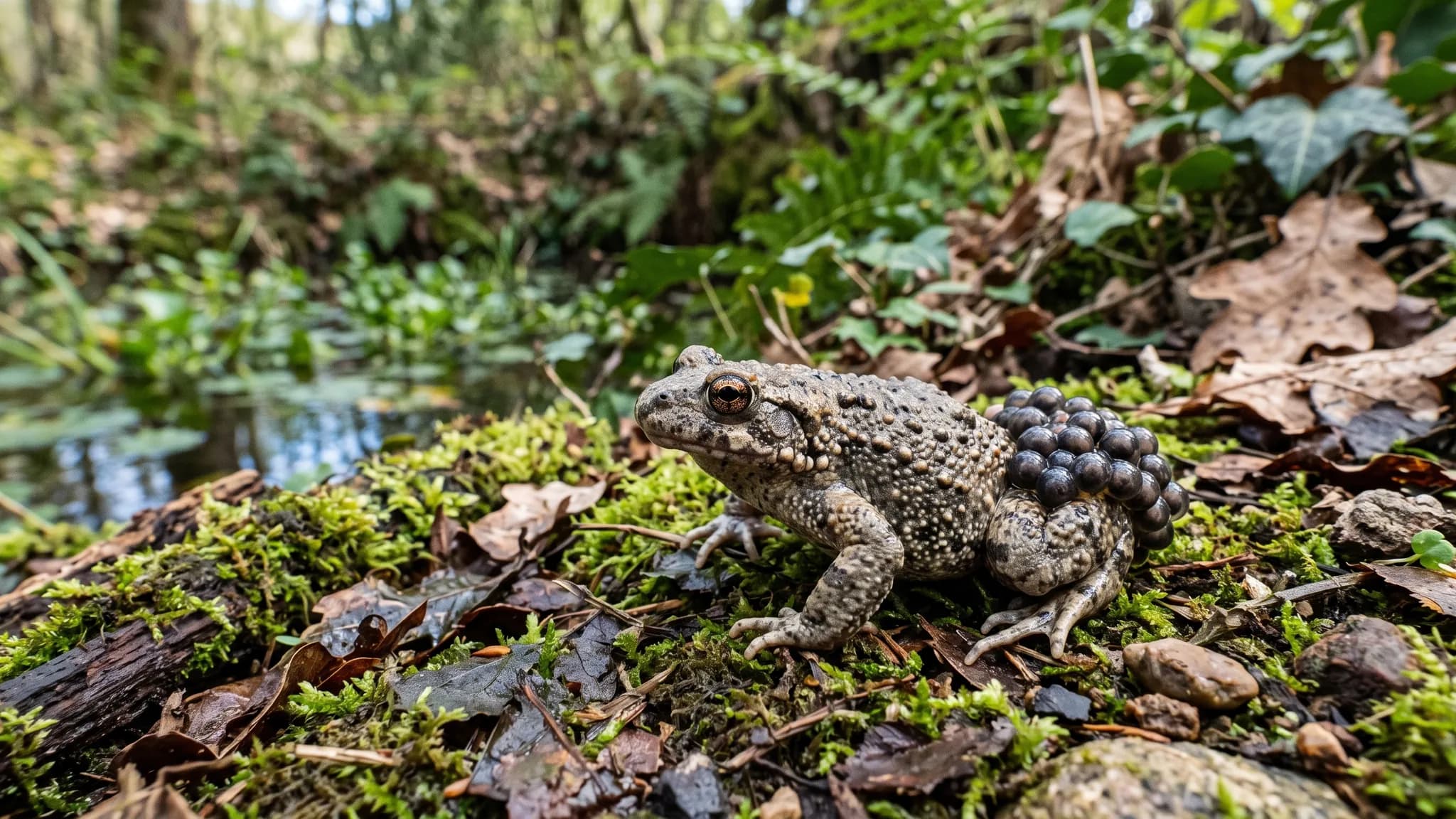
A Common midwife toad rests on mossy ground, carrying dark eggs on its hindquarters near a water source.
The common midwife toad (Alytes obstetricans) is a small, fascinating amphibian belonging to the family Alytidae. Characterized by a broad and stocky build, adults typically reach a snout-vent length of 3.5 to 5.5 centimeters, with females generally growing larger than males. They possess a large, flat head with prominent eyes featuring vertical, slit-shaped pupils. Their dorsal skin is mostly smooth but textured with small granules and a distinct row of large warts running down either side. The underbelly is paler and frequently dotted with cream spots. They also feature small parotoid glands, as well as distinct gland complexes located on their underarms and ankles.
Native to several countries across Western Europe, this species is found in Belgium, France, Germany, Luxembourg, the Netherlands, Portugal, Spain, and Switzerland, and has also been introduced to the United Kingdom. The common midwife toad relies on a dual-habitat ecosystem. On land, they favor open to semi-open landscapes that are structurally rich, utilizing sun-exposed hiding places like rocky areas, stone piles, embankments, and quarry walls. These terrestrial environments range from temperate and dry forests to shrublands, agricultural fields, and urban spaces.
As adults, common midwife toads are terrestrial predators that primarily consume a variety of terrestrial invertebrates. However, their aquatic tadpoles display opportunistic feeding behaviors. They act as both predators and scavengers, and have even been documented feeding on earthworms and the remains of deceased amphibians. Because some tadpoles are deposited late in the breeding season during July or August, they frequently overwinter in the water before metamorphosing, growing to exceptionally large sizes of up to 80 or 90 millimeters in length.
The species earns its unique common name through an extraordinary display of paternal care. Unlike most amphibians that lay eggs directly into the water, Alytes obstetricans mates on land. As the female expels a strand of eggs, the male fertilizes them externally and then wraps the strings around his hind legs and back. A single male can carry 150 or more eggs from up to three different clutches. He carries them continuously on land to protect them from aquatic predators. Once the eggs are fully developed and ready to hatch, the male wades into shallow, permanent, or slow-drying bodies of water, allowing the fully formed tadpoles to safely emerge into the aquatic environment.
The International Union for Conservation of Nature (IUCN) classifies the common midwife toad as a species of "Least Concern" due to its historically wide geographic distribution. Despite this broad categorization, the species faces significant localized declines. The primary threats include ongoing habitat loss, fragmentation, and the degradation of essential aquatic breeding sites. Furthermore, these toads are highly susceptible to chytridiomycosis, a fatal infectious amphibian disease caused by the fungal pathogen Batrachochytrium dendrobatidis. This disease has severely impacted certain populations, most notably those residing in the Pyrenees mountains.