African Clawed Frog
Xenopus laevis
 AI-generated
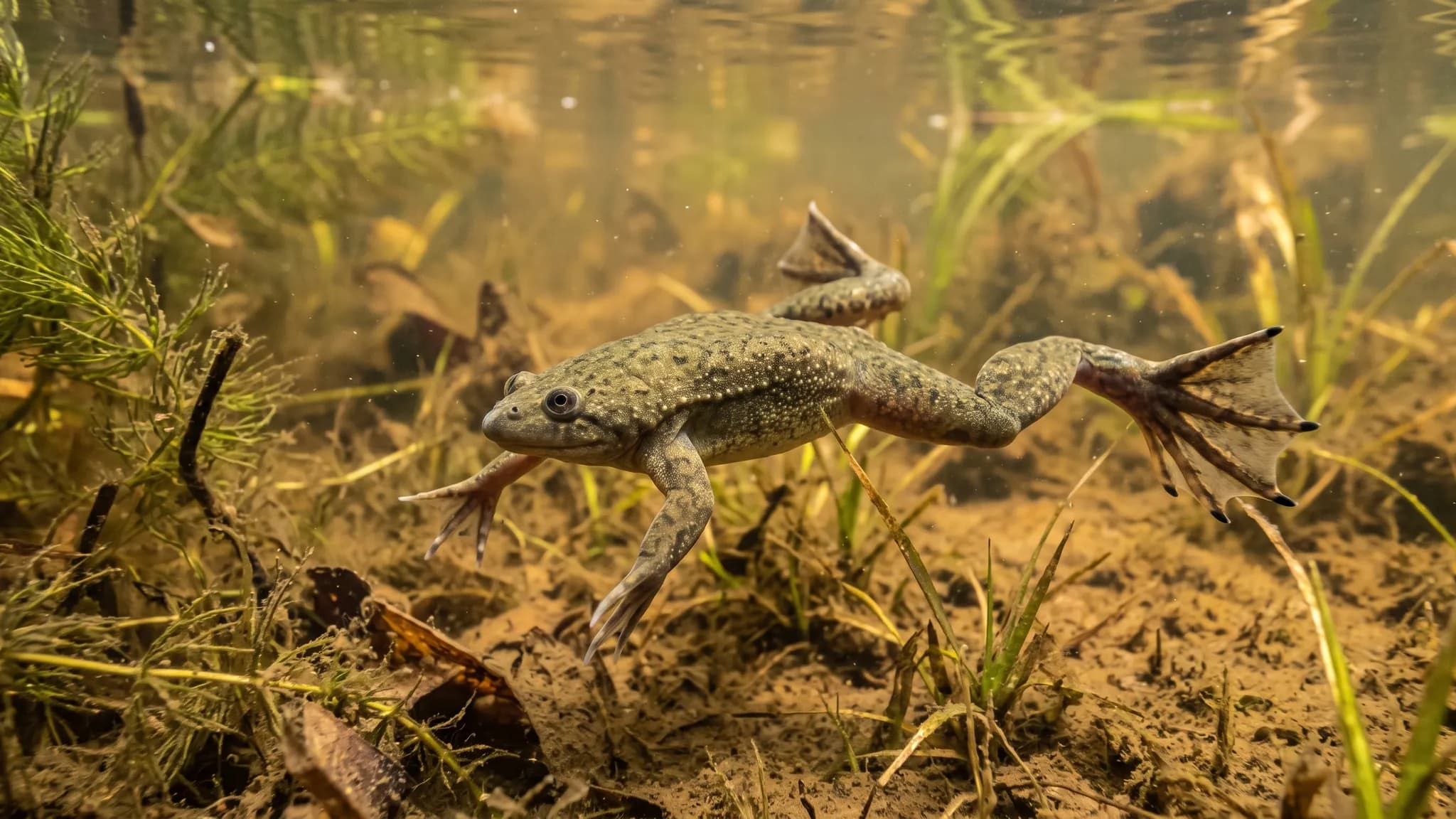
An African clawed frog swimming underwater, displaying its mottled skin, flattened body, and large webbed hind feet.
The African clawed frog (Xenopus laevis) is a strictly aquatic amphibian native to sub-Saharan Africa. Belonging to the family Pipidae, this species is uniquely adapted to a life entirely underwater. It is perhaps best known for its monumental role in human science, having served as the world's first reliable pregnancy test before becoming one of the most important model organisms in modern biological research. Despite its scientific value, its remarkable adaptability has allowed it to become a highly successful and damaging invasive species globally.
Morphologically, Xenopus laevis exhibits several fascinating adaptations for its aquatic lifestyle. It possesses a flattened, hydrodynamic body without visible external eardrums or vocal sacs. Instead of vocal cords, it uses subcutaneous cartilaginous disks to produce underwater vocalizations. Members of the family Pipidae are completely toothless and tongueless. To feed, the frog uses its front limbs to manually push food into its mouth, relying on a hyobranchial pump to suck in prey. The species derives its common name from the distinct, keratinized black claws on the three inner toes of its large, fully webbed hind feet, which are used to tear apart larger food items.
Because their vision is relatively poor, African clawed frogs rely heavily on a highly sensitive lateral line system, a keen sense of smell, and their sensitive fingers to locate food in murky waters. They are voracious scavengers and predators, feeding heavily on aquatic invertebrates, small fish, and the eggs and tadpoles of native amphibians. This opportunistic and aggressive feeding strategy ensures their survival in a wide variety of aquatic habitats, from stagnant ponds to slow-moving streams.
Reproduction in Xenopus laevis is famously prolific. Females can produce large batches of eggs year-round, which develop externally and rapidly. This trait made them central to the 'Hogben test' in the 1930s, where human chorionic gonadotropin (hCG) from a pregnant woman's urine would induce the frog to ovulate within 12 hours. Today, this reproductive capacity makes them an unparalleled model organism for developmental biology. Furthermore, they are extensively used in genetics due to their allotetraploid genome, and in regenerative medicine because tadpoles can completely regenerate their central nervous system after severe injury.
Ecologically, while they are a natural part of aquatic food webs in sub-Saharan Africa, their global export for medical and scientific use has led to unintended consequences. Accidental escapes and deliberate releases from laboratories and the pet trade have established invasive populations in North America, South America, Europe, and Asia. In these introduced ranges, their voracious appetite allows them to outcompete native species and decimate local aquatic biodiversity. Consequently, Xenopus laevis is highly monitored and classified as an invasive species of significant ecological concern in numerous countries.