American Bullfrog
Lithobates catesbeianus
 AI-generated
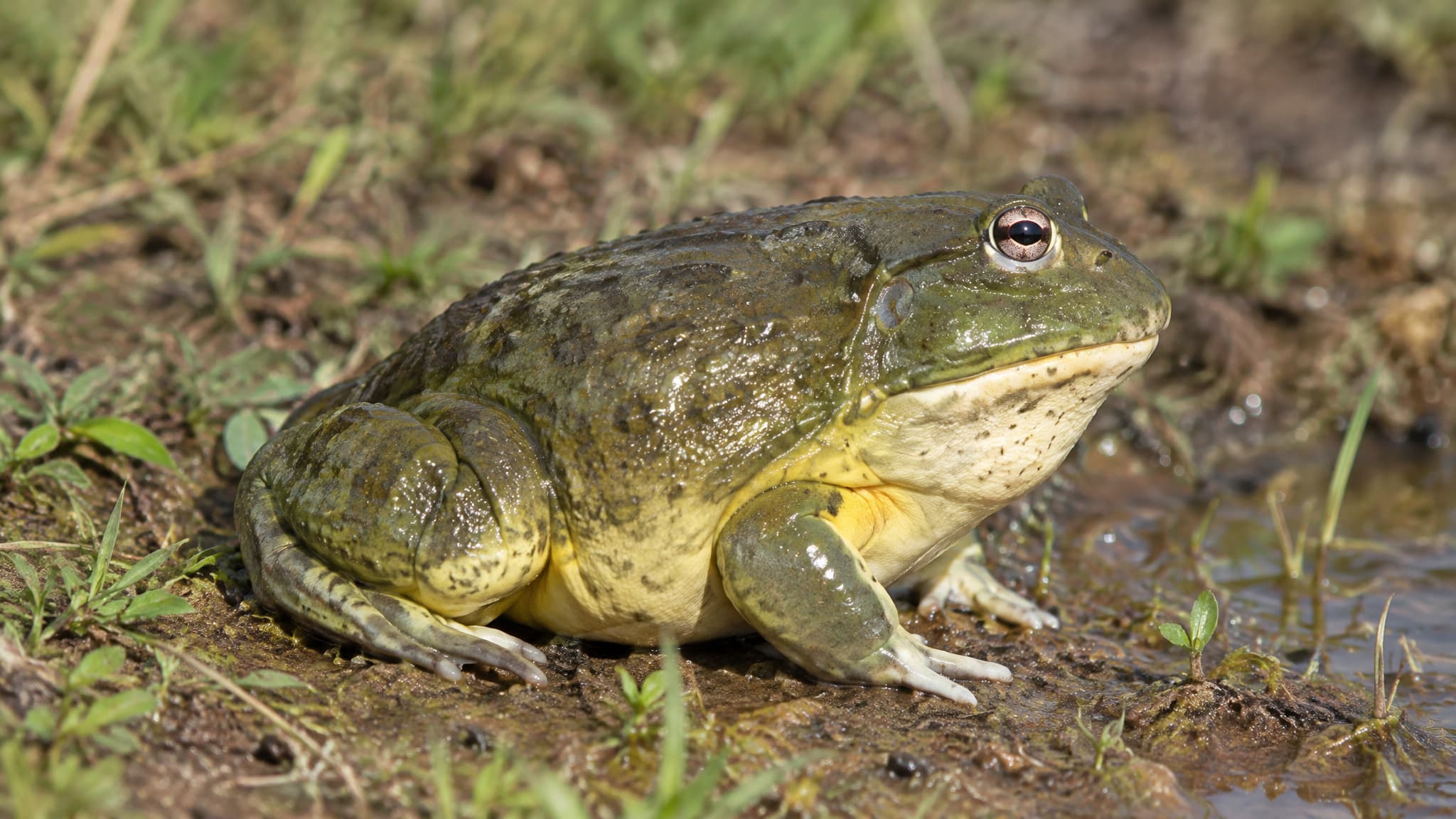
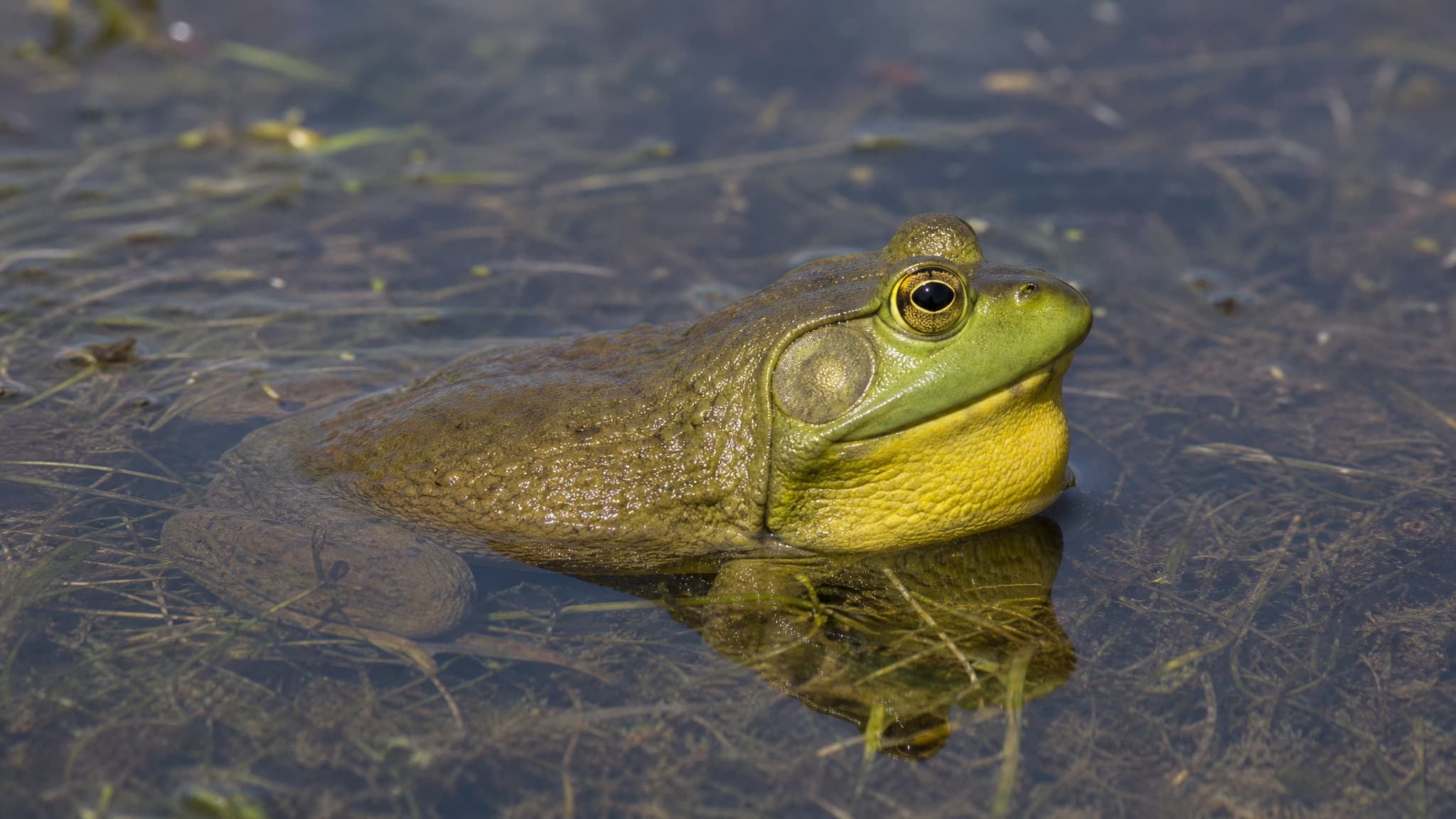
An American bullfrog rests partially submerged in shallow, vegetation-filled water, facing right with its large golden eye, rounded tympanum, smooth green head, and inflated yellow throat visible.
The American bullfrog is a very large, robust true frog, usually olive green to brown with darker mottling on the back. Adults commonly measure about 9–15 cm in body length, and exceptionally large individuals can be substantially bigger. Its broad head, powerful fully webbed hind feet, and conspicuous circular tympanum behind each eye are useful field marks. In breeding males, the tympanum is larger than the eye and the throat may become yellow; females generally have a tympanum no larger than the eye.
Native to eastern and central North America, this frog occupies warm freshwater habitats including ponds, lakes, marshes, sluggish rivers, reservoirs, canals, and vegetated wetlands. It requires water for breeding and for its long larval development. People have moved it widely for food production and trade, and established introduced populations occur in western North America and in parts of Europe, Asia, and South America.
Adults are ambush predators, waiting at the water’s edge or among aquatic plants before snapping up prey with a rapid tongue strike. Their broad diet includes insects, crustaceans, fish, other amphibians, reptiles, and occasionally small birds or mammals; cannibalism also occurs. Tadpoles feed mainly on algae and other plant-based material. The species is active in warm, moist conditions and may overwinter underwater in mud in colder parts of its range.
Breeding is seasonal and involves loud, low male calls and defended aquatic territories. Females release large floating egg masses, sometimes containing thousands of eggs. Eggs may hatch within days, but metamorphosis can take many months to several years depending on climate and habitat. Wild individuals commonly live about 7–9 years, while captive animals have reached roughly 16 years.
In its native ecosystems, the bullfrog is both a predator and prey species and helps link aquatic and terrestrial food webs. Globally it is listed as Least Concern because of its broad distribution, but its conservation significance is complex: where introduced, it can prey on native fauna, compete with other amphibians, and may contribute to pathogen transmission. Preventing releases and managing established populations are therefore important in vulnerable regions.