Amazon milk frog
Trachycephalus resinifictrix
 AI-generated
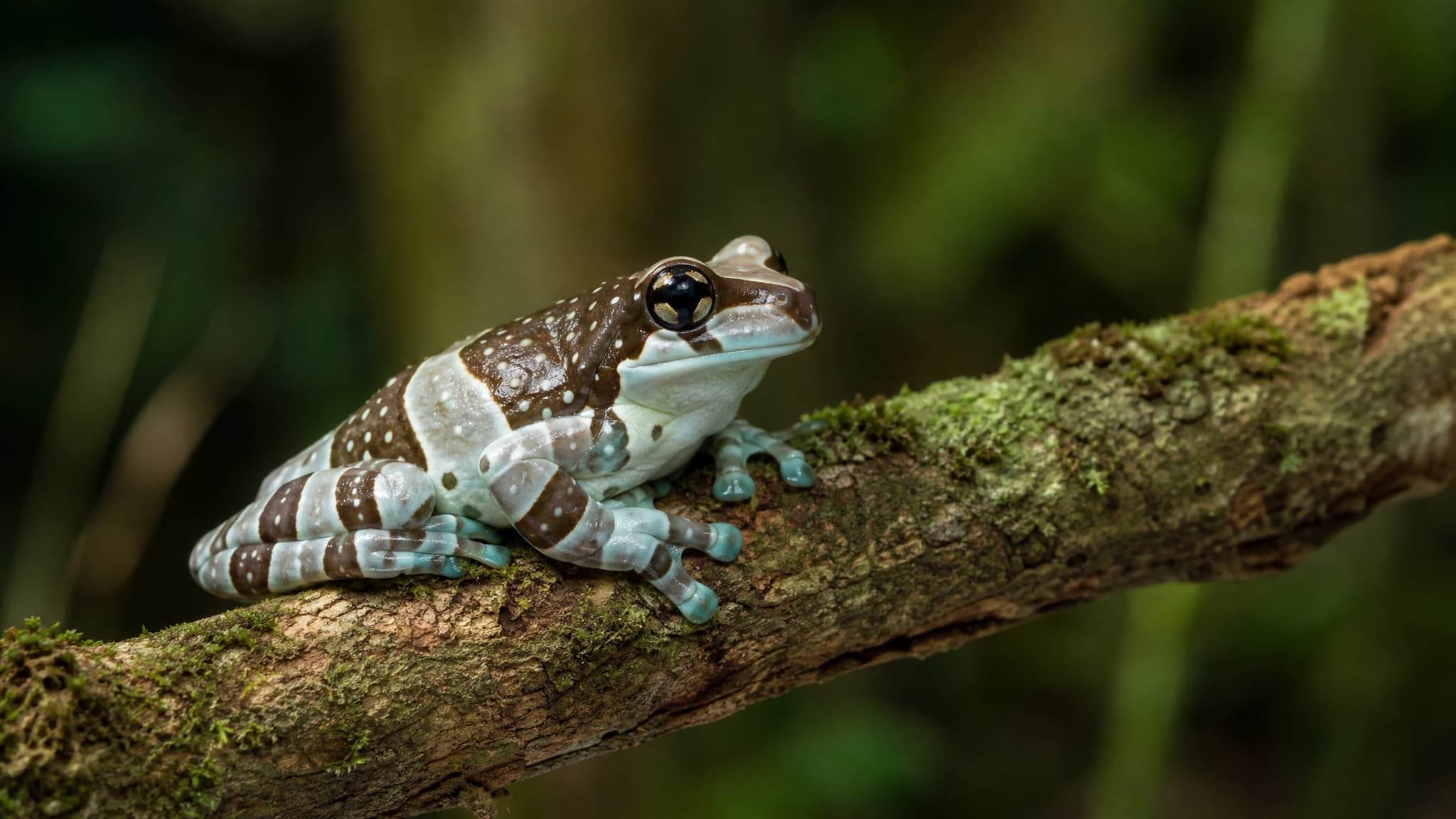
An Amazon milk frog crouches on a moss-covered branch, showing a brown-and-cream spotted body, pale blue-gray limbs, broad toe pads, and a prominent eye against a blurred green background.
The Amazon milk frog is a large, arboreal hylid frog of northern South America. It is also known as the Mission golden-eyed tree frog. Adults have a pale greenish-gray to brownish-gray back crossed by dark brown or gray bands and blotches; the markings are often stronger in young frogs. Its rough-looking, bumpy skin, golden eyes, broad head, and large adhesive toe discs make it well adapted for climbing.
Females can reach about 10 cm in snout–vent length, whereas males are usually smaller. When disturbed, the frog may release a milky skin secretion, which gives it its English common name and is a defensive trait rather than milk. The secretion should not be handled carelessly, as amphibian skin secretions can irritate predators and people.
This species is chiefly associated with the canopy of primary tropical rainforest in the eastern Amazon Basin of Brazil and the Guianas—French Guiana, Guyana, and Suriname. It spends much of its life above the forest floor, using water-filled tree cavities both as shelter and as breeding sites. Records farther west in the Amazon need care because the identities of some populations relative to related Trachycephalus species remain unresolved.
Nocturnal males call loudly from suitable flooded cavities and may defend these valuable sites. Adults take a range of invertebrates and sometimes small vertebrates. Females lay hundreds to thousands of eggs as a surface film in cavity water. Tadpoles hatch quickly, feed largely on detritus and, opportunistically, eggs, and can complete metamorphosis in captivity in roughly six to ten weeks.
By consuming animals in the canopy and by having larvae that process material in tiny tree-hole pools, the species links rainforest food webs above the ground. It is assessed as Least Concern, but logging, forest conversion, pollution, and disturbance can harm local populations by reducing mature forest and the water-holding cavities it requires. Wild lifespan is unknown; captive individuals have been reported to live around 6–8 years.