Amazonian giant centipede
Scolopendra gigantea
 AI-generated
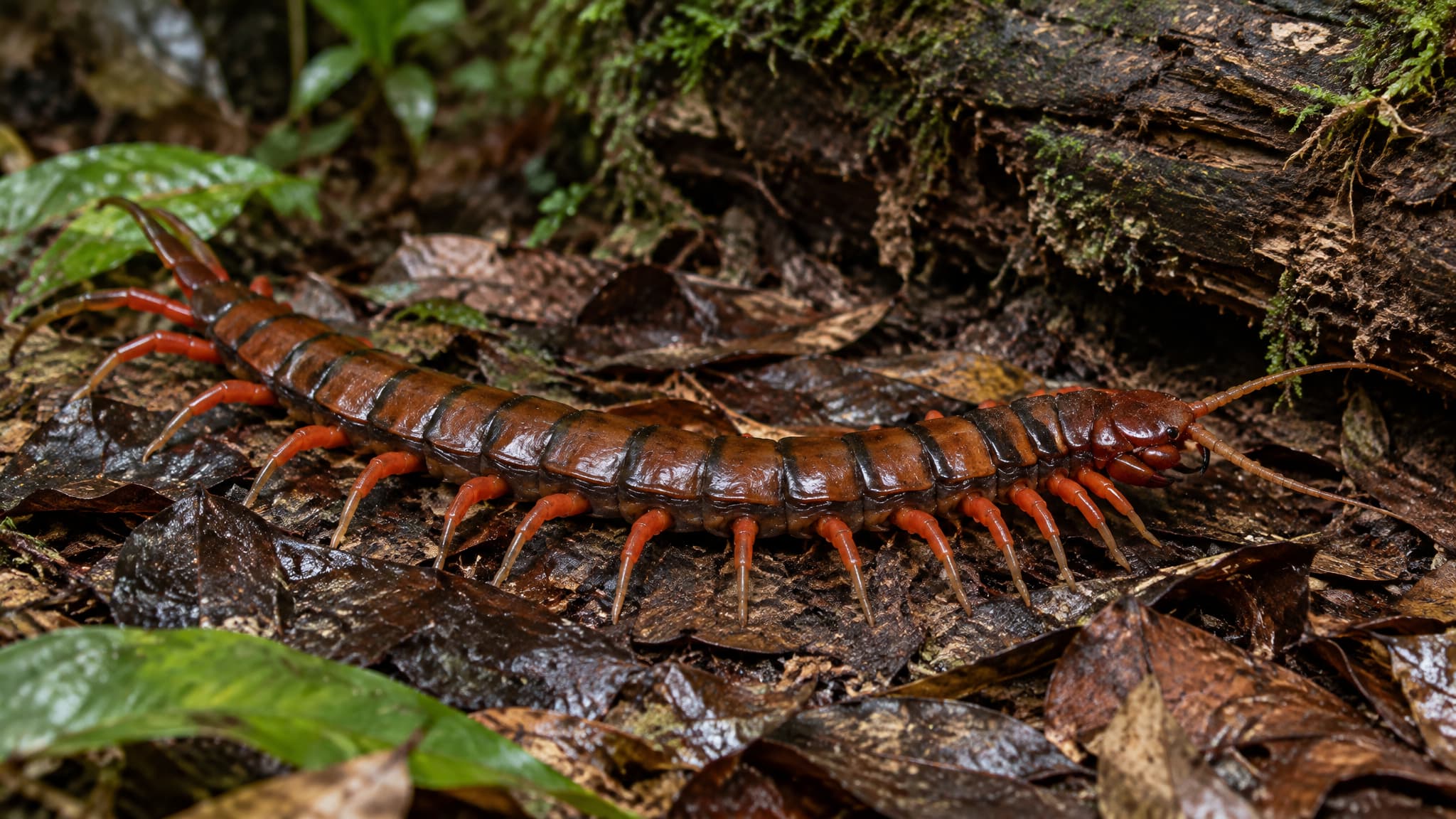
A large reddish-brown centipede lies in a shallow curve on wet leaf litter beside a moss-covered log, with a strongly segmented body, numerous orange legs, and long antennae visible.
The Amazonian giant centipede (Scolopendra gigantea), also called the Peruvian giant yellow-leg centipede, is the largest centipede in the world. Described by Linnaeus in 1758, it belongs to the family Scolopendridae and can exceed 30 cm in length. Its flattened body is divided into a head and a trunk of 21 or 23 segments, each bearing one pair of legs. The head ranges from dark brown to reddish brown, and the legs are olive green with yellow claws. Under the head sits a pair of legs modified into venom-bearing forcipules, and the last pair of legs is long, spiny and used for sensing and defence. Males and females look very much alike.
Despite its English name, verified museum specimens come mainly from northern South America: northern Colombia and Venezuela, including Margarita Island, and the islands of Trinidad, Curaçao and Aruba, with records from Brazil as well. Reports from Mexico, Honduras, Hispaniola, Puerto Rico and the US Virgin Islands are treated as accidental introductions or labelling errors. It lives in tropical rainforest and tropical dry forest, sheltering in leaf litter, rotten wood, under rocks and logs and beneath tree bark, and it also uses rubble, trash piles and wall crevices near houses.
Its exoskeleton lacks a waxy layer, so it loses water quickly through its breathing pores and must stay in moist, dark places. It is mainly nocturnal, has poor eyesight and finds prey with its antennae and sensory hind legs. A strong climber and a fierce predator, it eats almost any animal it can overpower: large insects, worms, snails, spiders, millipedes, scorpions and tarantulas, as well as lizards, frogs up to 9.5 cm long, snakes up to 25 cm long, mice and small birds. In a cave in Venezuela, large individuals were seen hanging from the ceiling, held by only a few legs, while they caught and ate bats.
Males have no copulatory organs. A male spins a silk pad and leaves sperm on it, and the female picks the sperm up and later lays her eggs. She coils over the clutch and broods it, keeping guard until the young can feed for themselves. Animal Diversity Web gives a lifespan of about 10 years.
As a predator of insects and other pests, the species is valued by farmers and gardeners, while it is itself eaten by large birds, spiders and mammals such as coatis, kinkajous and opossums. Its venom can immobilize bats and mice, and the bite is very painful to people. In 2014 a four-year-old child in Venezuela died after being bitten by one of these centipedes hidden in an open soda can. The species has not been assessed by the IUCN, and no threat to its survival is known.