American lobster
Homarus americanus
 AI-generated
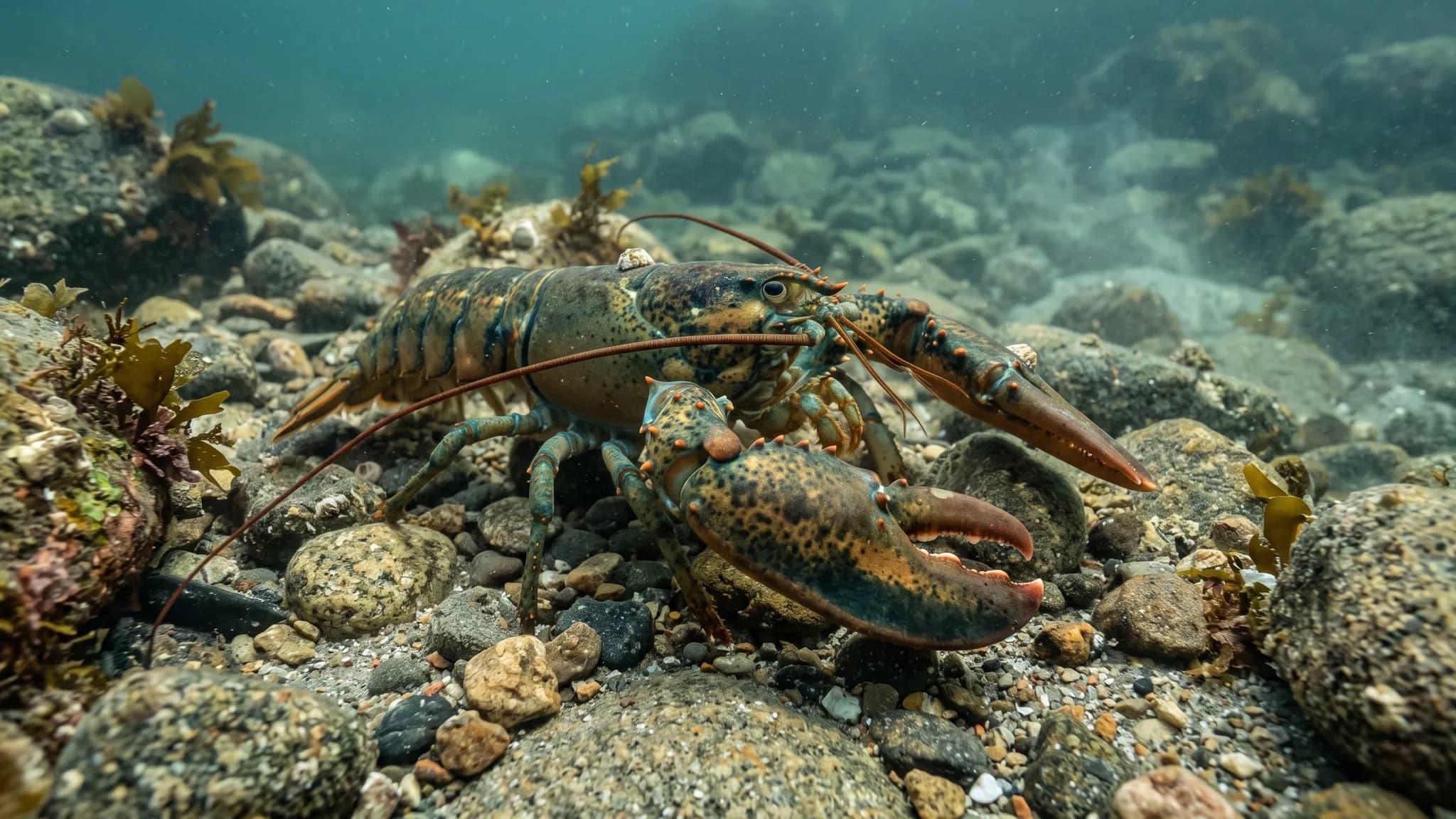
American lobster on a rocky ocean floor with large claws.
The American lobster (Homarus americanus) is a large marine crustacean belonging to the family Nephropidae. It holds the record for being the heaviest of all living arthropods, capable of reaching lengths up to 64 centimeters (25 inches) and weighing over 20 kilograms (44 pounds), though most harvested individuals average 25 centimeters in length and 0.5 kilograms in weight. In the wild, its exoskeleton is typically greenish-brown or blackish-green, turning bright red only when cooked due to the breakdown of shell pigments. Its most defining feature is its pair of large, asymmetrical claws: a bulkier "crusher" claw and a slender "pincher" claw utilized for feeding and defense.
Native to the cold, well-oxygenated waters of the Northwest Atlantic Ocean, this benthic species ranges primarily from Labrador, Canada, southward to North Carolina in the United States. As bottom-dwellers, they favor rocky and cobble-laden substrates in shallow coastal areas, which provide ample crevices and burrows for shelter from predators. While they are most abundant in these coastal zones, they can also be found at ocean depths reaching up to 400 meters.
American lobsters are opportunistic, primarily nocturnal foragers. During their early larval stages, they rely heavily on zooplankton for sustenance. As adults, they transition into largely carnivorous and omnivorous scavengers. Their regionally variable diet consists of crabs, mollusks like clams and snails, sea urchins, starfish, marine worms, small fish, and marine plants such as macroalgae and eelgrass. While they may occasionally forage during the day, active feeding bouts are typically brief, making up only a small percentage of their overall daily activity.
These long-lived crustaceans are an integral part of the Atlantic benthic ecosystem, serving both as predators of bottom-dwelling invertebrates and as prey for larger marine animals when they are young or molting. Under ideal conditions, American lobsters can live well over 50 years, with some estimates suggesting they may even reach lifespans exceeding 100 years. Their feeding habits help regulate populations of various benthic organisms, contributing to the balance of their marine habitats.
The American lobster supports the most lucrative single-species commercial fishery in North America. To protect populations, the fishery is strictly managed through size limits, trap reductions, and the release of V-notched egg-bearing females. Although the International Union for Conservation of Nature (IUCN) lists the species as Least Concern due to robust populations in colder regions like the Gulf of Maine, they face significant environmental pressures. Ocean warming is shifting their distribution northward, causing declines in southern populations. Furthermore, climate change, ocean acidification, and environmental contaminants are increasing their susceptibility to epizootic shell disease, posing a critical challenge to their long-term health and survival.