Atlantic blue crab
Callinectes sapidus
 AI-generated
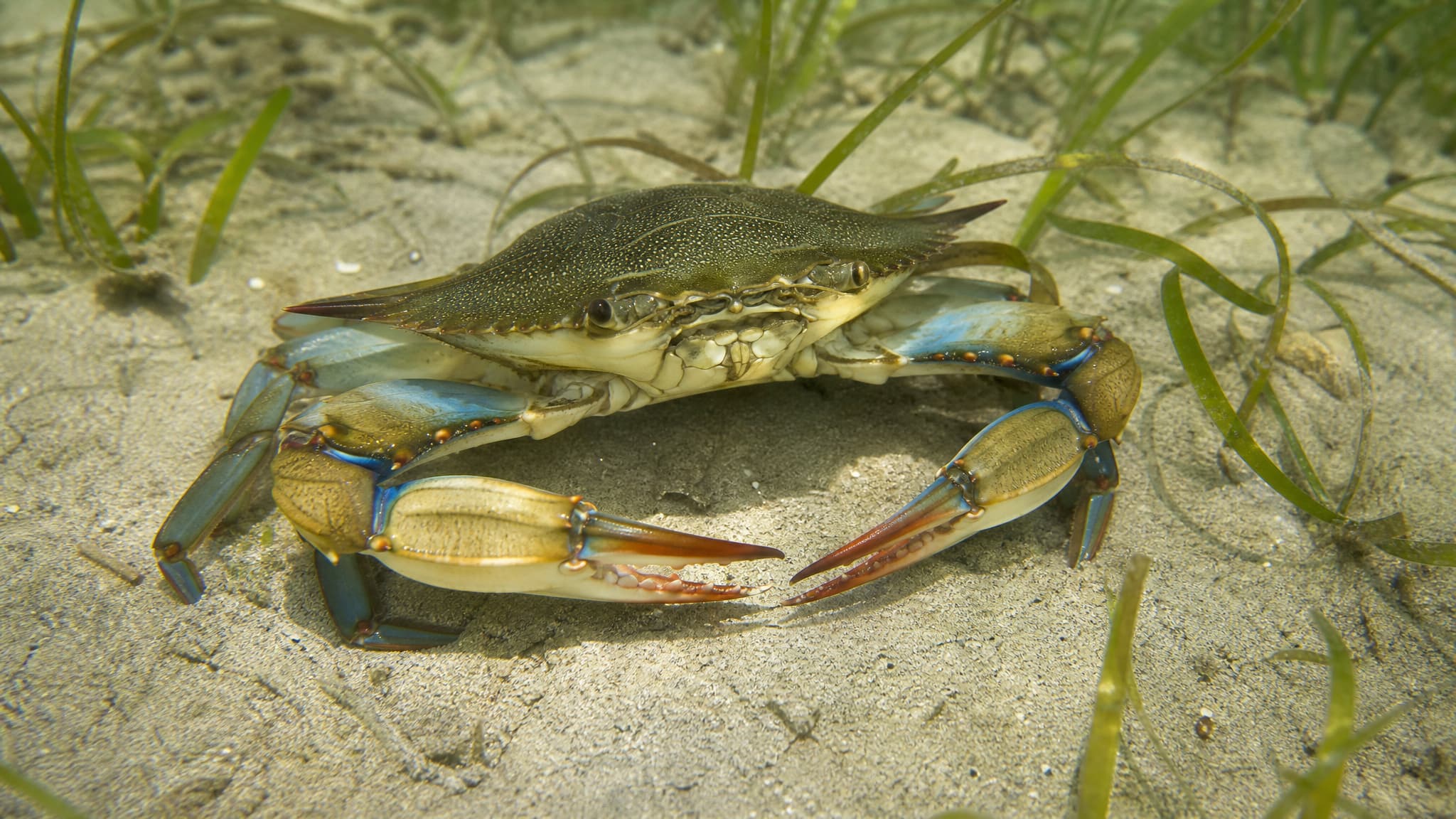
An Atlantic blue crab faces the camera on a sandy seabed among seagrass, with both large blue-edged claws extended and its broad, spiny carapace and eyes clearly visible. The crab is shown in a low, frontal underwater pose.
The Atlantic blue crab (Callinectes sapidus), whose scientific name translates to "beautiful savory swimmer," is a widely recognized decapod crustacean belonging to the swimming crab family, Portunidae. It exhibits prominent sexual dimorphism. Males, often called "jimmies," feature a T-shaped abdomen and bright blue highlights on their legs and claws. Females, known as "sooks" when mature, have a broad, circular abdomen and claws distinctively tipped with vibrant orange and purple. The average carapace width is 5.5 to 6 inches, though exceptionally large individuals can span up to 10 inches across.
Native to the western Atlantic Ocean, the blue crab's range extends from Cape Cod, Massachusetts, down to northern Argentina, encompassing the Gulf of Mexico, Bermuda, and the West Indies. They require dynamic estuarine habitats to complete their complex life cycle. Juveniles and adults thrive in shallow, soft-bottom environments, frequently utilizing seagrass beds and oyster reefs for foraging and protection from predators.
As opportunistic, benthic omnivores, blue crabs play a vital role in coastal food webs. They feed on a wide variety of prey, including bivalves, snails, small fish, aquatic vegetation, annelids, and other crustaceans. Concurrently, they are a primary food source for major predators such as the red drum, Atlantic croaker, various herons, and sea turtles. Their high agility allows them to be both effective predators and elusive prey in their native ecosystems.
Mating occurs in low-salinity upper estuaries, typically between February and November. Females mate only once in their lifetime, immediately following their terminal molt. After mating, they migrate to higher-salinity waters at the mouths of estuaries or into the coastal ocean to spawn. The early larval stages (zoeae) develop in oceanic waters before being guided by tidal currents back into estuarine nurseries as post-larval megalopae.
Within its native range, the blue crab holds monumental economic and cultural significance, supporting highly valuable fisheries. Currently, C. sapidus is not evaluated by the IUCN Red List. While populations are resilient, they are subject to fluctuations due to overfishing and habitat degradation. Interestingly, warming coastal waters may expand their habitable range. Conversely, outside the Americas—particularly in the Mediterranean Sea—the blue crab has become a destructive invasive species, severely disrupting local ecosystems and artisanal fishing economies.