Clown Anemonefish
Amphiprion ocellaris
 AI-generated
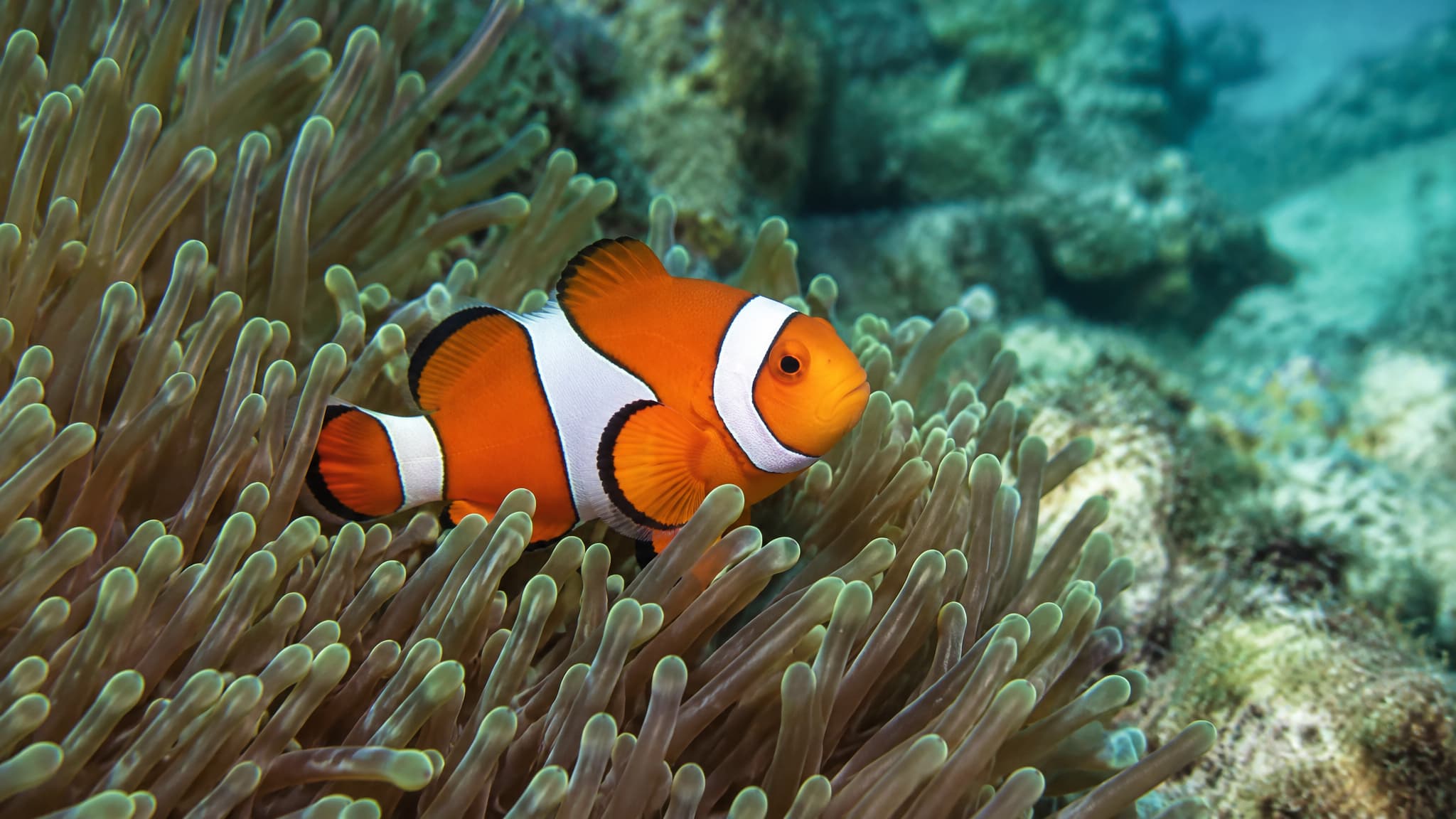
An orange clown anemonefish faces right in side view, nestled among the tentacles of a sea anemone. Its three white, black-edged bars, rounded eye, and orange fins are clearly visible.
Amphiprion ocellaris, the clown anemonefish or false clownfish, is a small, reef-associated damselfish famous for its partnership with sea anemones. It is usually vivid orange to reddish orange, marked with three vertical white bands edged by narrow black lines. The body is laterally compressed and the tail fin is rounded. Some populations, especially in northern Australia, include dark brown to black individuals with the same pale bands. Adults reach about 11 cm total length; females are larger than males.
This species occurs in the tropical Indo-West Pacific, from the eastern Indian Ocean and Southeast Asia to the Philippines, Taiwan, the Ryukyu Islands of Japan, and northwestern Australia. It occupies protected coral reefs and quiet lagoons, generally in shallow water from about 1 to 15 m deep. Rather than ranging widely across the reef, it lives closely associated with a host anemone, including Heteractis magnifica, Stichodactyla gigantea, and Stichodactyla mertensii.
The fish feeds chiefly on zooplankton, including small crustaceans such as copepods, and also takes algae and other nearby food. Its skin mucus enables it to live among an anemone’s stinging tentacles after acclimation. The anemone provides shelter from predators and protection for the nest; the fish, in turn, may contribute nutrients and water movement around its host. This conspicuous mutualism makes the species an important small resident of shallow reef communities.
Groups have a strict size-based hierarchy: the largest individual is the breeding female, the next-largest is the breeding male, and smaller fish are non-breeding males. The species is a protandrous sequential hermaphrodite, so a breeding male can change sex if the female disappears. A pair lays adhesive eggs on a cleared hard surface near the anemone. The male guards and fans the clutch until hatching, commonly after roughly a week; the larvae then enter a planktonic phase.
Wild longevity is commonly reported at about 6–10 years, and captive individuals have reached 12 years. The IUCN assesses A. ocellaris as Least Concern globally, based on an assessment completed on February 3, 2021. Nevertheless, dependence on coral-reef habitat and host anemones leaves local populations vulnerable to reef degradation, pollution, warming-related bleaching, and unsustainable collection for the ornamental aquarium trade. Captive breeding can reduce pressure on wild fish when responsibly managed.