Amazon puffer
Sphoeroides asellus
 AI-generated
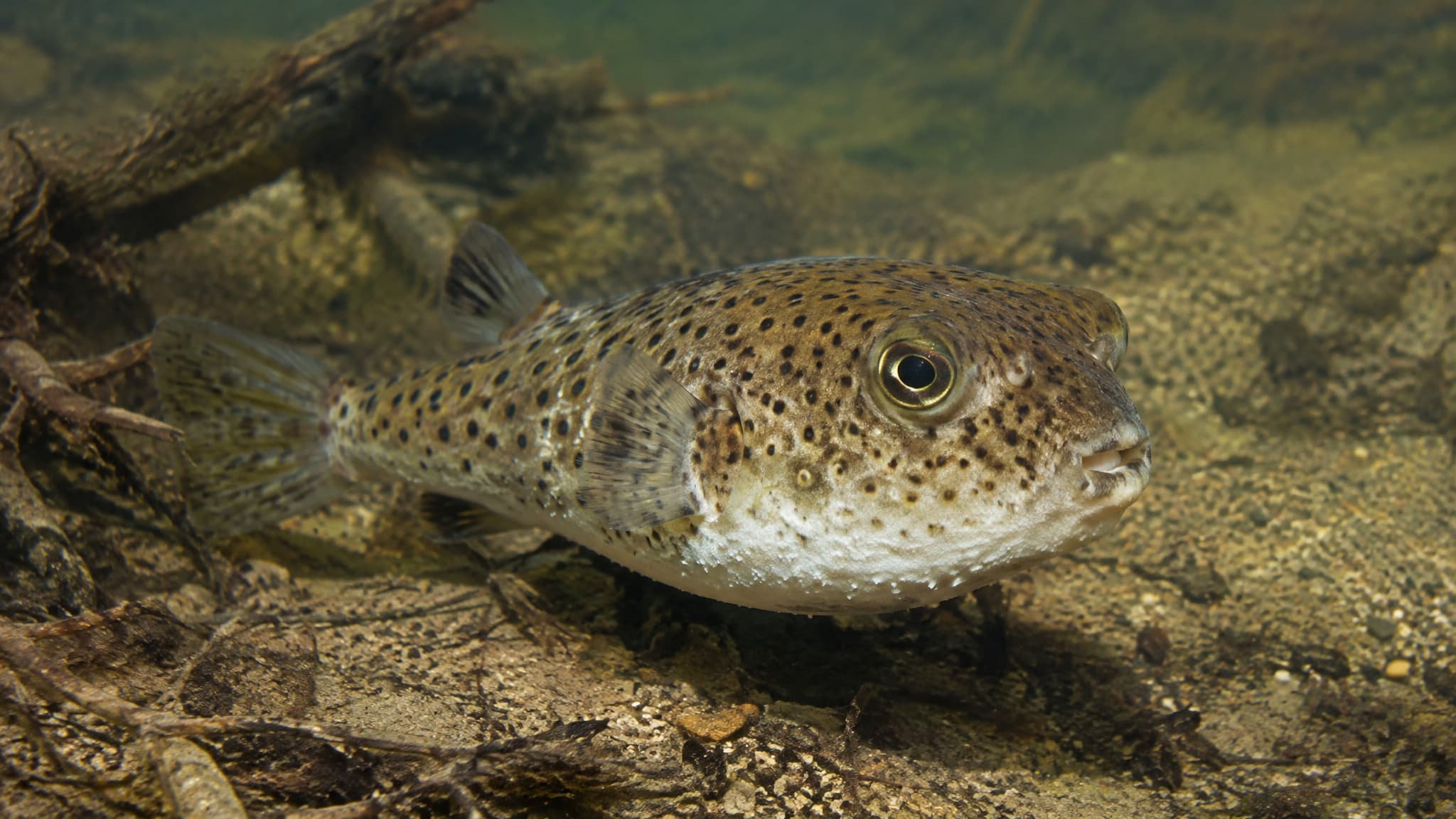
A spotted Amazon puffer is shown in side profile, hovering just above a sandy, rocky streambed beside submerged wood. Its rounded body, large eye, beaklike mouth, translucent fins, and dark body spots are clearly visible.
The Amazon puffer is a small South American pufferfish, long known as Colomesus asellus. Modern phylogenetic work and current catalogues place it in Sphoeroides, but the older combination remains widespread. It has the compact, deep-bodied form typical of puffers, a pale underside, greenish upper body marked with dark transverse bands, and a conspicuous black mark on the underside of the narrow caudal peduncle. It reaches about 12.8 cm standard length.
It occurs in tropical northern South America, chiefly across the Amazon basin from Peru to Marajó Island in Brazil, with records also from the lower Orinoco and Essequibo basins. The species is principally freshwater and demersal, living close to the bottom in rivers and streams; it can also tolerate brackish conditions, including coastal streams.
Its fused, beak-like teeth are suited to taking small hard-bodied prey. A study in the Tocantins River found a diet dominated by benthic invertebrates—especially mayfly nymphs—and classified the fish as insectivorous. Other records include crustaceans, planktonic invertebrates, periphyton, and occasional small fishes. By feeding on river-bottom invertebrates, it forms part of the link between aquatic insect production and larger freshwater predators.
Available evidence indicates rainy-season spawning in freshwater. The eggs are small, and early larvae drift downstream; captive work has shown that larval rearing conditions are demanding. Adults and juveniles may use river margins differently across the seasonal cycle. A dependable wild lifespan has not been established. The IUCN assessment lists the species as Least Concern, although freshwater habitats and local populations can still be affected by river alteration and water-quality pressures.