Angler (Monkfish)
Lophius piscatorius
 AI-generated
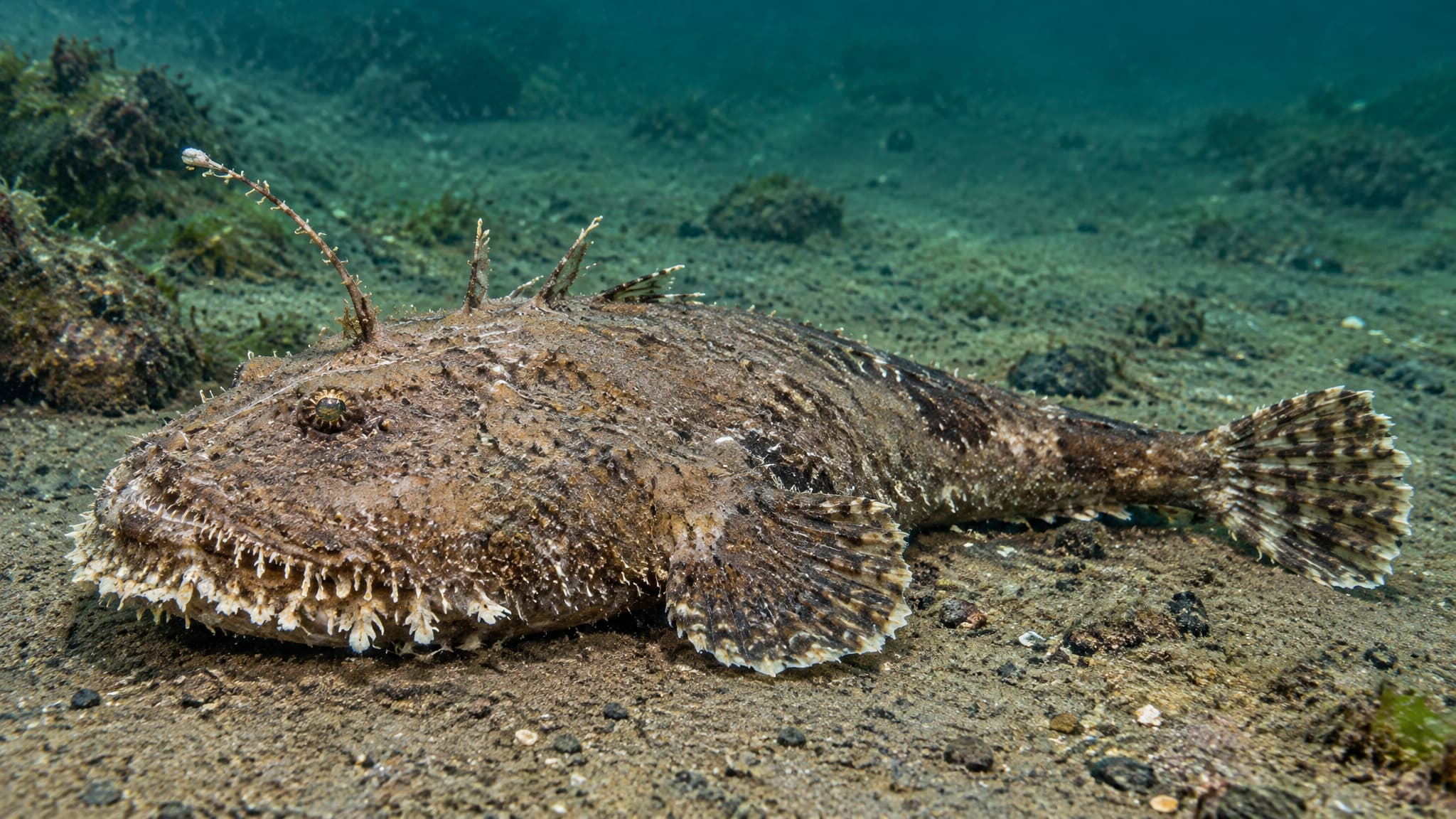
A monkfish rests on a sandy, rocky seabed in a low, front-facing pose, showing its broad flattened head, mottled skin, projecting lure, visible eye, and fringed fins.
The angler, also called the monkfish or white anglerfish, is a large bottom-dwelling fish. Its head and body are flattened from top to bottom, and its huge, wide mouth is lined with sharp teeth. The skin is loose and has no scales. A fringe of leaf-like flaps runs along the edges of the head and body. Colour varies, but the back is usually brown or greenish-brown with reddish or dark mottling, and the belly is always white. The first spine of the dorsal fin is a movable 'fishing rod' with a fleshy lure at its tip. Adults commonly reach about 1 m and can grow to 2 m and nearly 58 kg.
The species lives in the north-eastern Atlantic, from the south-western Barents Sea south to the Strait of Gibraltar, and also in the Mediterranean and Black Seas. It rests on sandy and muddy bottoms, and sometimes rocky ones, from shallow coastal water down to about 1,000 m. Depth changes with age, season, water temperature and available prey. North Atlantic angler tend to be larger and live in shallower water than those further south.
The angler is an ambush predator. It lies half-buried in sediment, perfectly camouflaged, and waves its lure to attract prey. When something comes close, it opens its enormous mouth and swallows the victim almost instantly. It mainly eats other fishes and has occasionally been recorded taking seabirds. It breathes unusually slowly: a single breathing cycle can last more than 90 seconds.
Fertilization happens outside the body, and the parents give no care. Females release their eggs in a floating, see-through jelly ribbon that can be over 10 m long. The larvae drift near the surface before settling to deeper water. Females grow larger than males and usually mature at about 55 cm. The oldest recorded age is 24 years.
As a large predator, the angler helps control fish populations on the seabed. It is also a highly valued food fish, sold as monkfish, and supports important commercial fisheries. FishBase rates it as highly vulnerable to fishing because it grows slowly and matures late. Its global IUCN status is Least Concern, but fishing pressure and good management still matter for its long-term health.