Peacock-tail anemone shrimp
Ancylocaris brevicarpalis
 AI-generated
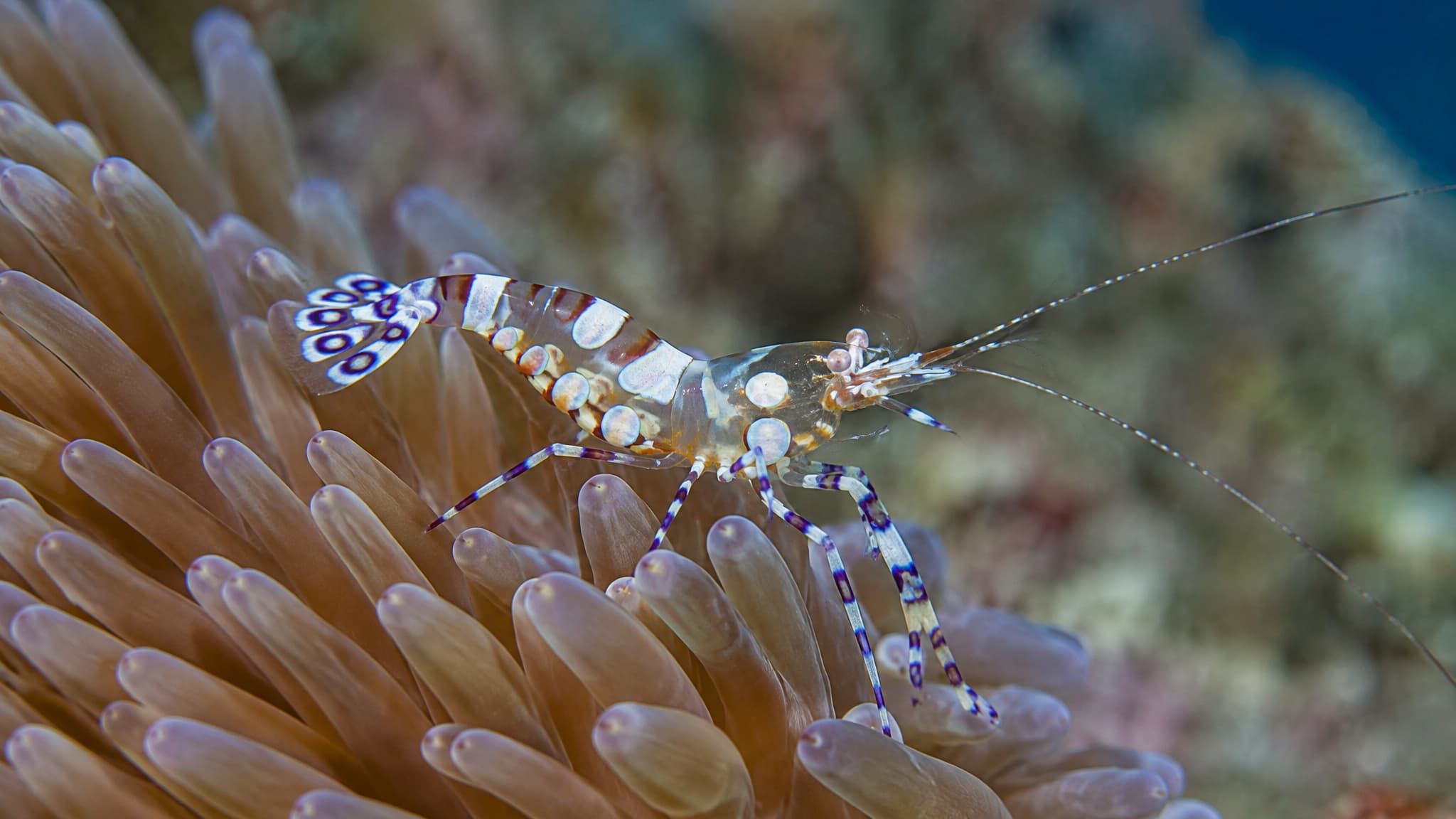
A peacock-tail anemone shrimp is shown in side view, perched among the tentacles of a sea anemone. Its translucent body, long antennae, banded legs, and conspicuous blue-ringed tail markings are visible. 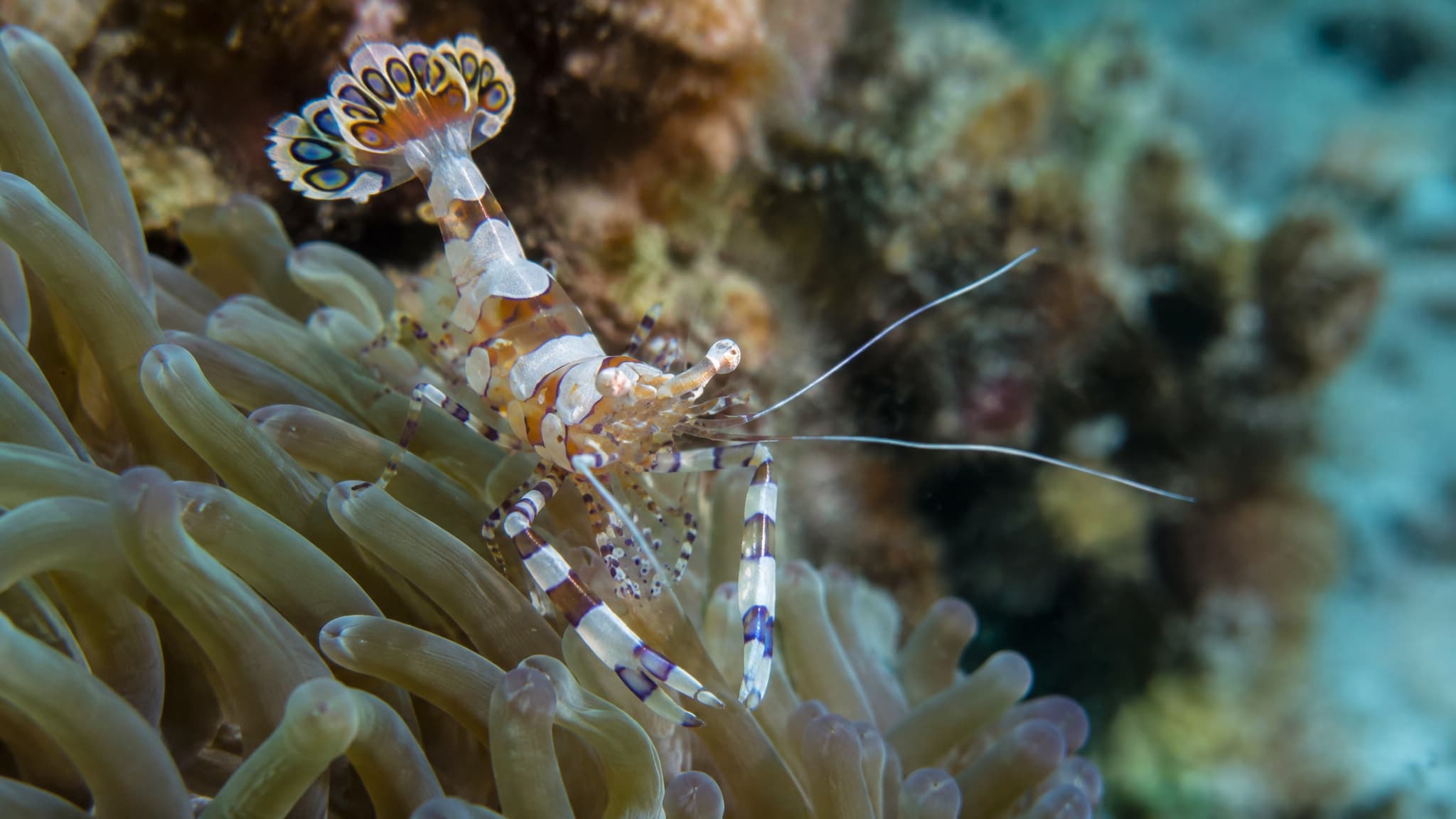 AI-generated
A translucent, banded shrimp rests among the tentacles of a sea anemone, displaying long antennae, slender legs, and a raised fan-shaped tail marked with peacock-eye spots.
The peacock-tail anemone shrimp, Ancylocaris brevicarpalis, is a small palaemonid shrimp that lives on sea anemones in the Indo-West Pacific. It was described by Schenkel in 1902 from Sulawesi and was long known as Periclimenes brevicarpalis. In 2017 a revision of Periclimenes revived the genus Ancylocaris for it, and it is currently the only species in that genus. Divers also know it as the glass, white-spot or Pacific clown anemone shrimp.
Adults measure about 2 to 4 cm. The body is largely transparent, marked with white and dark patches, and the tail fan is split into five sections, each bearing an orange spot ringed with a dark outline. Under the microscope it is recognised by a rostrum about as long as the antennular stalk with a toothed upper edge, and by stout second walking legs whose carpus is much shorter than the palm in adults. Its closest relatives are smaller and more slender.
The species ranges from South Africa and the Red Sea east to Japan and Polynesia, on coral reefs at depths of about 3 to 30 m. Adults are obligate partners of sea anemones, including the bubble-tip anemone Entacmaea quadricolor, while juveniles may also be found on soft and stony corals. Shrimps are seen alone or in pairs near the base or on the column of the host, often half hidden by its extended tentacles, and they may share an anemone with anemonefish, porcelain crabs and other anemone shrimps.
The relationship is not purely harmless. In 30-day aquarium experiments, the shrimps clipped and ate their host's tentacles, and many anemones kept with them lost most or all of their tentacles. The shrimps clearly gained from the partnership: 19 of 20 survived with a host, against 17 of 20 fed shrimps and only 6 of 20 unfed shrimps kept without one. Wild anemones usually keep long, numerous tentacles, so the cost to the host may be small in nature.
Like other caridean shrimps, females carry their eggs under the abdomen until the larvae hatch, and egg-bearing females have been collected in Papua New Guinea. In the experiments, growth rate, the time between moults and the number of larval releases all depended on access to an anemone rather than on extra food. No lifespan figures or conservation assessment were found for this species in the consulted sources.