Western Honey Bee
Apis mellifera
 AI-generated
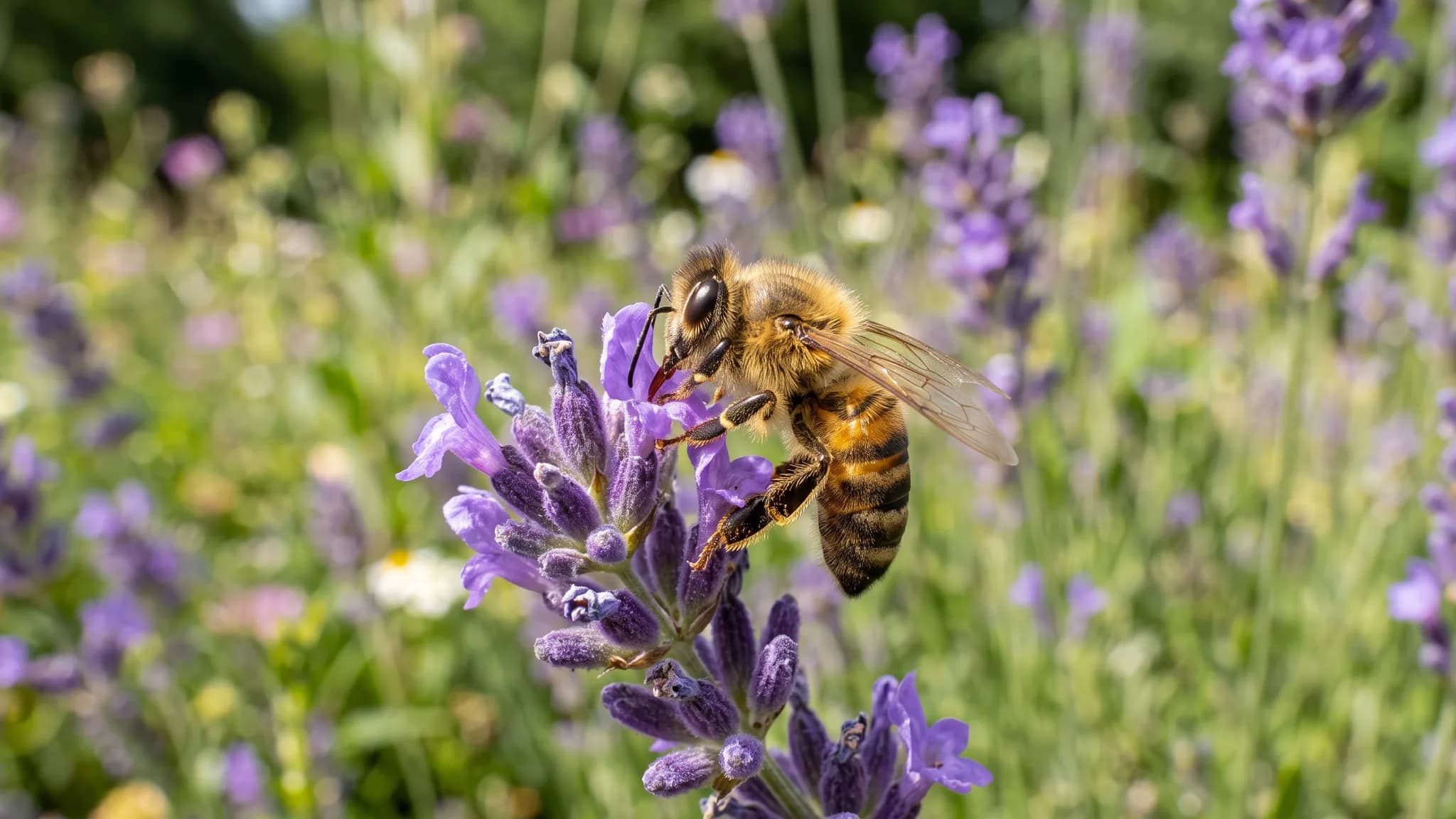
A Western Honey Bee foraging on a purple lavender flower, clearly displaying its fuzzy golden-brown thorax and banded abdomen.
Apis mellifera, commonly known as the Western honey bee or European honey bee, is a highly eusocial insect recognized globally for its role in pollination and honey production. This species features a distinct red-to-brown body adorned with prominent black bands and orange-yellow rings on the abdomen. The thorax is noticeably hairy, while the abdomen is relatively smooth. Within a colony, there are three distinct castes: sterile female workers measuring 10–15 mm with specialized pollen baskets and a barbed stinger; fertile female queens which are the largest at 18–20 mm; and male drones measuring 15–17 mm whose sole purpose is mating.
Historically native to Europe, Africa, and parts of western Asia, the Western honey bee was introduced globally by humans starting in the 17th century. Today, it inhabits every continent except Antarctica. These highly adaptable insects thrive in a variety of habitats, including meadows, open woodlands, agricultural areas, and gardens. To survive and establish colonies, they require a reliable source of water, abundant flowering plants for foraging, and natural or artificial cavities such as hollow trees or beekeeper hives for nesting.
The behavior and social structure of the Western honey bee are remarkably complex. A single colony operates as a superorganism where tens of thousands of individuals work cooperatively. One of their most famous behaviors is the "waggle dance," a specialized form of communication in which worker bees transmit precise spatial information to their nestmates regarding the location, distance, and quality of floral resources. As generalist foragers, their diet consists primarily of nectar, which provides carbohydrates, and pollen, which supplies essential proteins and lipids.
Reproduction is centralized, with the queen being the sole reproductive female in the colony. She mates early in life with multiple drones during mating flights and subsequently lays thousands of eggs daily. The lifespan of a honey bee varies significantly by caste and season: worker bees may live only a few weeks during the busy summer foraging season, but can survive for several months over winter to keep the cluster warm. Queens typically live for two to five years, while drones die shortly after mating or are expelled from the hive before winter.
As a keystone species, Apis mellifera plays an indispensable ecological and economic role. It is arguably the most critical agricultural pollinator, significantly enhancing global crop yields and ensuring food security. In natural ecosystems, it is the most frequent floral visitor worldwide. However, despite their ubiquity, honey bee populations face numerous threats including habitat loss, the widespread use of agrochemicals like neonicotinoids, and severe biotic pressures from parasites such as the Varroa destructor mite and various viral pathogens. Conversely, in regions where they are introduced, feral populations can outcompete native fauna for resources, highlighting the need for comprehensive habitat conservation that supports both managed and native pollinators.