Cockatoo dwarf cichlid
Apistogramma cacatuoides
 AI-generated
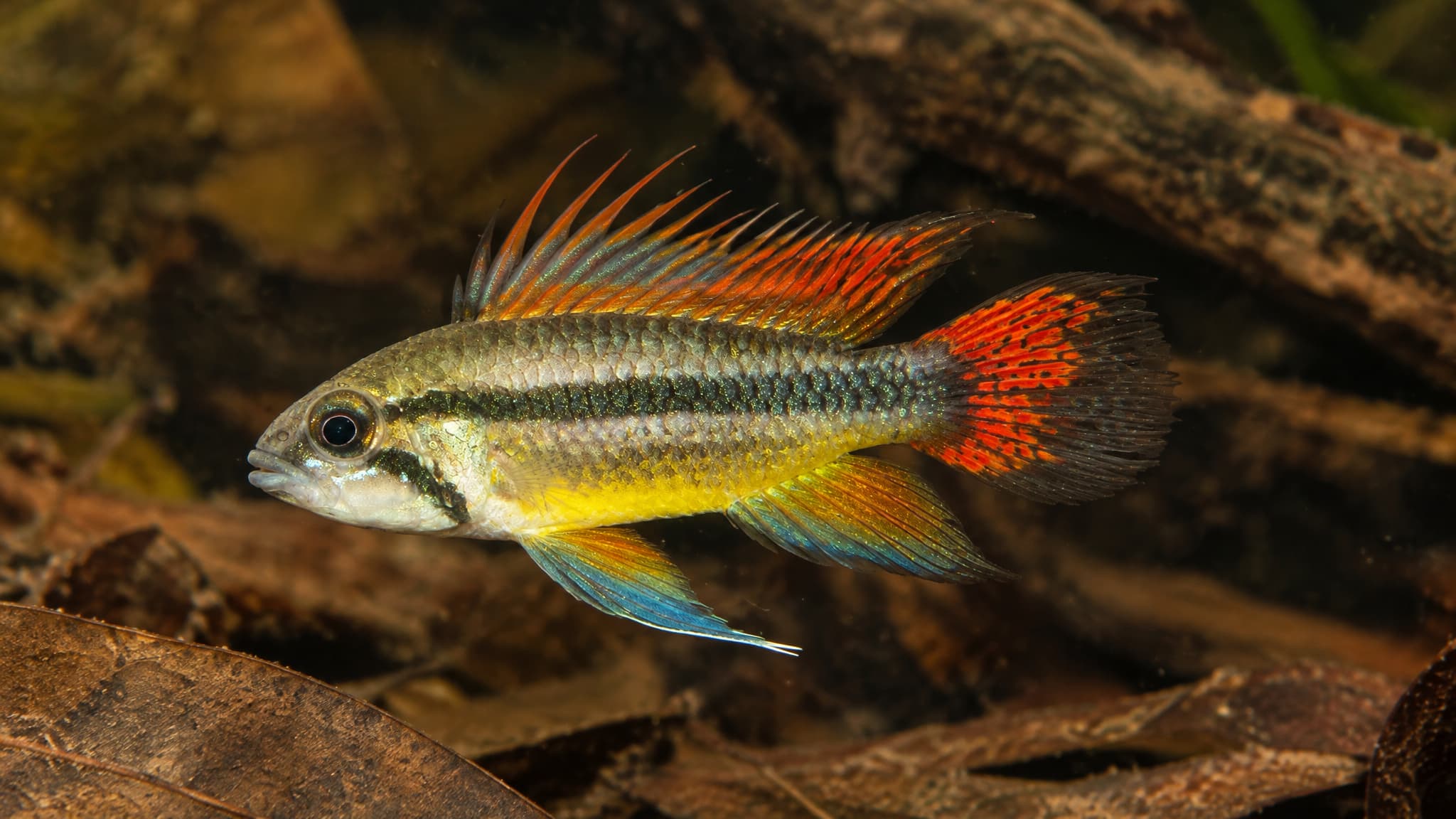
A cockatoo dwarf cichlid is shown in left-facing side profile above leaf litter and submerged wood in an aquatic habitat. Its elongated orange-spotted dorsal fin, yellow-green body, and broad colorful tail are clearly visible.
The cockatoo dwarf cichlid (Apistogramma cacatuoides), often simply called the cockatoo cichlid, is a small South American cichlid described by Hoedeman in 1951. Its name refers to the tall, crest-like front rays of the male's dorsal fin, which recall the crest of a cockatoo. The species was first said to come from Paramaribo in Suriname, but that locality was an error, and Kullander later placed its true origin in the Amazon basin.
Males reach about 7.5 cm in standard length, while females stay near 5 cm, so an adult male can be roughly twice the size of a female. Males are also more colourful and carry longer, more extended fins. The aquarium trade offers many line-bred colour forms, such as 'double red' and 'orange flash'.
The species lives in the upper Amazon basin, in tributaries of the Ucayali, Amazon and Solimões rivers from the Pachitea River to Tabatinga, in Peru, Colombia and western Brazil. It favours slow tributaries, backwaters, creeks and shallow lagoon-like waters in the rainforest, where fallen leaves pile up on the bottom and offer hiding places. Depending on place and season, the water may be black, white or clear.
In the wild it is primarily carnivorous, picking mostly small bottom-dwelling invertebrates from the leaf litter and the substrate. Males are territorial and do not tolerate rival males. Smaller, submissive males can mimic the plainer look of females to slip into a territory and fertilise eggs, and they only grow full male finnage if the dominant male disappears.
The female lays her eggs on the ceiling of a cave or under a leaf. FishBase records clutches of up to 80 eggs, and the female alone guards the eggs and the larvae, while the male patrols the wider territory. A brooding female can become very aggressive. In aquariums the cockatoo dwarf cichlid usually lives about 3 to 5 years; its lifespan in the wild is not documented.
The IUCN lists the species as Least Concern. Most fish in the hobby are now captive-bred, and these are fairly tolerant of different water conditions, although some wild populations need soft, acidic water to breed.
Ideal water
The water this fish does best in, as kept in aquariums.
- Water type
- Freshwater
- Temperature
- 24–25 °C
- pH
- 6.0–8.0
- acidic to alkaline
- General hardness
- 5–19 dGH