Common starfish
Asterias rubens
 AI-generated
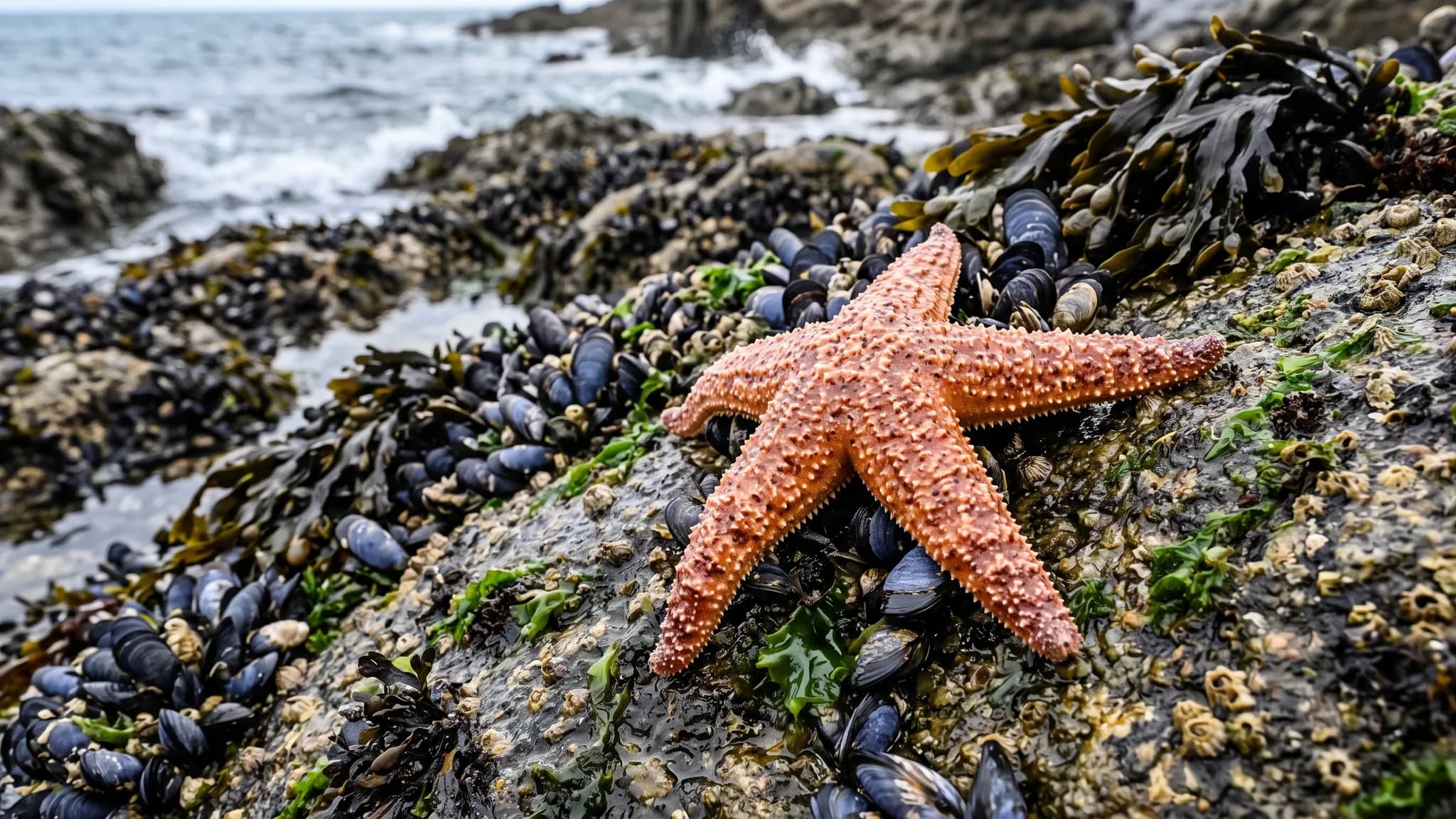
A Common starfish (Asterias rubens) resting on a rocky shore surrounded by mussels and seaweed in its natural intertidal habitat.
Asterias rubens, commonly known as the common starfish, common sea star, or sugar starfish, is a widely recognized marine invertebrate. It is the most abundant starfish species found in the north-east Atlantic Ocean. Taxonomically classified by Carl Linnaeus in 1758, it plays a critical ecological role as a benthic marine predator in various coastal and deep-water ecosystems.
This species is easily identified by its radially symmetrical body, which typically features five arms that are broad at the base and taper to slightly upturned points. The underside of these arms is equipped with a highly specialized water vascular system containing numerous fluid-filled tube feet. These structures are essential for locomotion, respiration, and securing prey. While most individuals measure between 10 and 30 centimeters in diameter, exceptional specimens can reach up to 52 centimeters. Their coloration varies with habitat depth; shallow-water starfish are typically orange, pale brown, or occasionally violet, while those in deeper waters display significantly paler hues.
The common starfish is an Arctic-boreal species renowned for its wide thermal tolerance, capable of surviving in waters up to 22°C. Its geographic range is extensive, stretching from the frigid waters of Arctic Norway and the White Sea down the Atlantic coast to Senegal. It inhabits a broad spectrum of depths, from exposed intertidal zones to roughly 650 meters below sea level. Ecologically versatile, it thrives on diverse substrates such as rocky seabeds, shelly gravel, sand, mud flats, and algal carpets, often forming massive aggregations over nutrient-rich mussel and barnacle beds.
As a highly effective carnivorous benthic predator, Asterias rubens primarily feeds on bivalve mollusks like mussels and clams, as well as other small benthic invertebrates, fish eggs, and carrion. To consume hard-shelled prey, the starfish employs a fascinating two-stage feeding mechanism. It uses the sustained hydraulic suction of its numerous tube feet to pry apart the shells of bivalves.
Once a tiny gap is created in the prey's shell, the starfish everts its cardiac stomach out through its mouth and inserts it directly into the shell. This stomach secretes potent digestive enzymes that liquefy the prey's soft tissues externally. The resulting nutrient-rich fluid is then drawn back into the starfish's internal pyloric stomach, where digestion is finalized with the help of pyloric caeca located within each arm.