Atlantic goliath grouper
Epinephelus itajara
 AI-generated
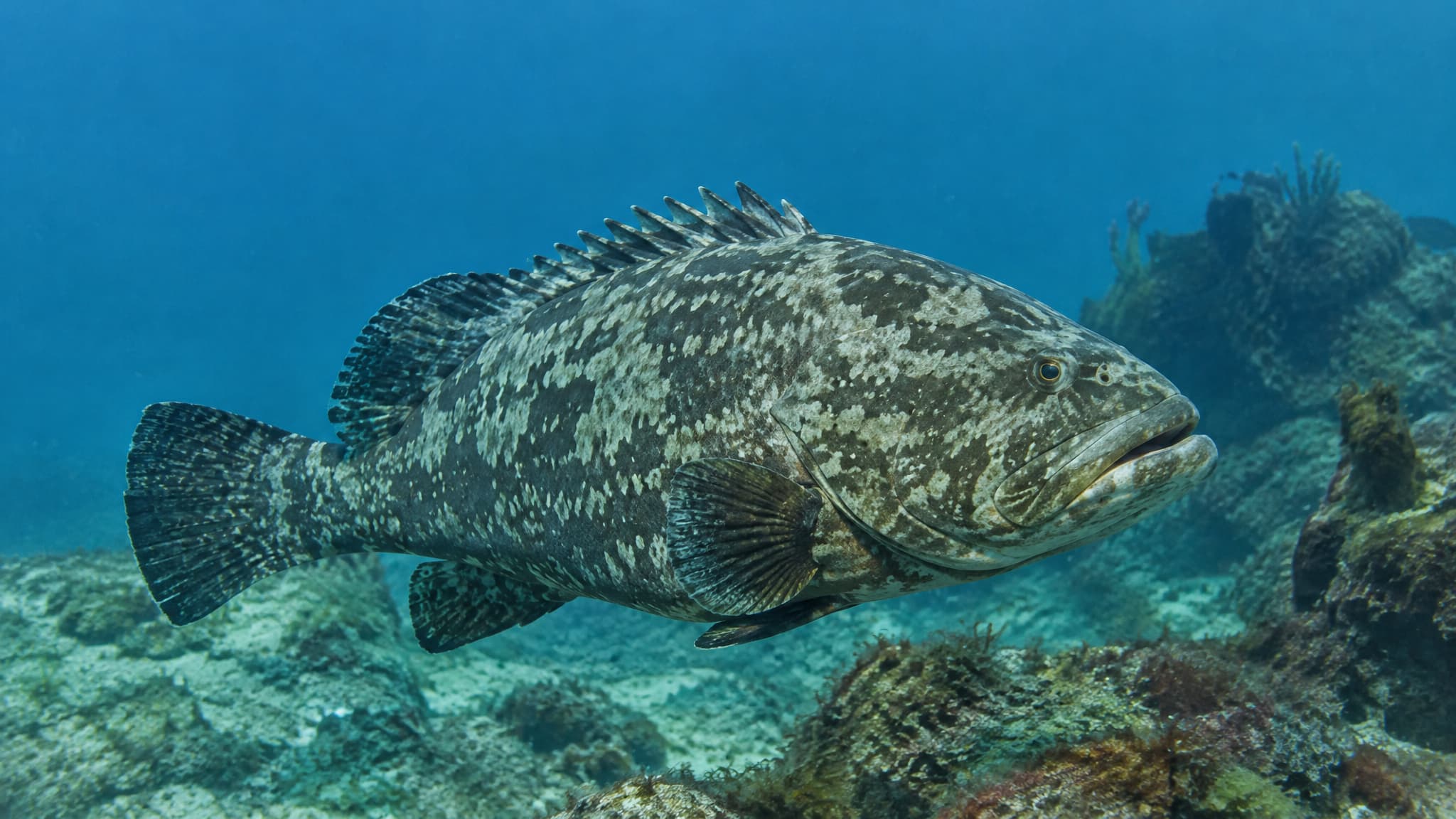
A large Atlantic goliath grouper swims in side profile above a rocky coral-reef seafloor, with its mouth slightly open. Its massive mottled body, broad pectoral fins, rounded tail, and prominent dorsal spines are clearly visible.
The Atlantic goliath grouper is an enormous, heavy-bodied reef fish and the largest grouper in the Atlantic. Adults are usually yellowish-brown, gray, or greenish, with irregular darker blotches and many small dark spots; young fish show more distinct oblique dark bars. Its broad head, small eyes, huge mouth, rounded tail, and robust profile make it unmistakable. It can reach about 2.5 m in total length and more than 400 kg.
This species occurs on both sides of the Atlantic. In the western Atlantic it ranges from Florida through the Gulf of Mexico and Caribbean to southern Brazil; it also occurs along the west African coast from Senegal to Angola. Adults occupy shallow coastal waters around coral and rocky reefs, wrecks, artificial structures, and other hard-bottom habitat. Juveniles depend especially on sheltered estuaries and mangrove-root habitats, although they may also use nearby seagrass beds, docks, and jetties.
A powerful ambush predator, the Atlantic goliath grouper eats fishes and large invertebrates, particularly crustaceans such as crabs and lobsters. Individuals often stay close to a home area and can defend shelter sites; they may produce a low-frequency booming sound with the swim bladder. By consuming sizeable prey and moving between mangrove nurseries and reef habitats through life, it is an important large predator in tropical coastal food webs.
Adults gather at particular sites to spawn, a behavior that has made the species especially vulnerable to fishing pressure. It is long-lived—more than 30 years, with a reported maximum of 37 years—and its slow population recovery heightens that risk. The global IUCN assessment lists it as Vulnerable. Historical overfishing, capture at spawning aggregations, and loss or degradation of mangroves and reef habitat remain major threats; it is known in Brazil as mero and receives fishery protection there.