Atlantic Tarpon
Megalops atlanticus
 AI-generated
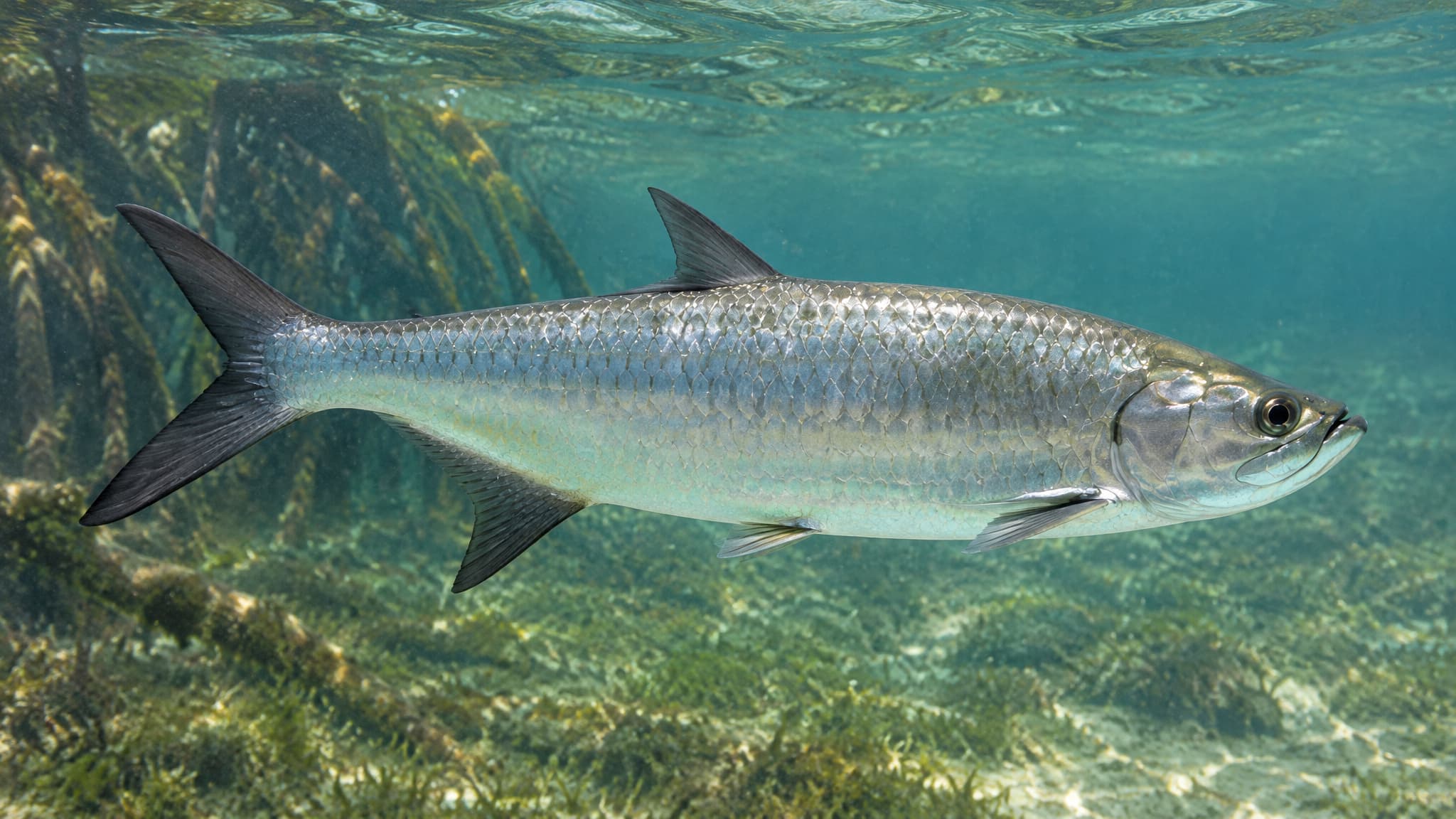
An Atlantic tarpon swims horizontally to the right in clear, shallow water above a rocky, algae-covered bottom. Its large reflective scales, deeply forked tail, prominent dorsal and anal fins, and upturned mouth are clearly visible.
The Atlantic tarpon (Megalops atlanticus), often called the "silver king," is a large, bright silver fish with a greyish back. It has a long, flattened body and very large, thick scales. Other features include big eyes (the name Megalops means "great appearance"), an upturned mouth with a jutting lower jaw, a bony plate under the throat, and a deeply forked tail. The last ray of its single dorsal fin is stretched into a long filament. Adults can reach about 2.5 m in length and weigh up to 161 kg.
The species lives on both sides of the Atlantic. In the west it ranges from about North Carolina through the Gulf of Mexico and the Caribbean to Brazil. In the east it is found from Senegal to Angola. It lives in warm, shallow coastal waters, bays, estuaries, mangrove lagoons, and rivers, and it can move between salt, brackish, and fresh water.
The tarpon's swim bladder is connected to its esophagus and works like a simple lung. The fish rolls at the surface to gulp air, which lets it survive in warm, oxygen-poor water where many other predators cannot. What it eats changes as it grows. Adults mainly hunt schooling fish such as mullet and sardines, and they also take shrimp and crabs. Because its teeth are small, the tarpon swallows its prey whole. It often travels in small schools and makes long seasonal migrations, sometimes crossing international borders.
Adults gather in schools of roughly 25 to 200 fish and move offshore to spawn, mostly in late spring and summer. They release eggs and sperm into open water, where fertilization takes place, and they give no care to their young. After two or three days the eggs hatch into transparent, ribbon-shaped larvae called leptocephali. Currents carry the larvae toward coastal nurseries such as mangroves and marshes. Tarpon grow slowly, mature late, and live a long time, with ages of up to about 55 years reported.
Tarpon are important mid- to top-level predators along tropical and subtropical coasts. Large sharks are their main natural predators. The species supports a valuable catch-and-release sport fishery, and in some regions it is also caught for food.
The IUCN lists the Atlantic tarpon as Vulnerable. Its main threats are commercial and subsistence fishing, loss and damage of habitat such as mangroves and estuaries, poor water quality, and deaths after anglers release them, including shark attacks on tired fish. Because the species grows slowly, matures late, and migrates widely, managing it well requires cooperation between countries.