West Atlantic trumpetfish
Aulostomus maculatus
 AI-generated
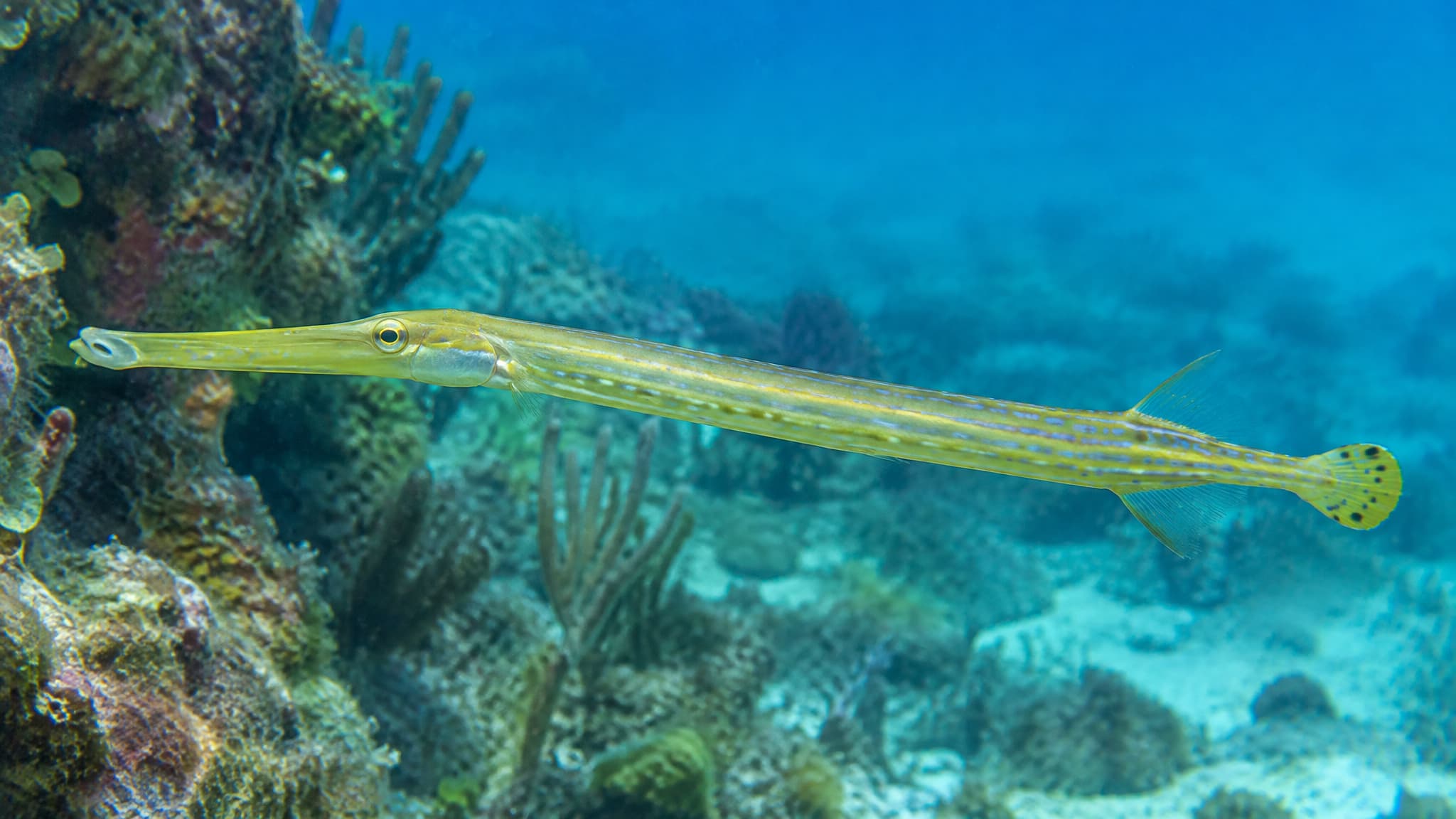
A West Atlantic trumpetfish swims horizontally above a coral reef, showing its elongated tubular snout, slender body, small fins, and rounded, spotted caudal fin.
The West Atlantic trumpetfish is a remarkably long, laterally compressed reef fish distinguished by its very long, tube-like snout and a small barbel beneath the chin. Its first dorsal fin consists of widely separated, short spines, while the soft dorsal and anal fins sit opposite one another near the rear of the body. The rounded tail usually shows two conspicuous dark spots at its base. Individuals are commonly 60 cm long, although records reach 100 cm total length.
Its coloration is highly variable: reddish-brown, gray-brown, or pale individuals may show light longitudinal lines and scattered dark spotting. This flexibility, combined with a habit of holding the body almost motionless and often head-down, makes the fish difficult to detect among gorgonians, corals, and other upright reef structures.
Aulostomus maculatus occurs in the western Atlantic, from southern Florida and Bermuda through the Gulf of Mexico and Caribbean to northern South America; records extend to Brazil. It is a marine, reef-associated fish of clear coastal waters, using coral reefs, soft-coral stands, rocky areas, and seagrass beds. It is most often encountered in shallow habitat, though it has been reported from deeper water.
A solitary carnivore, it ambushes small bony fishes and mobile crustaceans. It can stalk prey by blending with corals or by “shadowing” larger, non-predatory fishes—especially parrotfishes and tangs—using them as moving cover. At striking range, its mouth expands dramatically and produces rapid suction that pulls prey in. This makes the trumpetfish a mesopredator that helps link small reef fishes and crustaceans with larger reef predators.
The species is oviparous and has separate sexes; available references indicate pelagic eggs and larvae. Courtship includes color changes and a display often described as a dance, but many details of spawning, development, age at maturity, and longevity remain poorly documented. It is assessed as Least Concern globally in the cited conservation references, has minor local fishery and aquarium-trade use, and depends on the persistence of healthy coastal reef and seagrass habitats.