Banded Coral Shrimp
Stenopus hispidus
 AI-generated
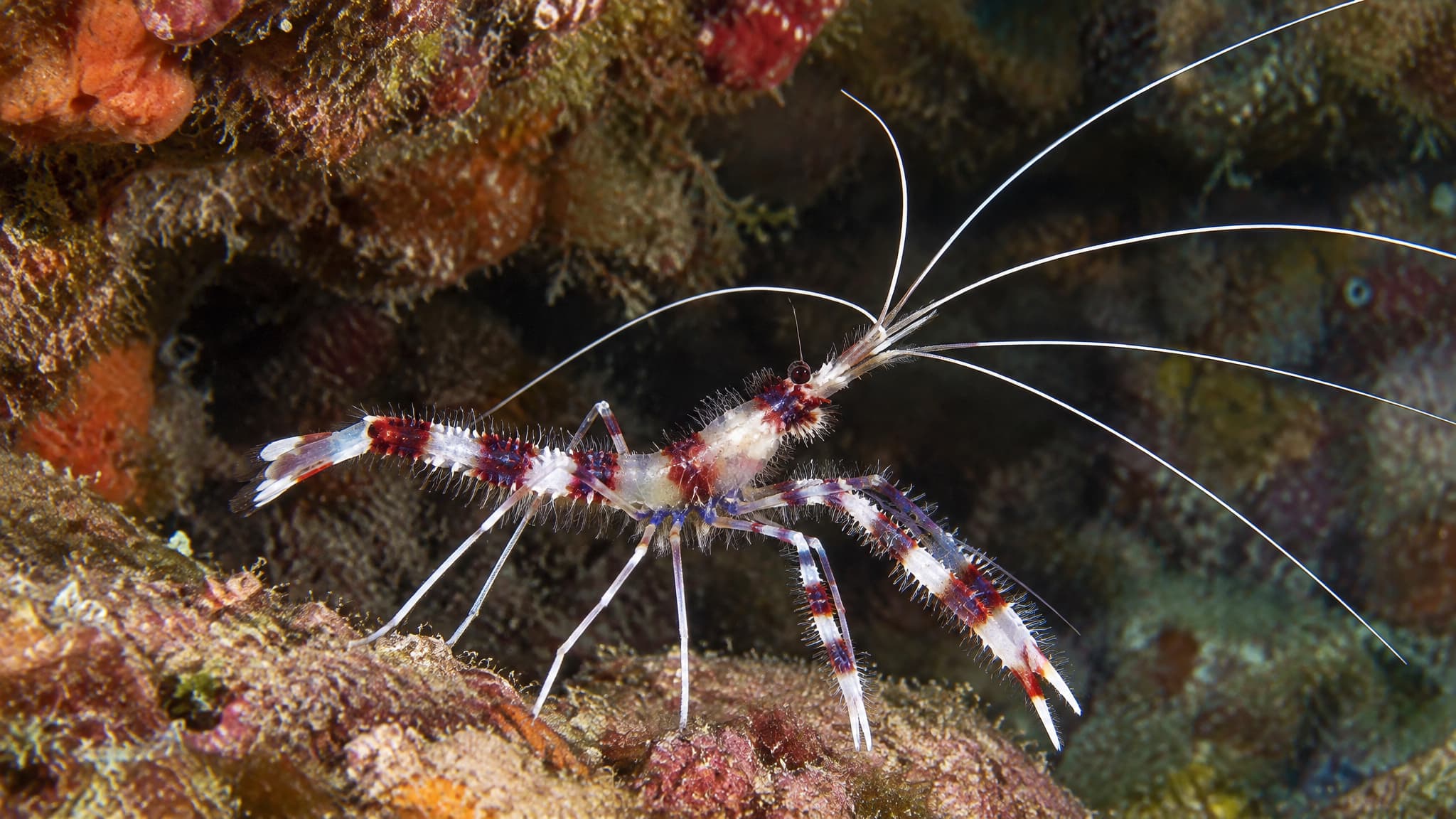
A banded coral shrimp rests side-on on a rocky coral reef, displaying its red-and-white banded body and legs, long white antennae, and spiny appendages.
The banded coral shrimp (Stenopus hispidus) is a small decapod crustacean of the family Stenopodidae, famous for its bold red-and-white stripes. The bands run across the carapace, the abdomen and the enlarged third pair of legs, which carry its big claws, and the red bands are sometimes edged in purple. Two pairs of long, white, hair-like antennae are longer than the body, while the other walking legs look partly translucent. The body and the large claws are covered in spines. Adults reach a total length of about 6 cm, and females are usually larger than males.
This shrimp has a pan-tropical distribution. In the Indo-Pacific it ranges from the Red Sea and southern Africa to Hawaii, the Tuamotu Islands and Easter Island, and in the western Atlantic from Bermuda and North Carolina through the Gulf of Mexico and the Caribbean to São Paulo in Brazil. It lives on coral reefs and rocky bottoms, sheltering in crevices, ledges and reef overhangs. It is most often seen at 2 to 4 m, but it has been recorded from 2 m down to 210 m.
The banded coral shrimp is a well-known cleaner. It perches at the entrance of its cave or ledge and slowly waves its white antennae to attract fish, turning the spot into a cleaning station. With its claws it picks off parasites, damaged tissue and leftover food from clients such as moray eels, tangs, grunts and groupers, and Brazilian researchers note that it even cleans sea turtles. Besides cleaning, it eats small arthropods, marine worms and other invertebrates. It is territorial and sedentary: each shrimp holds an area about 1 to 2 m across and rarely strays far from it.
The species is monogamous. Pairs often form when the shrimp are still juveniles and can stay together for years. The female mates soon after molting, and she carries her greenish eggs under her abdomen, attached to the swimmerets. At 28 °C the eggs hatch in about 16 days, usually at night, and breeding happens all year. The larvae drift in the plankton through 9 described larval stages and can delay settling until they find suitable habitat. Adults molt every 3 to 8 weeks, depending on food and temperature. Its lifespan in the wild is not well documented.
The species is not evaluated on the IUCN Red List. It was one of the first tropical marine animals imported for the aquarium trade and remains one of the most popular invertebrates with reef keepers. In Brazil, most specimens sold are wild-caught sub-adults and adults collected by divers in Rio de Janeiro, Espírito Santo, Bahia and Ceará. Poor holding conditions after capture cause high mortality, and its territorial temper makes captive breeding difficult.