Bargibant's pygmy seahorse
Hippocampus bargibanti
 AI-generated
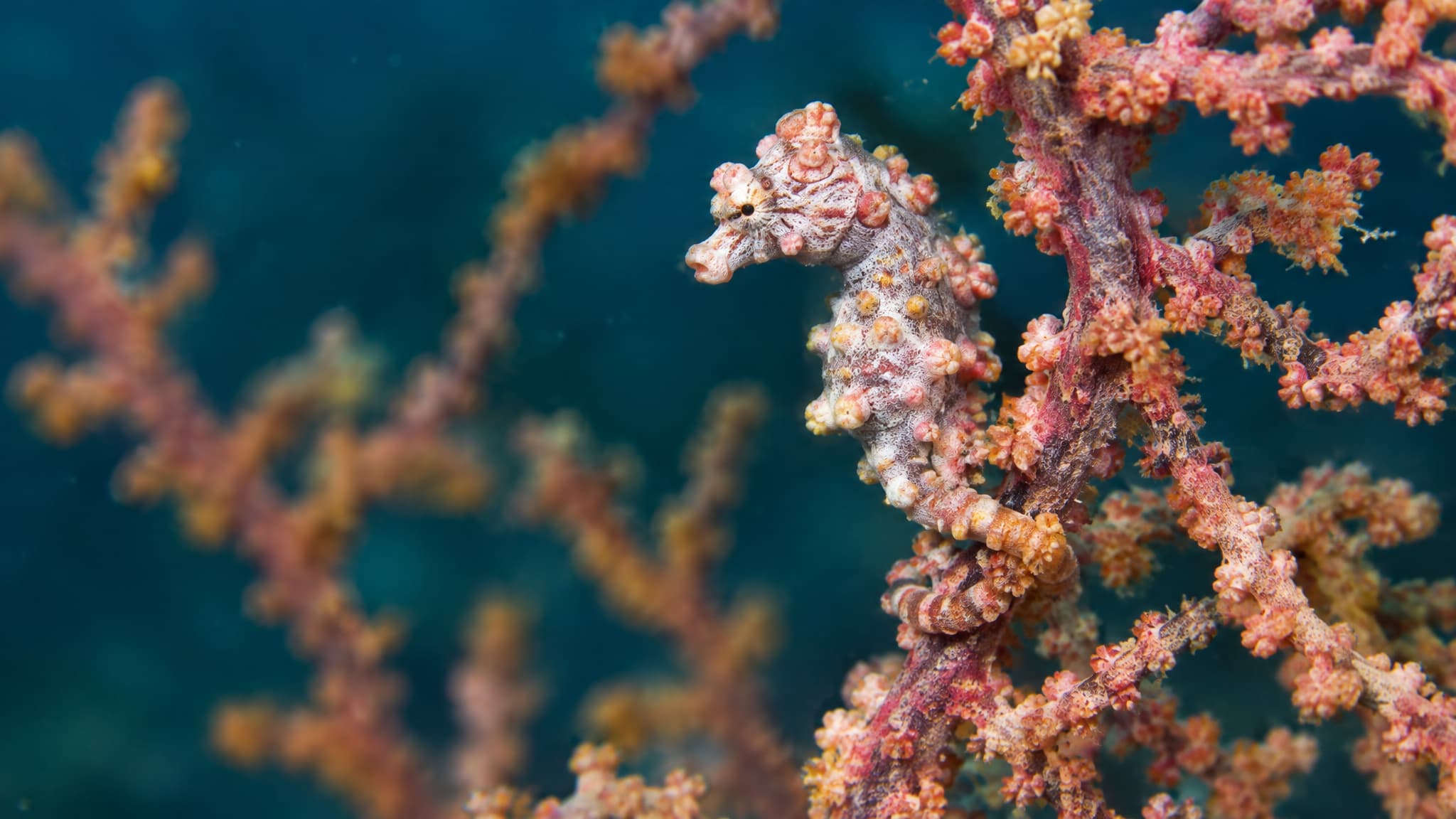
A Bargibant's pygmy seahorse clings upright to a branching pink-orange coral, with its curled tail wrapped around the branch and its tubercle-covered head facing left.
The Bargibant's pygmy seahorse (Hippocampus bargibanti) is one of the smallest seahorses in the world and the first pygmy seahorse to be described, named by Whitley in 1970. It usually measures under 2 cm and reaches at most about 2.4 cm, maturing at around 1.3 cm. Its fleshy head and body carry large, rounded tubercles, it has a very short snout and a long prehensile tail. Two colour forms are known: pale grey or purple with pink to red tubercles, and yellow with orange tubercles.
The species lives in the tropical Indo-West Pacific, from southern Japan through the Philippines and Indonesia to northern Australia, New Caledonia and Vanuatu. It is found on reefs and slopes at about 10 to 40 m, and breeding adults mostly occur deeper than 20 m. Adults live only on gorgonian sea fans of the genus Muricella, gripping the stem with the tail. The tubercles imitate the host's polyps so closely that the species was first noticed only after a gorgonian collected for study was examined in the laboratory.
Pygmy seahorses are usually seen in pairs or in small groups of pairs, and up to 28 pairs have been recorded on a single gorgonian. The relationship with the sea fan provides shelter and does not harm the host. Little is known about the diet; sources describe small crustaceans such as copepods and amphipods as the likely prey, possibly picked from among the host's polyps.
Breeding takes place all year. The pair is thought to be monogamous, and, as in other seahorses, the male carries the eggs in a brood pouch for about two weeks before giving birth. Broods of about 12 to 65 young have been reported, each only about 2 mm long, and one birth observed in the wild released 34 young. The newborns are dark miniatures of the adults and are independent from birth. Young fish may settle on several kinds of hosts, but breeding adults prefer red Muricella fans. Its lifespan has not been documented.
The IUCN Red List assesses the species as Least Concern (assessment of December 2023). Its total dependence on a few gorgonian species makes it vulnerable to coral reef degradation, climate change and destructive fishing. Like all seahorses, it is listed in CITES Appendix II, and Australian populations are legally protected. It has proved very hard to keep in captivity, where many specimens and their host corals have died.
Ideal water
The water this fish does best in, as kept in aquariums.
- Water type
- Marine
- Temperature
- 27–29 °C