Blue parrotfish
Scarus coeruleus
 AI-generated
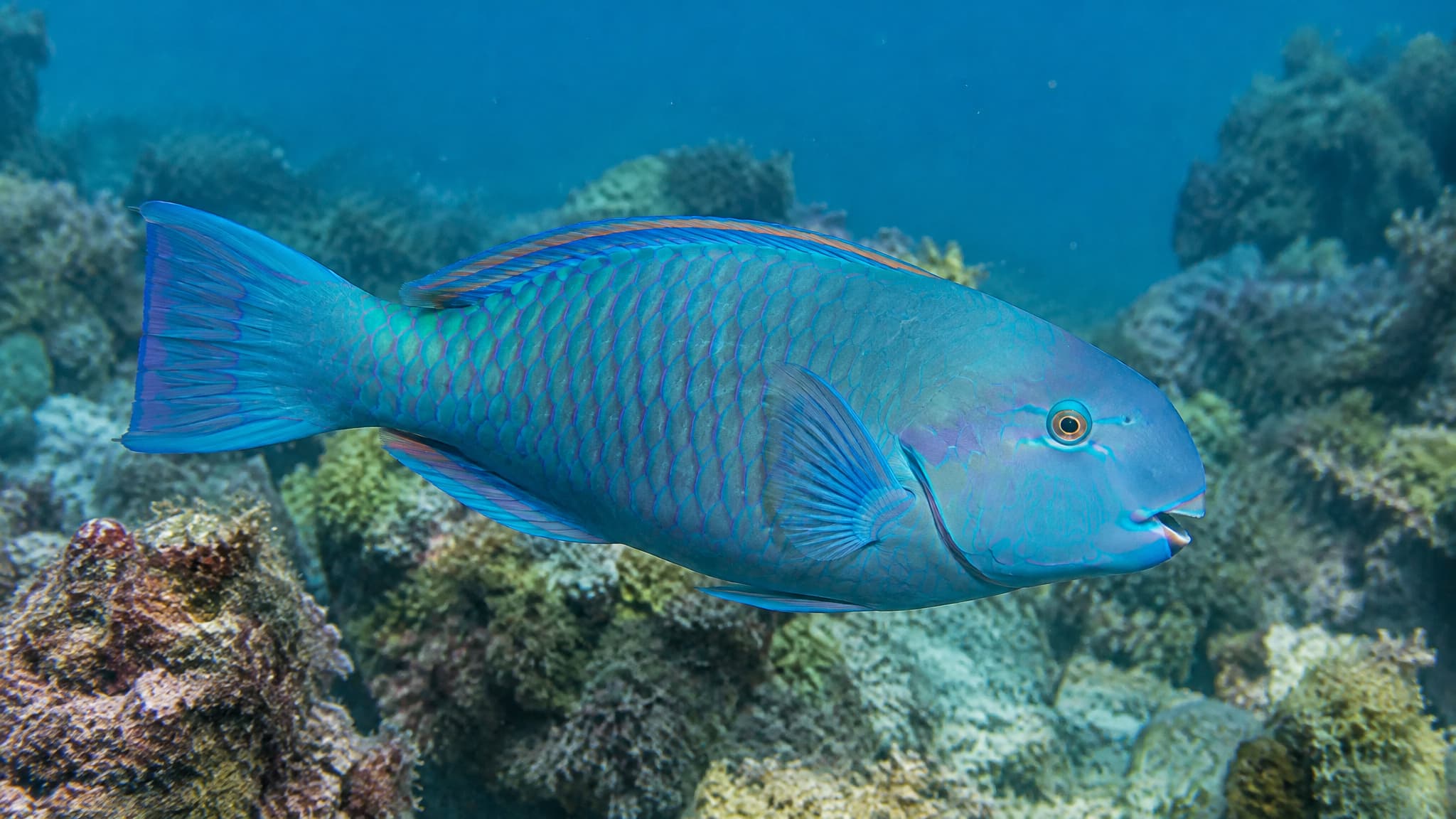
A blue parrotfish swims in side profile above a coral reef, showing a broad blue body, turquoise-edged scales, prominent eye, fins, and fused beak-like teeth.
Blue parrotfish
The blue parrotfish, Scarus coeruleus, is a large western Atlantic parrotfish recognized by its deep blue to greenish-blue adult coloration and its heavy, fused teeth. Those teeth form a conspicuous beak-like dental plate, used to bite and scrape food from hard reef surfaces. Juveniles are paler blue-grey and show yellow over the upper head and front of the back; this yellow pattern fades as they grow. Large individuals may develop a pronounced forehead hump and elongated tail-fin lobes. Reported maximum length reaches about 120 cm, although many adults are smaller.
It occurs from the southeastern United States and Bermuda through the Gulf of Mexico, Bahamas, Caribbean, and along the Atlantic coast of South America to Brazil. The species is closely associated with shallow coral reefs and other hard-bottom habitats; juveniles may also use seagrass beds, including Thalassia habitat. Shelter, reef structure, and surfaces bearing benthic algae are important features of its habitat.
This fish feeds chiefly by grazing and scraping benthic algae, while also taking small organisms associated with sand or reef surfaces. Its continual foraging makes it an important herbivore in reef food webs: by consuming algae, it contributes to the grazing pressure that can help keep reef surfaces available for other reef organisms. Like other parrotfishes, its beak and internal crushing structures are specialized for processing tough material collected from the bottom.
The species is oviparous, with external fertilization and no parental care. It is reported to be protogynous, meaning that some individuals can change sex from female to male, and it may form spawning aggregations; breeding pairs have also been recorded. A well-supported maximum lifespan is not established in the consulted references. Its global IUCN status is Least Concern, but local populations can still be affected by reef degradation, loss of seagrass or hard-bottom habitat, and fishing pressure.