Bluestreak Cleaner Wrasse
Labroides dimidiatus
 AI-generated
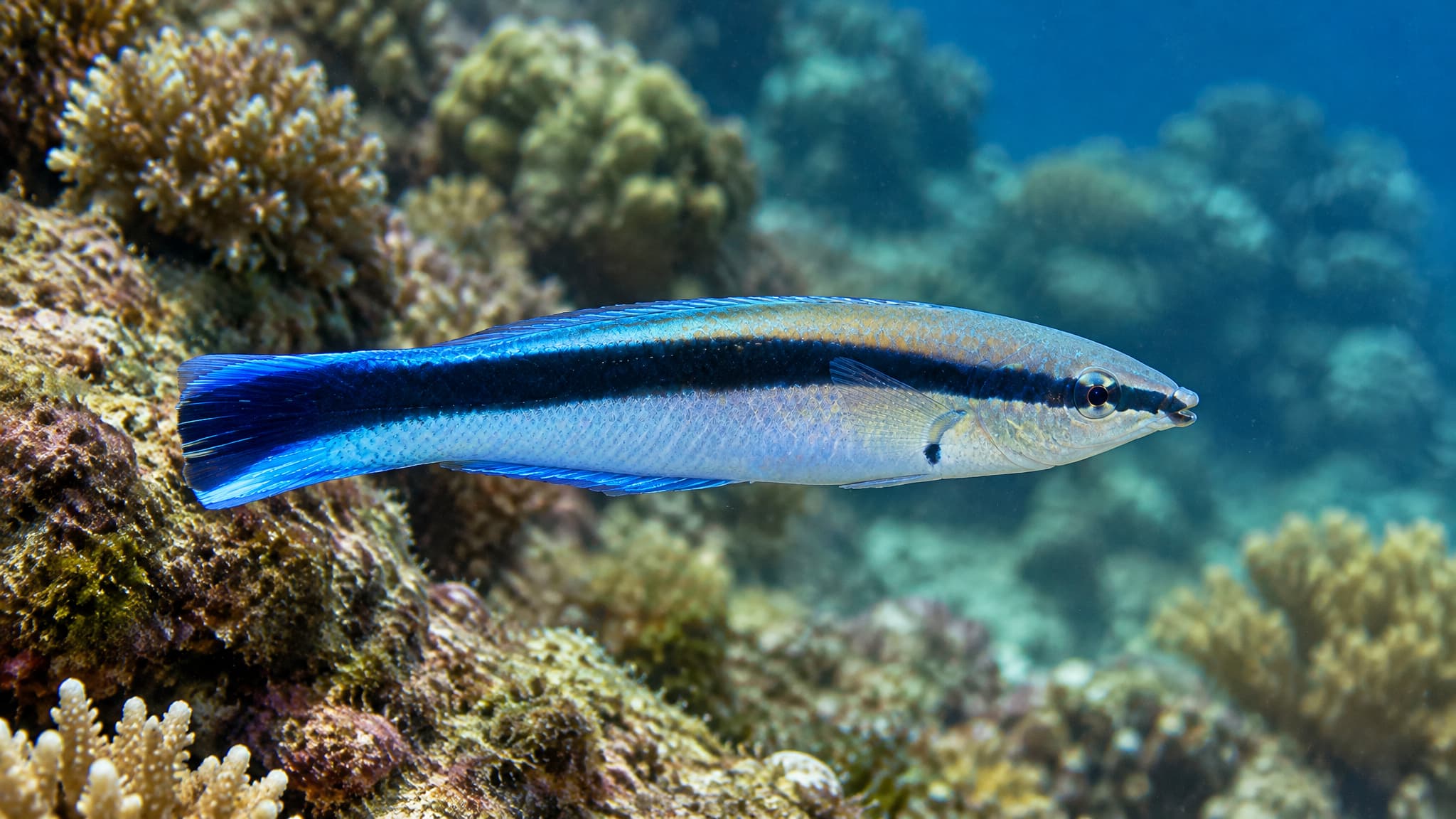
A Bluestreak Cleaner Wrasse swims horizontally to the right above a coral reef, showing its elongated body, blue-and-white coloration, dark lateral stripe, and translucent fins.
The bluestreak cleaner wrasse (Labroides dimidiatus) is a small, slender wrasse that grows to about 14 cm in total length. Adults are easy to spot. A bold black stripe runs from the tip of the pointed snout through the eye and widens into a wedge toward the tail. The forehead is greyish, the breast is white, and both shade into bright blue toward the rear. Larger adults may have a slight hook in the tail fin. Juveniles look different: they are mostly black with one neon-blue line along the back. The mouth sits at the very tip of the snout. This is the best way to tell it apart from its near-perfect mimic, the false cleanerfish (Aspidontus taeniatus), whose mouth is underneath.
The species lives across the Indo-Pacific, from the Red Sea and East Africa to French Polynesia, including the Great Barrier Reef. It favors coral-rich inner lagoons, subtidal reef flats and seaward reefs. It is usually found at 1 to 30 m but has been recorded much deeper, and it sometimes turns up in tide pools.
This wrasse is famous for its cleaning stations: fixed spots on the reef where other fish come to be serviced. Larger fish, including predators, hold still and open their mouths and gill covers. The wrasse picks off crustacean ectoparasites and also eats mucus and dead tissue. It swims in a distinctive bobbing, dancing way to attract clients. The relationship is a classic example of mutualism.
A cleaning station may hold an adult pair, a group of juveniles, or a harem of females with one dominant male. The species is a protogynous hermaphrodite: if the male disappears, a female can become a functional male within a few weeks, and sex change in both directions has been confirmed. It spawns in open water, releasing eggs that drift as plankton. The maximum reported age is about 4 years.
Cleaner wrasses matter to reef communities. Studies link their presence to greater fish diversity and better health among client fish. The IUCN lists the species as Least Concern, and it is common across most of its range. It is collected for the aquarium trade, but it often does poorly in captivity unless there are plenty of fish for it to clean.
In collections
Ideal water
The water this fish does best in, as kept in aquariums.
- Water type
- Marine
- Temperature
- 24–28 °C
- pH
- 8.1–8.4
- alkaline
- Carbonate hardness
- 8–12 dKH