Boeseman's Rainbowfish
Melanotaenia boesemani
 AI-generated
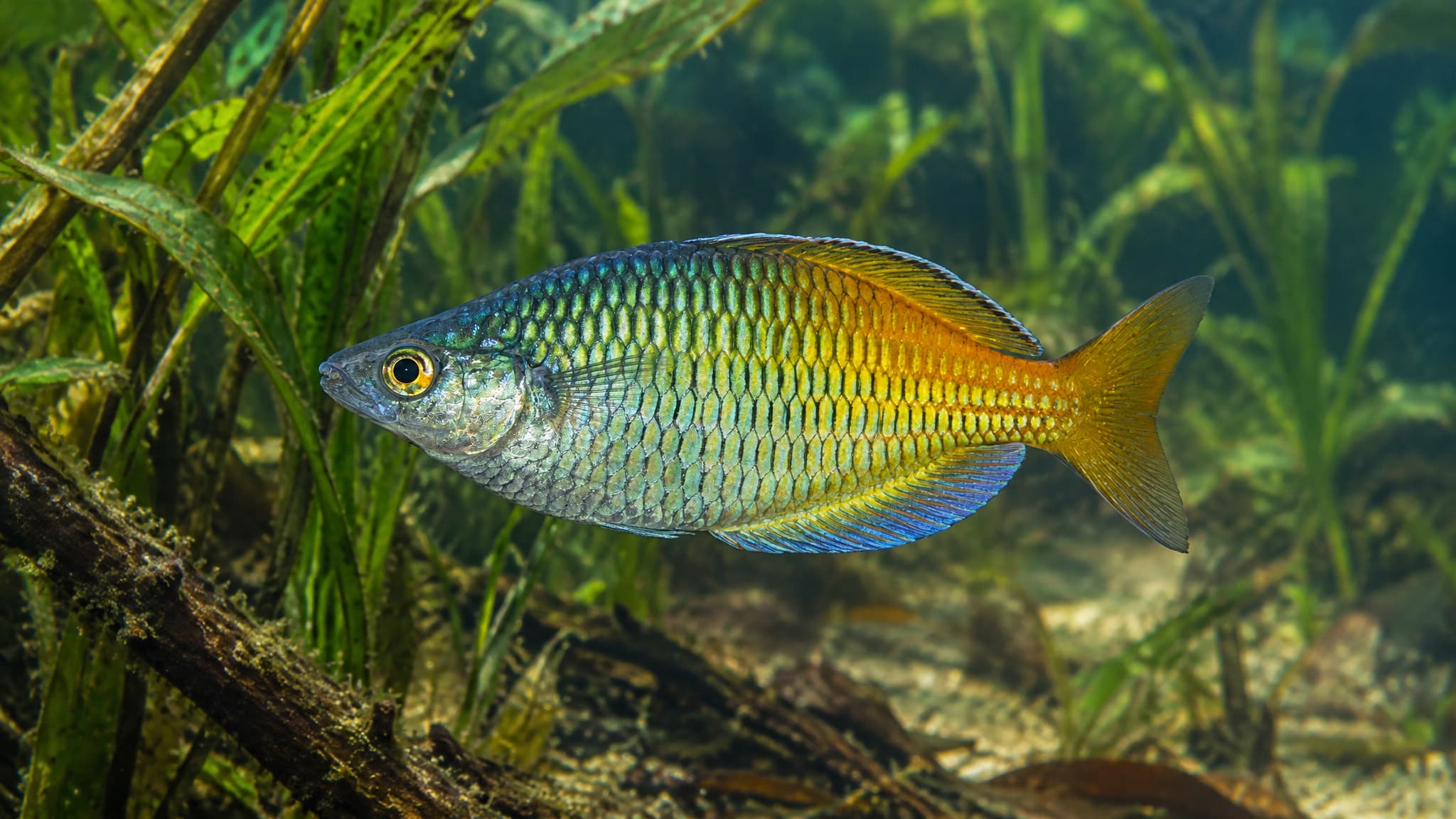
A Boeseman's Rainbowfish is shown in left-facing side profile, swimming among dense aquatic plants and submerged wood in a freshwater aquarium. Its body displays blue-green scales transitioning to golden yellow and orange toward the tail, with blue-edged fins.
Boeseman's rainbowfish (Melanotaenia boesemani) is a small, deep-bodied rainbowfish from western New Guinea, described by Gerald R. Allen and N. J. Cross in 1980 and named after the Dutch ichthyologist Marinus Boeseman, who collected the type specimens. Its colour pattern is unmistakable: the head and front half of the body are blue-grey to purplish, while the rear half is bright orange, with two or three slender dark bars marking the boundary. The fins are usually orange with white edges. FishBase gives a maximum of 9 cm standard length for males and 7 cm for females, although well-fed aquarium specimens can exceed 10 cm. Mature males are larger, deeper-bodied and more vividly coloured than females.
The species is endemic to the Ajamaru (Ayamaru) Lakes, nearby Lake Aitinjo and their tributaries on the Vogelkop (Bird's Head) Peninsula of West Papua, Indonesia. These are clear, alkaline lakes at the headwaters of the Ajamaru River, with dense aquatic vegetation. The fish gather in the shallow, weedy margins, and some populations also live in the small creeks that feed the lakes.
In the wild it is an omnivore that feeds near the surface on small insects, including ants, as well as algae and small crustaceans. It is a peaceful schooling fish but can be skittish, and males become more aggressive toward each other during breeding, when they flash a white patch on the head. Fry and juveniles shelter in vegetation, because adults will eat them.
Spawning takes place in the early morning, in pairs or groups, among plants. Females scatter small batches of about 10 to 20 adhesive eggs, which hatch after roughly 7 to 12 days depending on temperature. The newly hatched fry, about 4 mm long, first live on their yolk reserves. Wild lifespan is poorly known; in aquariums the species usually lives about 5 to 8 years.
Within its lakes, Boeseman's rainbowfish is both a consumer of insects and algae and prey for larger fishes such as grunters, snappers and cardinalfishes, as well as for water birds, especially during droughts. Local communities have also eaten it.
The IUCN Red List classifies the species as Endangered, mainly because its range is tiny and restricted to a few locations. Heavy collection for the aquarium trade drove its decline: in 1989 about 60,000 fish were reportedly caught and exported each month. Habitat degradation and introduced species add further pressure. Today most fish in the hobby are captive-bred, which reduces demand for wild stock.
Ideal water
The water this fish does best in, as kept in aquariums.
- Water type
- Freshwater
- Temperature
- 27–30 °C
- pH
- 7.0–8.0
- neutral to alkaline
- General hardness
- 9–19 dGH