Bronze Corydoras
Osteogaster aenea
 AI-generated
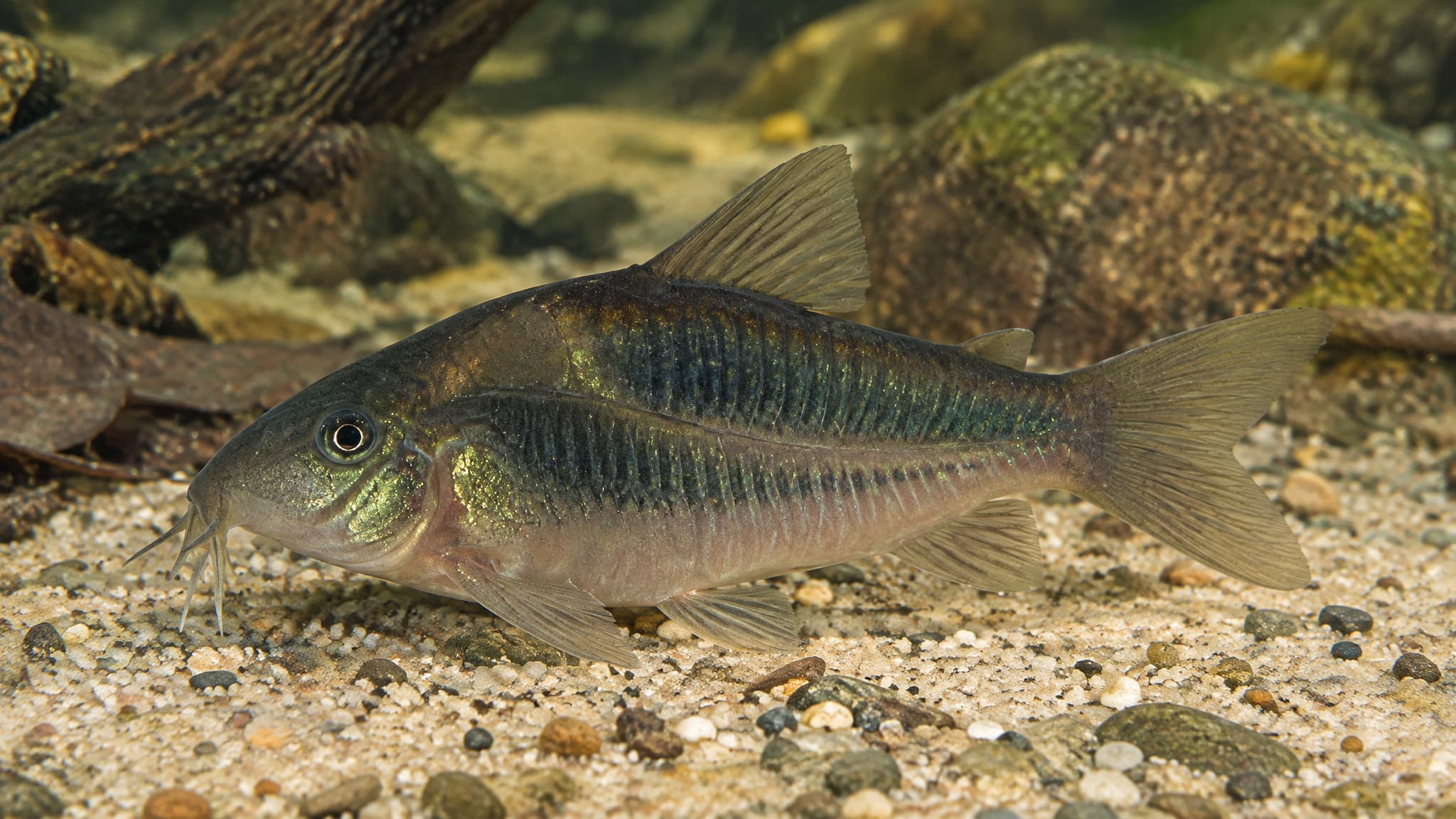
A Bronze Corydoras rests in side view on a gravel substrate in a rocky aquarium, with prominent barbels, armored body plates, and translucent fins visible.
The bronze corydoras (Osteogaster aenea), long known as Corydoras aeneus, is a small armoured catfish in the family Callichthyidae. In 2024, a phylogenomic revision of the subfamily Corydoradinae moved it to the resurrected genus Osteogaster. Adults reach about 7.5 cm, and females are slightly larger and broader than males. The body is protected by overlapping bony plates. Sharp spines in the dorsal and pectoral fins, together with barbels around the mouth, help identify it. Its colour is a metallic bronze-green with a pale belly, and an albino form is common in the aquarium trade.
The species was described from Trinidad and is reported east of the Andes from Colombia and Trinidad south to the Río de la Plata basin. Such a wide range has led researchers to suspect a complex of similar species, so the identity of populations outside Trinidad is uncertain. It mostly lives in quiet, shallow waters with soft bottoms, but it also occurs in running water and in clear or muddy pools.
This bottom-dweller sifts the substrate with its barbels for worms, crustaceans, insects and plant matter. It is social and gathers in schools of about 20 to 30 fish. It is a facultative air-breather: it gulps air at the surface and absorbs oxygen through its intestine, rising anywhere from once to 45 times per hour. This lets it survive in poorly oxygenated water.
In the wild, spawning begins when rainy-season water changes the water chemistry. During courtship the pair takes the 'T-position' typical of corydoras, with the female's mouth pressed against the male's genital area. She then places the adhesive eggs on plants, rocks or other surfaces and does not guard them. The eggs hatch in about five days. In captivity a female can lay large numbers of eggs, and aquarists report a typical lifespan of about three to five years.
As a scavenger of the river bottom, the bronze corydoras recycles organic matter and is prey for larger fish and other predators, which its locking spines help deter. It is one of the most widely traded aquarium catfish. It has been recorded as introduced in Hawaii, the Philippines and Mexico, but it is not reported as invasive there. The IUCN assessed it as Least Concern in 2018.
In collections
Ideal water
The water this fish does best in, as kept in aquariums.
- Water type
- Freshwater
- Temperature
- 25–28 °C
- pH
- 6.0–8.0
- acidic to alkaline
- General hardness
- 5–19 dGH