Common Toad
Bufo bufo
 AI-generated
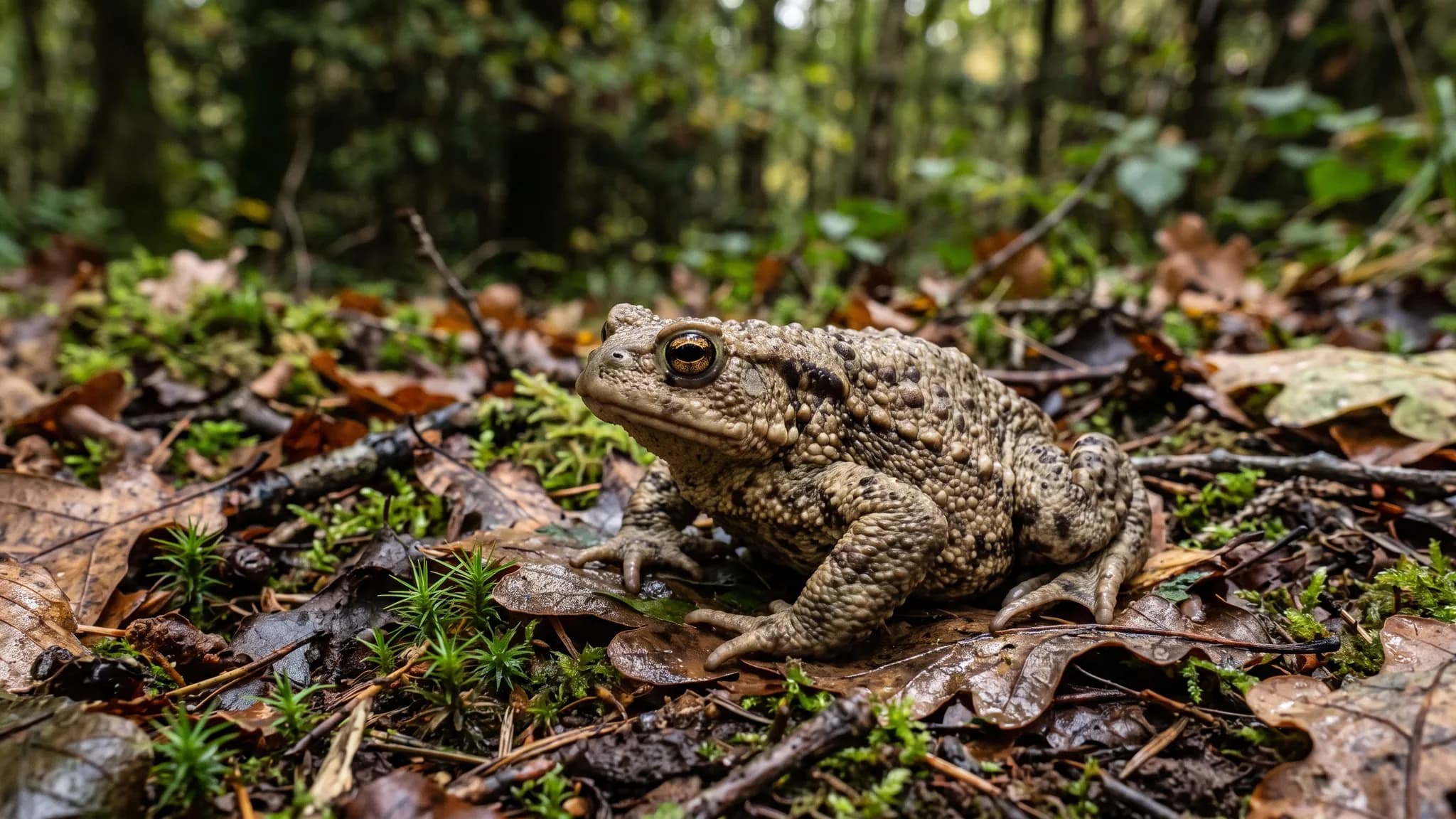
Common Toad on forest floor leaves.
Bufo bufo, widely known as the common toad or European toad, is a robust amphibian belonging to the family Bufonidae. It forms part of a complex of closely related toad species and is found extensively throughout most of Europe. Its geographic range also extends into the western stretches of North Asia and a small portion of Northwest Africa, though it is notably absent from Ireland, Iceland, parts of Scandinavia, and some Mediterranean islands.
This species is visually distinguished by its heavy-set body, short hind legs, and rounded snout. Its skin is characteristically warty and ranges in color from olive-brown to grayish or dark brown, allowing for excellent camouflage among soil and woodland debris. Due to its short legs, it generally moves with a slow, ungainly walk rather than hopping. As a primary defense mechanism, the toad secretes a noxious substance called bufotoxin from its skin and the prominent parotoid glands located behind its copper-colored eyes, rendering it highly unpalatable and deterring most predators.
Highly adaptable, the common toad occupies a diverse array of habitats, including woodlands, grasslands, heathlands, farmlands, and wetlands. Adult common toads are highly terrestrial, spending the daytime hiding under log piles, stones, or leaves, and hibernating during the winter months in solitary or group refuges. They are predominantly nocturnal, emerging at dusk to hunt. Their diet consists of invertebrates such as slugs, snails, spiders, insects, and earthworms, caught with a sticky tongue. Because they consume vast amounts of garden pests, they are highly beneficial to agriculture. Larger adult toads have even been documented consuming small vertebrates like grass snakes, slow worms, and harvest mice.
The reproductive cycle features a massive annual migration in early spring, usually taking place on the first warm, damp evenings of the year. Guided by a strong homing instinct, the toads return to their ancestral breeding ponds, which are generally larger and deeper than those preferred by frogs. Female toads lay their eggs in distinct, long double strings wrapped securely around aquatic vegetation. The developing tadpoles carry chemical toxins, a trait that protects them from the predatory fish that often inhabit these deeper ponds.
Globally, Bufo bufo is classified as a species of Least Concern on the IUCN Red List due to its expansive range and large overall population. However, populations in specific regions, such as the United Kingdom, have experienced noticeable declines in recent years. A primary threat to the species is habitat fragmentation and the intersection of busy road networks across their traditional migration routes. To combat the widespread road mortality of toads migrating to breeding pools, conservation initiatives like volunteer-led toad patrols and specialized wildlife tunnels beneath highways have been implemented.