Caribbean spiny lobster
Panulirus argus
 AI-generated
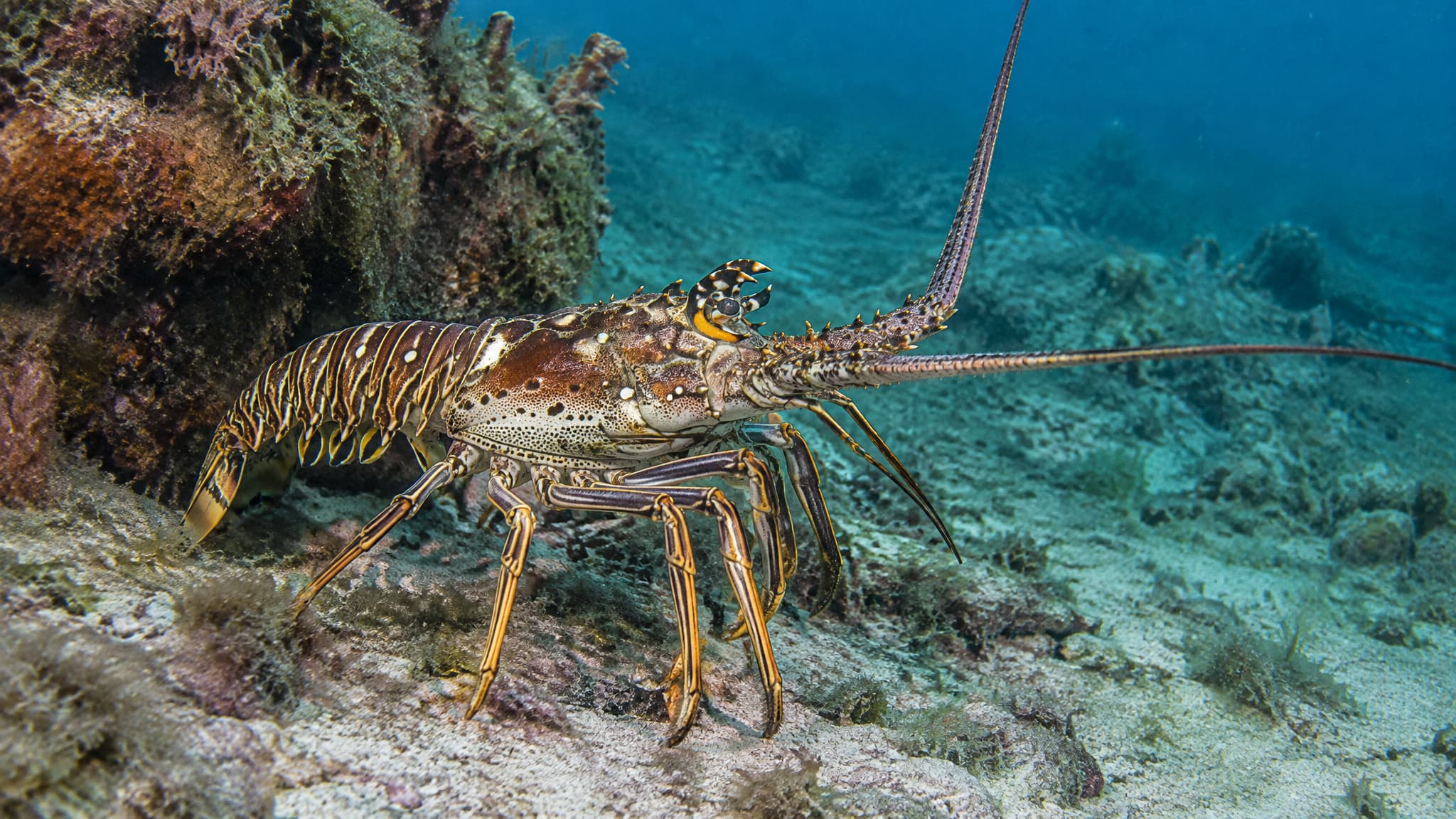
A Caribbean spiny lobster is shown in side view on a rocky coral-reef bottom, facing right. Its long antennae, spiny carapace, segmented abdomen, and numerous walking legs are clearly visible.
Caribbean spiny lobster
The Caribbean spiny lobster is a large, clawless marine lobster distinguished by its cylindrical, heavily spined shell, long whip-like antennae, and two conspicuous horns above the eyes. Adults are often reddish-brown, greenish-brown, or darker on the back, with pale sides and diagnostic pale yellow or white eyespots edged in dark pigment on the abdomen. Unlike the American lobster, it does not have oversized front pincers. It may reach about 45 cm in total length, though much smaller adults are more typical.
Panulirus argus occurs in the western Atlantic, from the southeastern United States and Bermuda through the Gulf, Caribbean, and tropical Atlantic coast of South America to Brazil. Its habitat changes dramatically through its life cycle: transparent, leaf-like phyllosoma larvae drift offshore in the plankton, while settling juveniles occupy algae-rich coastal nurseries. Larger juveniles shelter in crevices, sponges, octocorals, and holes; adults use reefs, rocky bottom, bays, estuaries, and seagrass habitats, generally in shallow water but down to roughly 90 m.
This is chiefly a nocturnal bottom-dweller. During daylight it remains concealed in dens, emerging at night to feed on snails, clams, crabs, and other benthic invertebrates. It is itself important prey for reef predators including groupers, snappers, sharks, turtles, and octopuses. Individuals can be social and conduct notable seasonal migrations, sometimes travelling in antenna-to-tail single-file lines toward deeper water when cold or turbid conditions develop.
Reproduction involves a male attaching sperm packets beneath a female; she releases eggs and carries the fertilized mass under her abdomen. Larger females can produce hundreds of thousands to more than two million eggs per spawning event, and the eggs hatch after about three weeks. The species passes through oceanic larval, swimming postlarval, juvenile, and adult stages. A lifespan of at least 15 years has been reported.
The Caribbean spiny lobster supports valuable commercial and recreational fisheries across much of its range. Fishing pressure, harvest of undersized or egg-bearing females, habitat degradation, and lost traps can pose risks locally. Its global IUCN category is Data Deficient, meaning the available information was insufficient for a full global extinction-risk assessment; however, size limits, seasonal closures, catch controls, and protections for egg-bearing females are used in parts of its range.