Cherry Shrimp
Neocaridina davidi
 AI-generated
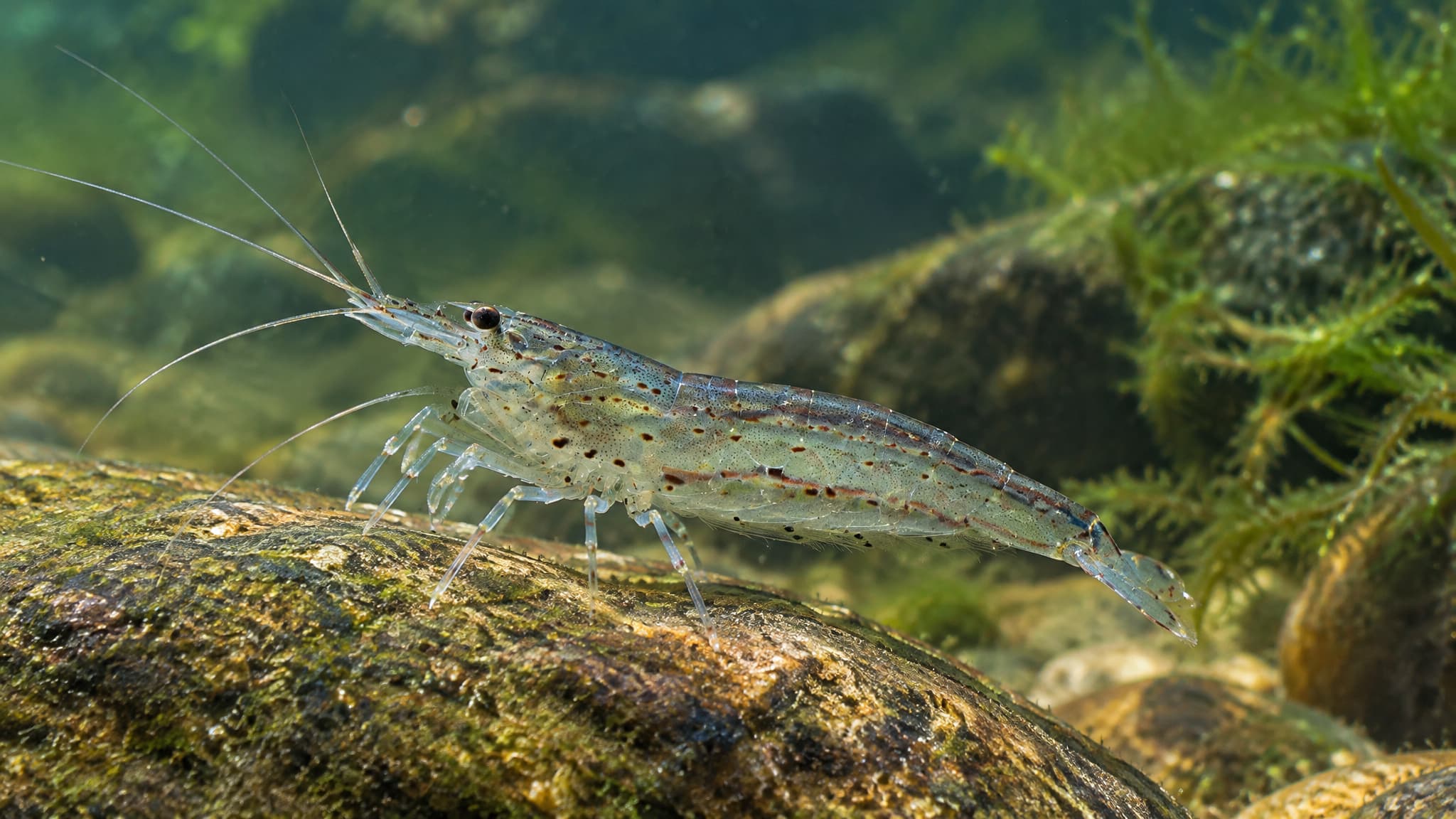
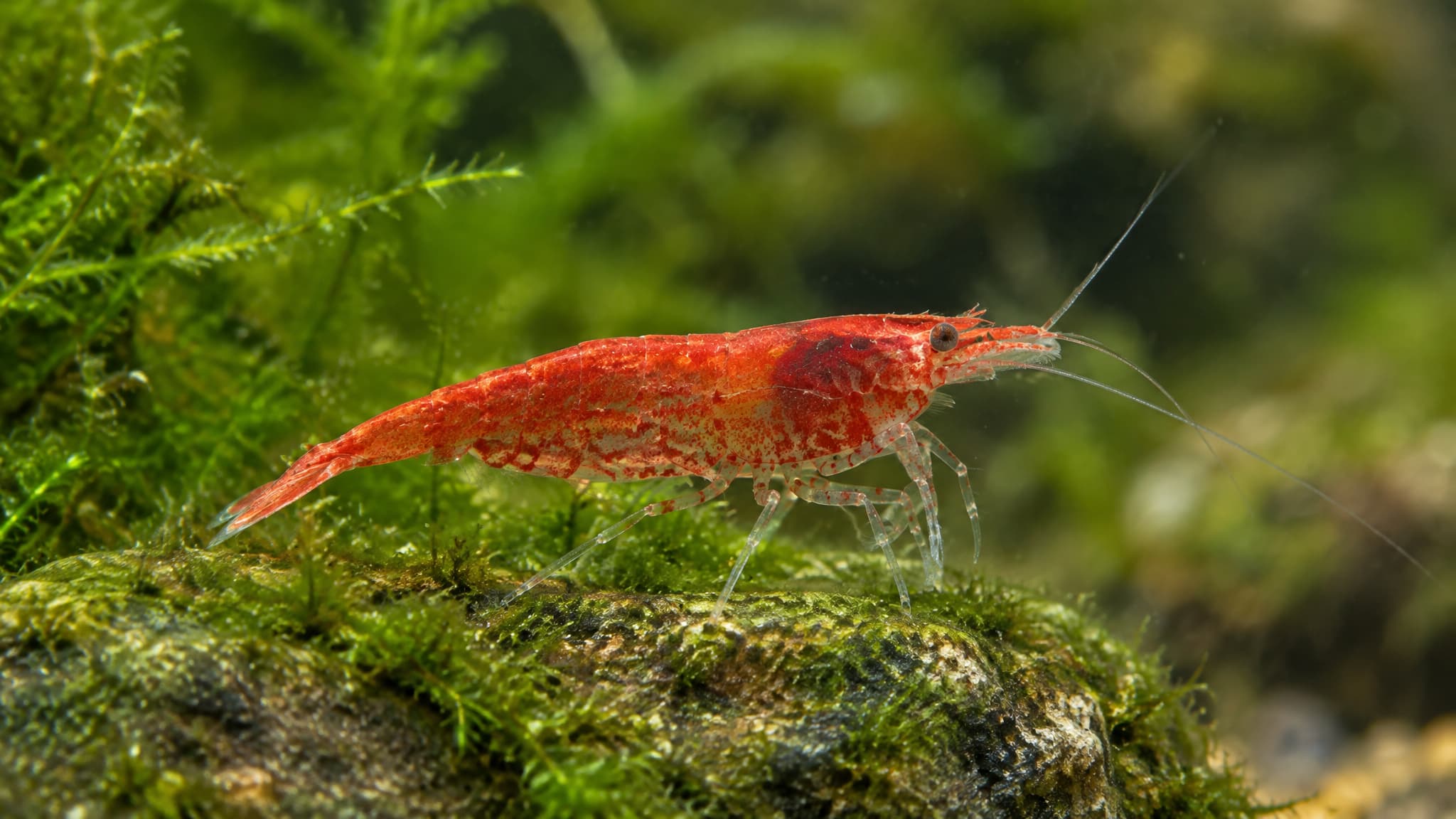
A red shrimp rests in side view on moss-covered rock, with long antennae, a segmented body, visible eyes, and translucent walking legs. The softly blurred green aquatic background suggests a planted aquarium setting.
The cherry shrimp (Neocaridina davidi) is a small freshwater shrimp of the family Atyidae and one of the most popular invertebrates in the aquarium trade. Wild-type animals are semi-translucent or a mottled greenish brown, but generations of selective breeding have produced red, orange, yellow, green, blue, black, white and striped forms, each sold under its own trade name. Adults reach a maximum length of about 3 to 4 cm, and females are larger and more richly colored than males, with a broader tail used to carry eggs. Like other decapods it has five pairs of walking legs, the first two ending in small claws for picking up food, and five pairs of swimming legs under the abdomen.
The species is native to the fresh waters of East Asia. Sources agree on Taiwan and mainland China, and some also list Korea and Vietnam, where it lives in streams, rivers, ponds and lakes; unresolved taxonomy within the genus makes the exact native range uncertain. Releases from aquariums have created wild populations far from home. On Oahu, Hawaii, it has been recorded since 1991 in streams, springs and reservoirs, and in Europe it is known mostly from thermally polluted waters, such as a canal of the Oder River in Poland and the Erft and Gillbach rivers in Germany.
The cherry shrimp is a peaceful, timid grazer that spends most of its time picking at the bottom. It feeds on biofilm, algae, detritus and decaying plant and animal matter, and studies of introduced populations found that it eats leaf litter, preferring alder and goat willow leaves. It also eats meiofauna, tiny bottom animals such as nematodes and rotifers, and it consumes its own shed exoskeleton to recover nutrients.
Females carry their eggs under the abdomen, where the swimming legs fan and clean them to prevent fungal growth. In a laboratory study, clutches held 43 to 60 eggs and incubation lasted 16 to 19 days. There is no free larval stage: the young hatch as miniature adults only 1 to 2 mm long, can reach sexual maturity in about a month, and adults may live 1 to 2 years.
In its habitat the shrimp recycles nutrients by feeding on decaying vegetation and serves as food for other aquatic animals. Where it has been introduced, it can reduce the abundance and biomass of meiofauna and may compete with native shrimp; the U.S. Fish and Wildlife Service rates its overall risk to the contiguous United States as high. The species has not been evaluated by the IUCN, and it is thought to number in the billions worldwide, mostly in aquariums.