Clown Loach
Chromobotia macracanthus
 AI-generated
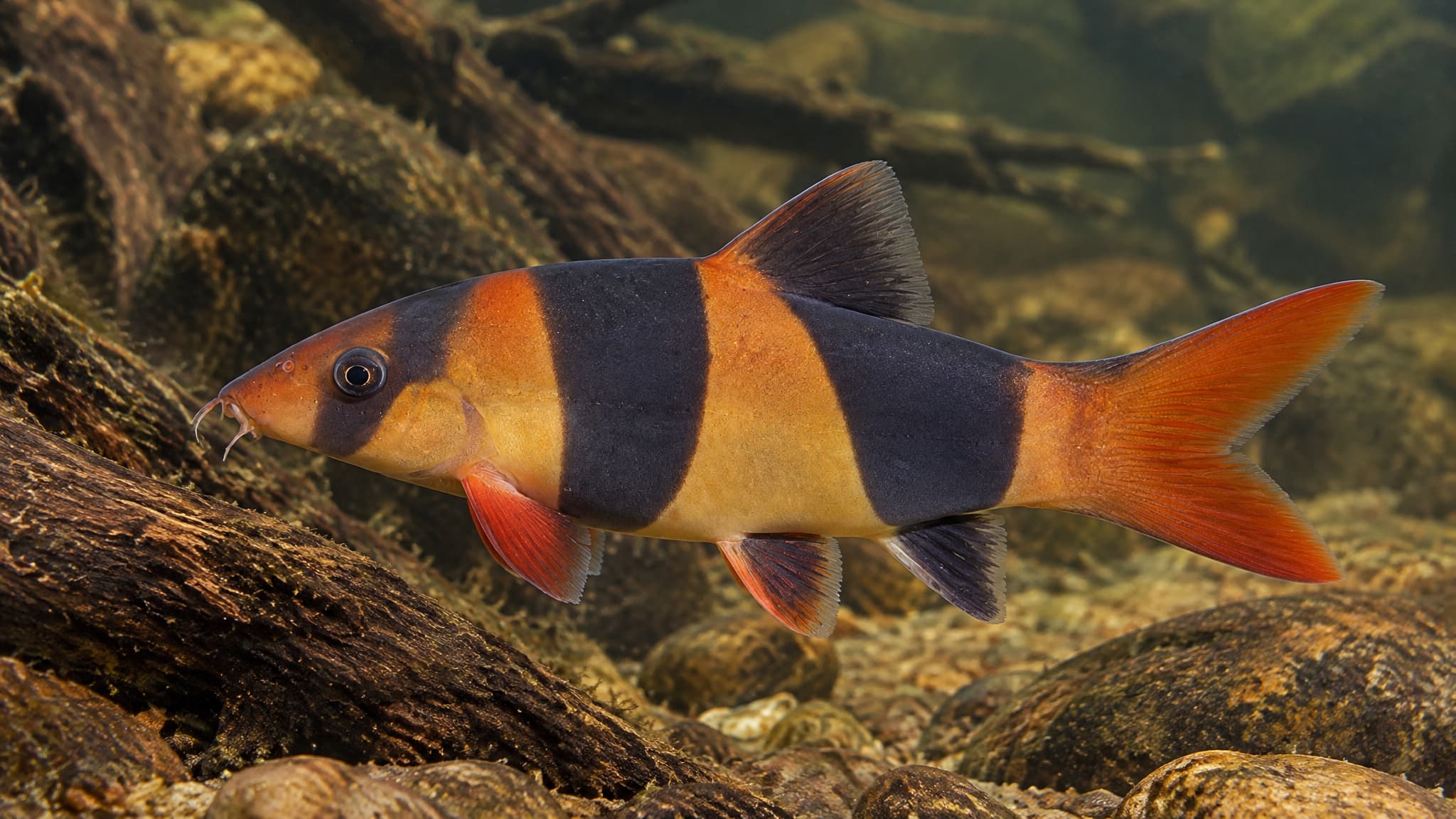
A clown loach is shown in left-facing side profile, swimming above driftwood and rounded stones in a clear freshwater habitat. Its orange-gold body has three broad black bands, red-orange fins, and visible facial barbels.
The clown loach (Chromobotia macracanthus) is a large tropical freshwater loach of the family Botiidae and the only member of the genus Chromobotia. Its torpedo-shaped body, oval in cross-section, is bright orange crossed by three broad black bars. This pattern has made it one of the most recognisable fishes in the aquarium trade. FishBase lists a maximum length of about 30.5 cm and a weight of up to 469 g, and some sources report wild fish approaching 40 cm.
The species is endemic to Indonesia, where it lives in the river systems of Sumatra and Borneo. Adults mostly stay near the bottom of main river channels, sheltering under rocks, submerged wood or in mud cavities. Juveniles are commonly found on floodplains. Many of its native rivers carry soft, tea-coloured water through rainforest, although much of that forest has been degraded.
Clown loaches are bottom-dwelling omnivores that eat worms, crustaceans and plant matter. This makes them mid-level consumers of invertebrates on the river bed. They are social fish, and in captivity they do best in groups of five or more, since lone individuals may become withdrawn. Their surroundings change with the seasons, because water flow, depth and turbidity rise sharply during the wet season.
Breeding is tied to the rains. At the start of the wet season, adults migrate upstream into smaller tributaries and temporarily flooded areas to spawn. They appear to mature at roughly 12–15 cm standard length. Natural spawning in home aquariums has not been confirmed, and commercial breeding in Indonesia and Europe relies on hormone treatment. The clown loach lives a long time, and well-kept captive fish often pass 20 years.
The IUCN Red List classifies the species as Least Concern. Even so, it is heavily harvested for the international ornamental trade, and this pressure on wild stocks has driven the development of artificial breeding techniques. Degradation of its rainforest rivers is a further concern. In aquariums it needs a very large tank and is especially prone to white spot disease (ich).
In collections
Ideal water
The water this fish does best in, as kept in aquariums.
- Water type
- Freshwater
- Temperature
- 25–30 °C
- pH
- 5.0–8.0
- acidic to alkaline
- General hardness
- 5–12 dGH