Common Mudpuppy
Necturus maculosus
 AI-generated
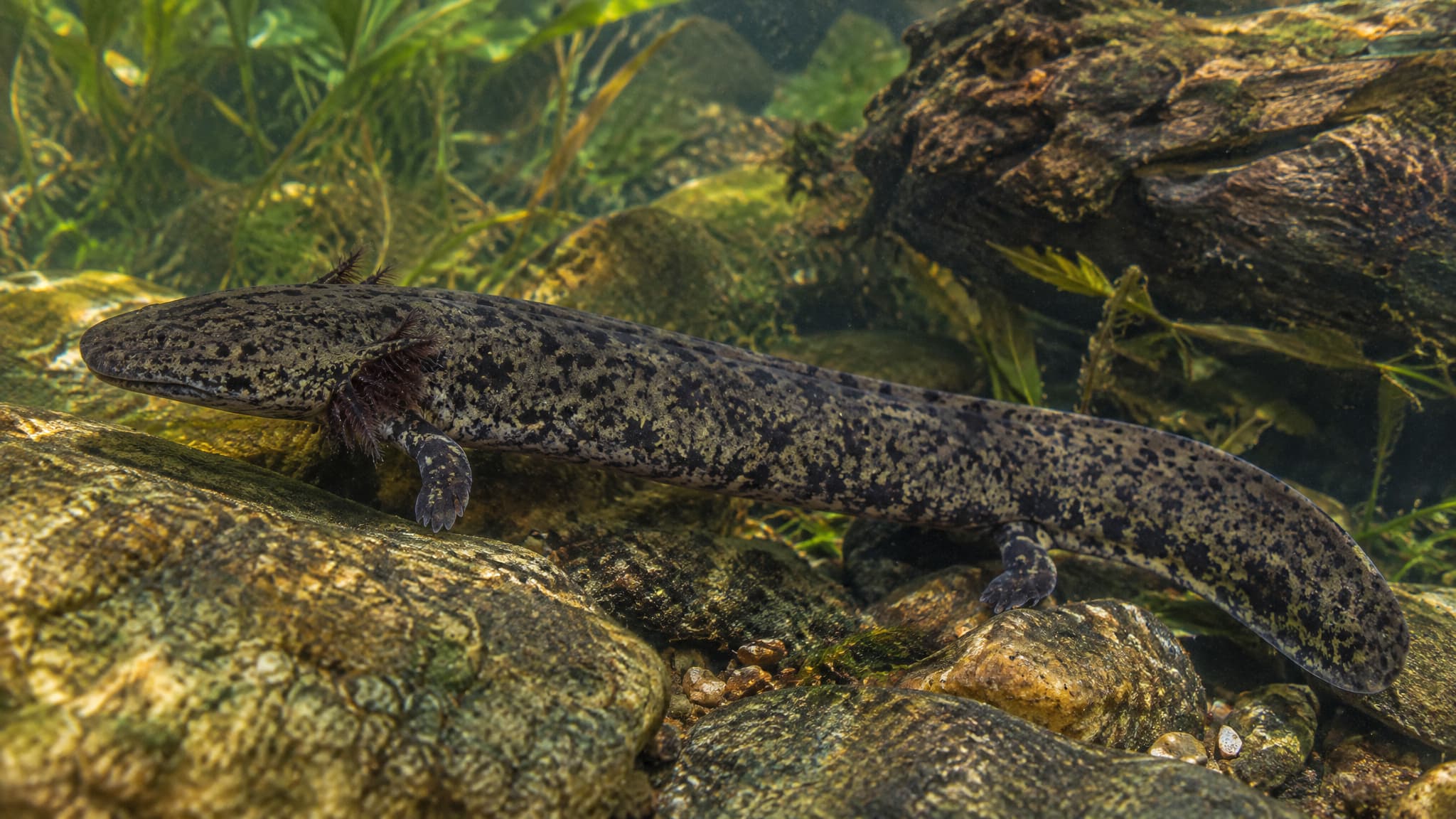
A Common Mudpuppy rests among rounded rocks in clear, plant-filled freshwater, shown in side view with its elongated body, spotted dark coloration, four limbs, and prominent feathery external gills visible. Its tail curves toward the lower right.
The common mudpuppy (Necturus maculosus) is a large North American salamander that spends its whole life in water. It is the largest member of its genus. Adults usually measure 20 to 33 cm, and some reach about 40 cm. The body is gray to rusty brown with scattered blue-black spots. It has a flat head, a tail flattened from side to side, short legs and four toes on each foot. Its best-known feature is a pair of bushy red external gills that it never loses.
The mudpuppy is neotenic: it keeps its larval body form throughout adulthood and never leaves the water. Its range runs from southeastern Manitoba to southern Quebec, and south to Missouri and northern Georgia. It lives in rivers, permanent streams, weedy ponds and some large lakes. It needs plenty of cover, so it shelters under rocks, logs and plants. It can be found in shallow water or as deep as 30 m, depending on the season.
The mudpuppy is mainly active at night, foraging along the bottom and hiding during the day. It is an opportunistic predator, and crayfish make up a large part of its diet. It also eats insect larvae, aquatic worms, snails, small fish, fish eggs and other amphibians, and it will scavenge carrion. Its common name comes from the popular belief that its squeaking sounds like a dog's bark.
Courtship and mating take place in autumn, or in winter in southern populations. Eggs are laid in late spring. The female digs a nest under a submerged rock or log, attaches the eggs one by one to the underside, and guards them until they hatch 1 to 2 months later. Clutches range from about 18 to 180 eggs. Mudpuppies take 4 to 6 years to mature and live about 11 years on average in the wild. One captive individual is recorded at 34 years.
As a bottom-dwelling predator, the mudpuppy links invertebrate prey such as crayfish to larger predators, including big fish, herons and water snakes. The IUCN lists it as Least Concern with a stable population. Even so, it is sensitive to water pollution and habitat degradation, which makes it a useful indicator of the health of freshwater ecosystems.