Common Pill Bug
Armadillidium vulgare
 AI-generated
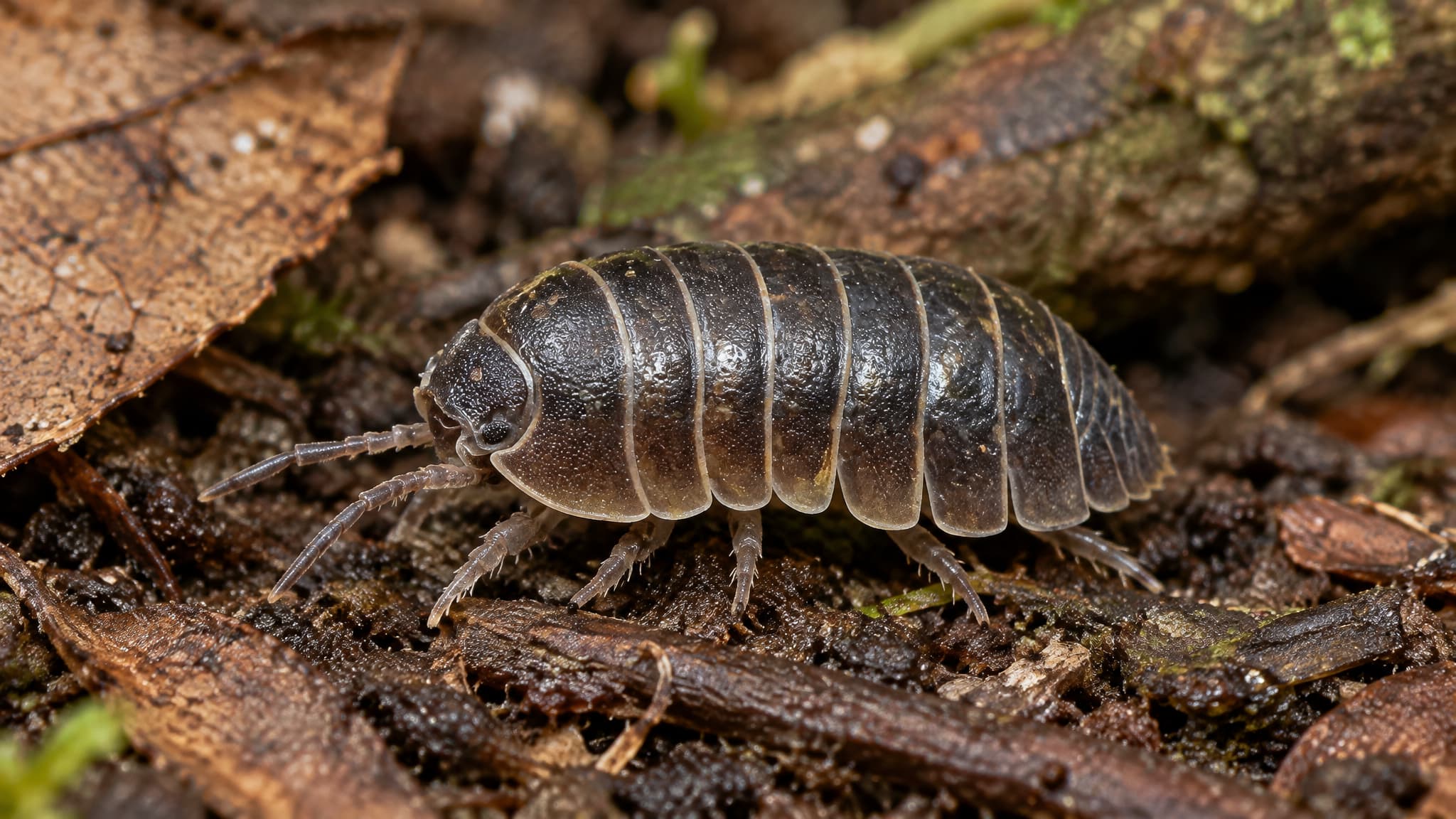
A dark, segmented pill bug walks in side view across damp leaf litter, with its antennae and several pairs of legs visible.
The common pill bug (Armadillidium vulgare), also called the pillbug, roly-poly or common pill woodlouse, is not an insect but a land-dwelling crustacean in the isopod order. Adults are oval, about twice as long as wide and usually around 10 mm long, reaching up to 18 mm. Most are dull dark gray, though some are brown or carry yellowish or reddish spots. The body has a seven-segmented thorax with one pair of legs per segment, and when disturbed the animal rolls into a tight ball, a habit that sets it apart from sowbugs, which cannot roll up.
Native to the Mediterranean edge of Europe, the species has been carried by people to nearly every landmass and is now considered cosmopolitan, with dense populations in temperate regions such as the United States, as well as records from South Africa, Australia, India and Madagascar. It lives in damp soil and on the ground surface, sheltering under stones, logs, mulch and fallen leaves in forests, fields, gardens, hedgerows, farmland and cities. It favors soil rich in organic matter with a neutral to alkaline pH and avoids tilled, waterlogged or acidic ground.
The pill bug is mainly a detritivore that feeds on decaying leaf litter and other dead plant material. It also eats roots, fruit, dung and occasionally seeds, and it may re-ingest its own feces or eat weak or molting companions. It is mostly nocturnal, avoids bright light and gathers in groups guided by pheromones, which helps it conserve moisture. Rolling up protects its soft underside and reduces water loss, although this defense does little against larger predators such as birds.
Mating is seasonal, typically from late spring to early summer, and females can store sperm from several males. Eggs develop in a fluid-filled brood pouch, the marsupium, on the female's underside; broods usually contain about 100 eggs, though counts from 6 to 300 have been recorded. The young hatch as miniature adults called mancas, lacking the last pair of legs, which they gain through successive molts. Sexual maturity comes at about one year. Sources differ on lifespan: Animal Diversity Web reports about 1.5 to 2 years in the wild, while a University of Florida fact sheet states that adults can live two to five years.
By shredding leaf litter, pill bugs speed up decomposition and return nitrogen, phosphorus and potassium to the soil. They are prey for ground spiders of the genus Dysdera, birds such as the common starling, and certain ants, and they host parasites including a worm that makes infected individuals wander into the open. Large populations can nibble seedlings and garden crops, but the species is generally regarded as beneficial and only an occasional minor pest. It has not been assessed by the IUCN and faces no known conservation concern.