Common Shiny Woodlouse
Oniscus asellus
 AI-generated
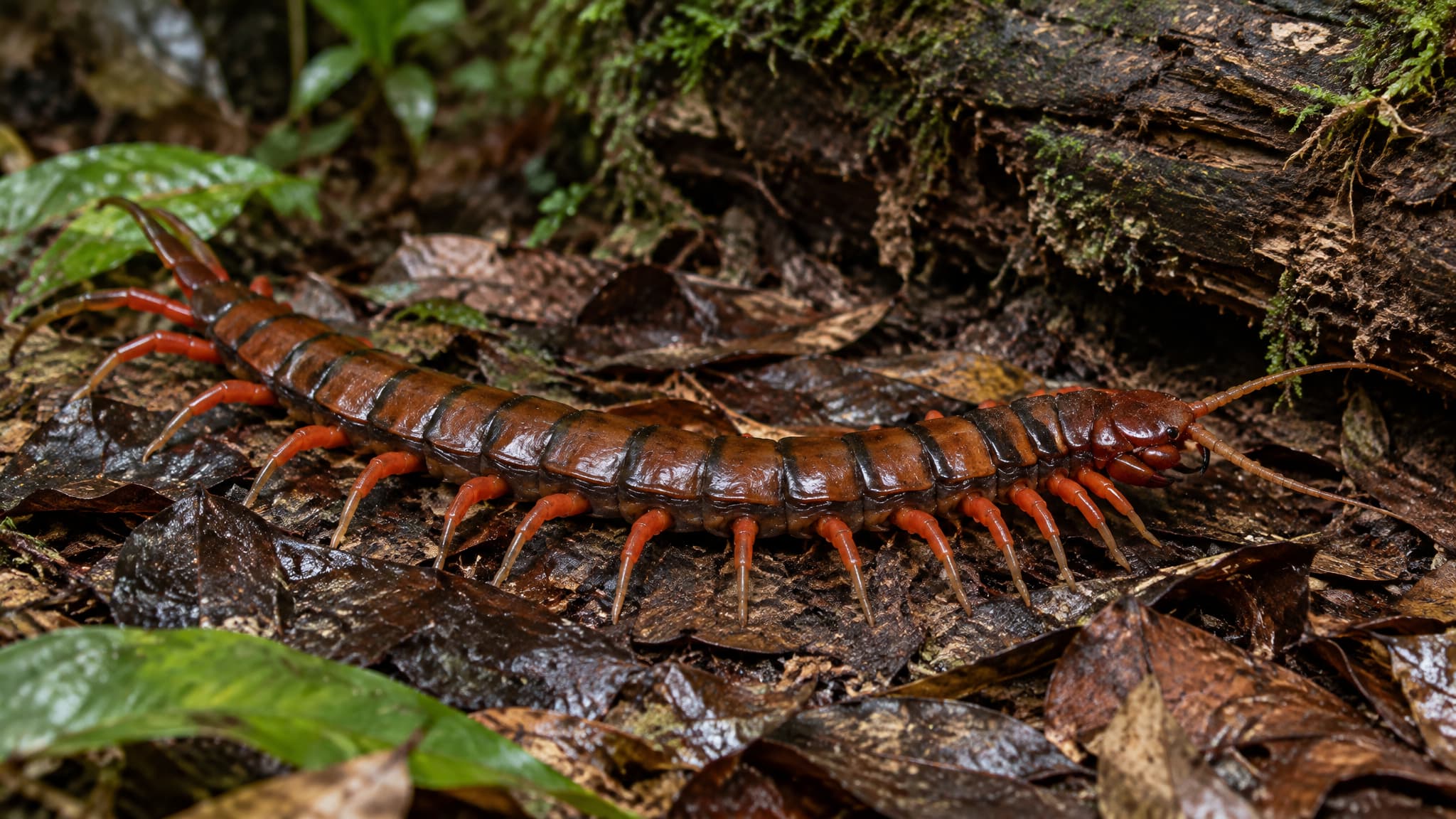
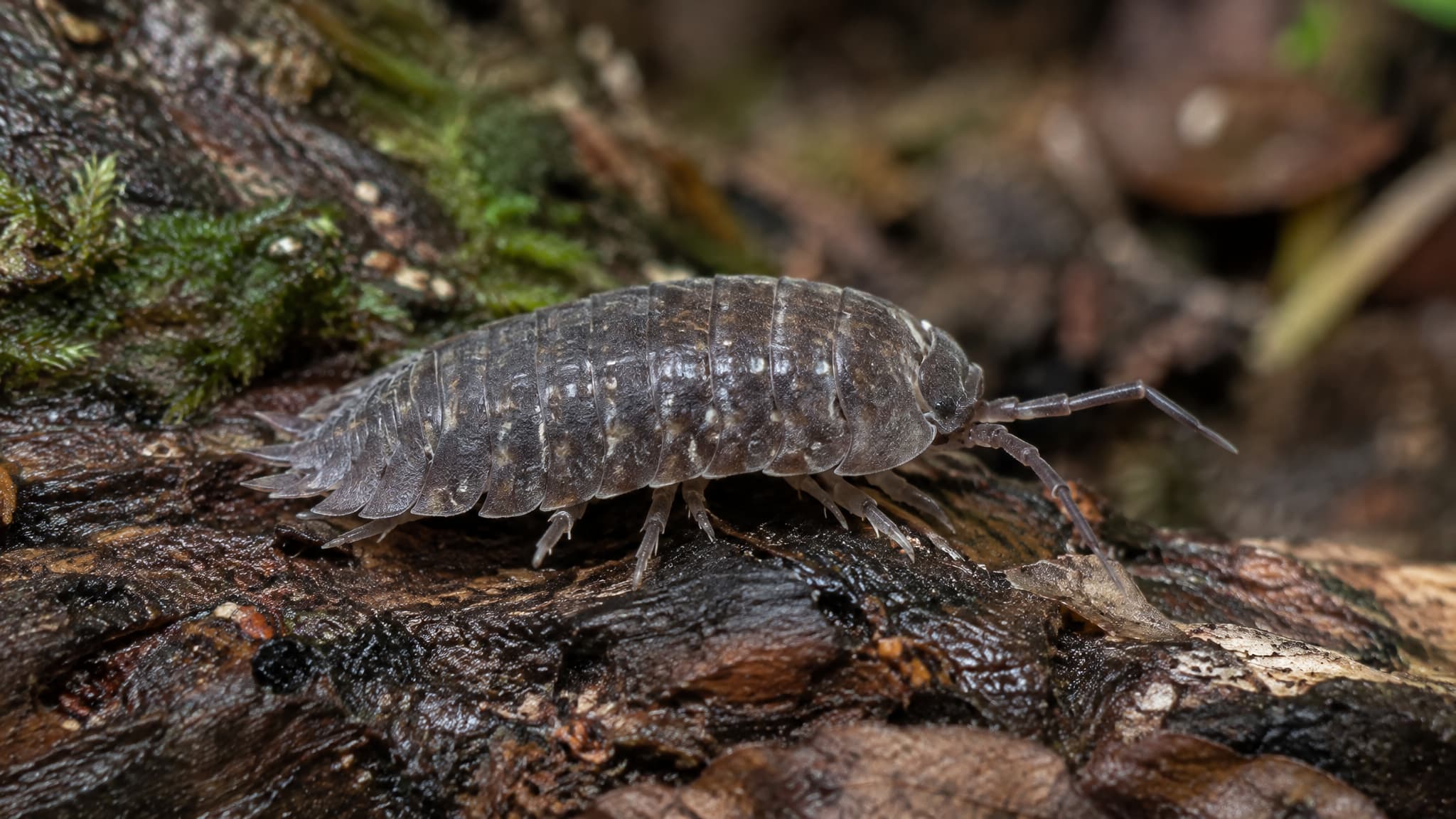
A Common Shiny Woodlouse is shown in side profile walking across damp, moss-covered decaying wood. Its dark, glossy body has overlapping armored segments, numerous visible legs, and long antennae.
The common shiny woodlouse (Oniscus asellus) is one of the largest and most familiar woodlice of Western and Northern Europe, often described as the archetypal woodlouse. It is a land-living crustacean of the order Isopoda, not an insect. Adults reach about 16 to 18 mm in length and around 6 mm in width, with a broad, flattened body whose smooth, glossy surface sets them apart from rougher relatives. They are usually grey or brownish grey with irregular pale patches and paler edges to the body plates; these pale patches store calcium used to harden the new exoskeleton after a moult. The tip of each antenna has three segments, the animal lacks the white pleopodal "lungs" seen in Porcellio scaber, and it cannot roll into a ball.
Juveniles look rather different from adults: they are rough and bumpy with orange markings, and small ones are often mistaken for the common rough woodlouse. Young woodlice also hatch with only six pairs of legs and gain the seventh pair as they grow.
The species is native from Portugal to Sweden and east to Ukraine, is less common around the Mediterranean, and also lives in the Azores and Madeira. It has been widely introduced to the Americas, mainly Mexico and the United States. In south-west Britain and western France it is partly replaced by the genetically distinct subspecies O. a. occidentalis, which hybridises with the common form where they meet.
It is found in almost every habitat as long as conditions are damp, including woodlands, hedge banks, meadows, coastal cliffs, waste ground, parks, gardens and even damp houses and outbuildings. It stays near ground level under logs, stones and bark, in leaf litter and compost heaps, and is especially at home in rotting wood. It avoids dry places but tolerates acid soils. Mostly nocturnal and active all year, it finds dead organic matter, chiefly decaying plants and wood, by taste and smell. When disturbed it tends to cling tightly to the surface instead of running away.
Mating usually happens at night: the male climbs onto a receptive female's back, drums her with his front legs and licks her head with his mouthparts. Females carry their eggs in a fluid-filled brood pouch formed by overlapping plates under the body, and the young leave it once fully developed. As an efficient decomposer the woodlouse helps recycle nutrients, and it is food for toads and newts. It also accumulates heavy metals such as lead, cadmium, copper and zinc in its digestive gland, which has made it useful as an indicator of pollution. It remains abundant and is listed as Least Concern in Great Britain.