Dyeing poison frog
Dendrobates tinctorius
 AI-generated
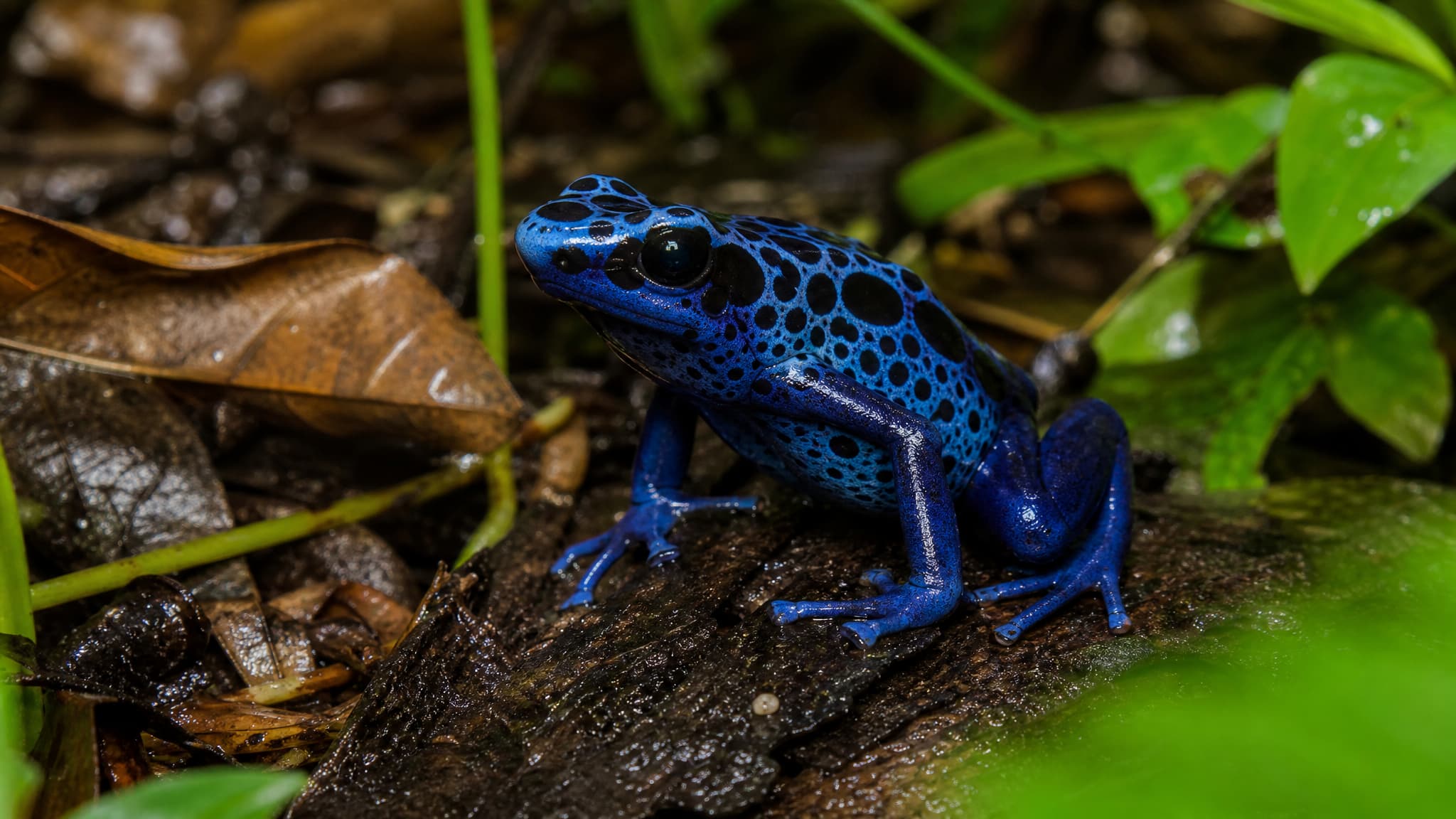
A dyeing poison frog crouches on a wet fallen log amid leaf litter and lush vegetation. Its bright blue skin is covered with irregular black spots, and its large dark eyes and slender limbs are clearly visible.
Dendrobates tinctorius, the dyeing poison frog, is a relatively large, day-active poison frog of the Guiana Shield. Adults are typically about 3.7–5.3 cm long, while females are generally larger than males. Its appearance is exceptionally variable among and within populations: blue, black, yellow, white, and irregular spots or bands can occur in many combinations. These conspicuous colors function as warning coloration, advertising skin alkaloids that make wild frogs unpalatable to many predators.
The species occurs in lowland forests of Guyana, Suriname, French Guiana, and adjacent northern Brazil, chiefly from sea level to roughly 600 m. It uses humid tropical forest, especially leaf litter, fallen wood, buttress roots, and recently opened tree-fall gaps. Although sometimes seen climbing on vegetation, it is primarily a terrestrial forest-floor frog. Its moisture-dependent skin makes persistently humid microhabitats important.
Adults actively hunt small arthropods, particularly ants and mites, along with termites, other insects, and spiders. Dietary compounds are associated with the alkaloids found in its skin, so captive frogs fed different prey may not possess the same chemical defenses as wild individuals. By preying on invertebrates and, as tadpoles, consuming detritus and aquatic larvae, the species links forest-floor and tiny water-pool food webs.
Breeding takes place on land. Small clutches are laid in sheltered places such as leaf litter, logs, or plant structures; the male attends the eggs and later carries newly hatched tadpoles on his back to water-filled tree holes, palm bracts, or other small pools. Tadpoles develop there for about two months and may be predatory, including on other frog larvae or conspecific tadpoles. The species is assessed as Least Concern, but habitat loss, localized collecting for trade, and chytrid-fungus infection remain concerns. It is listed in CITES Appendix II. Captive individuals can live up to about 15 years.