Lesser Treefrog
Dendropsophus minutus
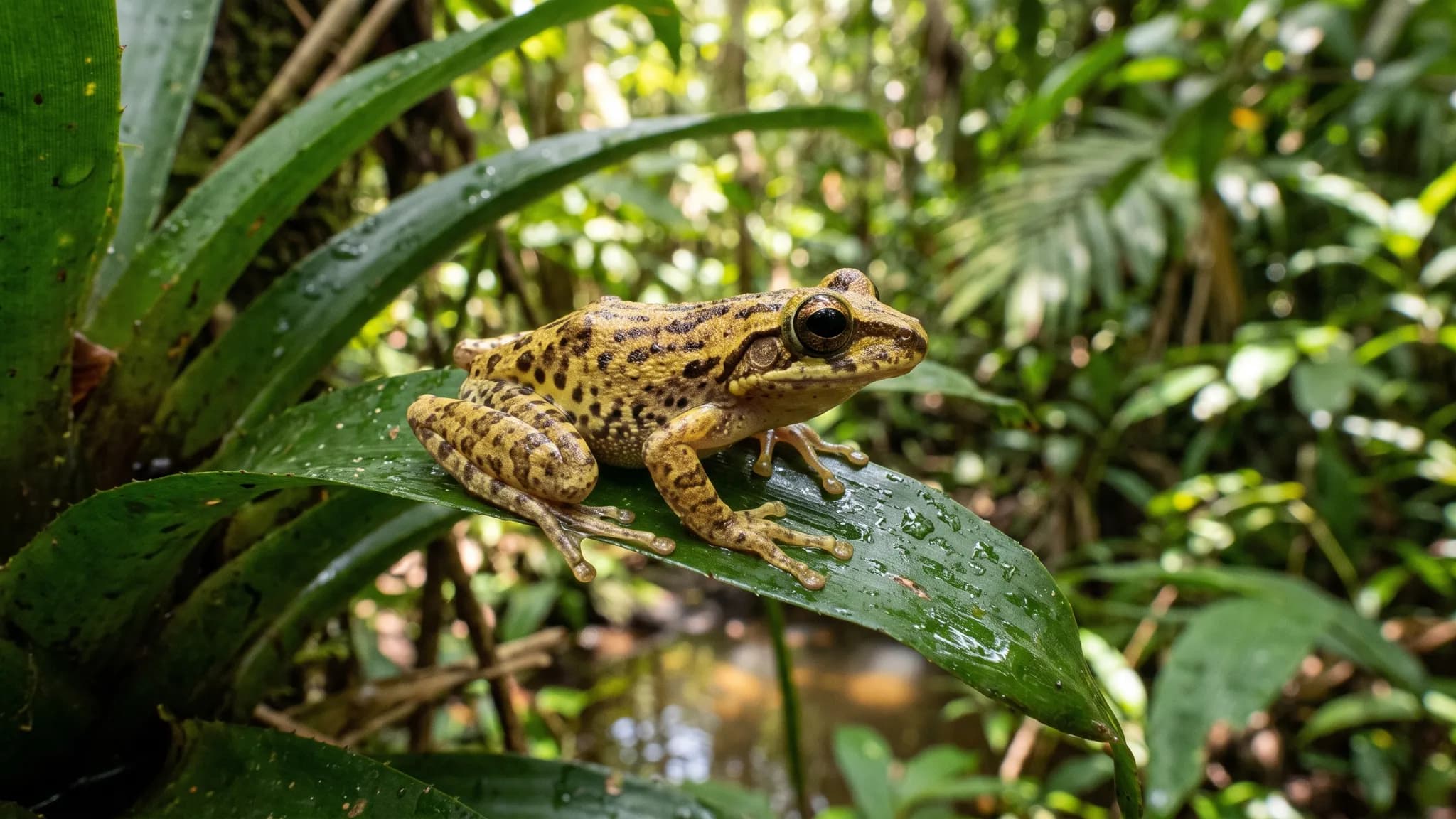 AI-generated
A yellowish treefrog with dark spots resting on a wet green leaf.
Dendropsophus minutus, commonly known as the lesser treefrog, is a small and highly adaptable species of tree frog within the family Hylidae. Characterized by a short head, a rounded snout, and an indistinct tympanum, these frogs exhibit distinct sexual dimorphism; males possess bright yellow throats while females have white ones. Their dorsal coloration is highly variable, ranging from shades of orange and brown to tan, often accented by intricate dorso-lateral stripes referred to as "hourglass" or "bivittata" patterns. Interestingly, recent studies indicate that their coloration is influenced by habitat, with individuals in open grasslands displaying much higher color saturation than their forest-dwelling counterparts.
This species boasts an exceptionally broad geographic range across the Neotropics, occurring east of the Andes. Its distribution spans across Argentina, Bolivia, Brazil, Colombia, Ecuador, French Guiana, Guyana, Paraguay, Peru, Suriname, Trinidad and Tobago, Uruguay, and Venezuela, ranging from sea level up to elevations of 2,000 meters. Ecologically versatile, the lesser treefrog is primarily arboreal but thrives in pristine tropical forests, dry savannas, flooded lowland grasslands, and intermittent freshwater marshes. It also demonstrates a remarkable tolerance to human-altered landscapes, frequently inhabiting pasturelands, rural gardens, and urban areas.
As a nocturnal and crepuscular generalist, Dendropsophus minutus relies on an opportunistic foraging strategy to capture a variety of small arthropods. Stomach content analyses reveal that true bugs (Hemiptera) and spiders (Araneae) are fundamental components of their diet, supplemented by flies and other small invertebrates. This varied diet allows them to successfully capitalize on the diverse prey available in both closed canopy forests and open environmental settings.
The lesser treefrog is known for continuous gametogenesis, allowing reproduction to persist throughout the year whenever ecological conditions are favorable. During breeding seasons, males gather near still bodies of water to establish perches on aquatic plants and shrubs. They emit shrill advertisement calls, leading to loud "mass concerts" that extend from dusk into the night. Males are highly territorial and defend their calling sites through vocalizations and physical combat, though some adopt a silent "satellite" strategy to intercept females. Mating occurs via axillary amplexus, which is sometimes so competitive and indiscriminate that males mistakenly attempt to mate with completely different frog species.
Currently classified as a species of "Least Concern" by the IUCN, the lesser treefrog maintains large, stable populations aided by its extreme adaptability to degraded habitats. However, its broad classification may soon change. Extensive genetic and phylogeographic analyses suggest that Dendropsophus minutus is actually a cryptic species complex hiding numerous distinct evolutionary lineages. As scientists uncover deep genetic divergences and highly structured regional diversity, future taxonomic revisions are anticipated to reclassify these geographically distinct populations into multiple unique species.