Desert Woodlouse
Hemilepistus reaumurii
 AI-generated
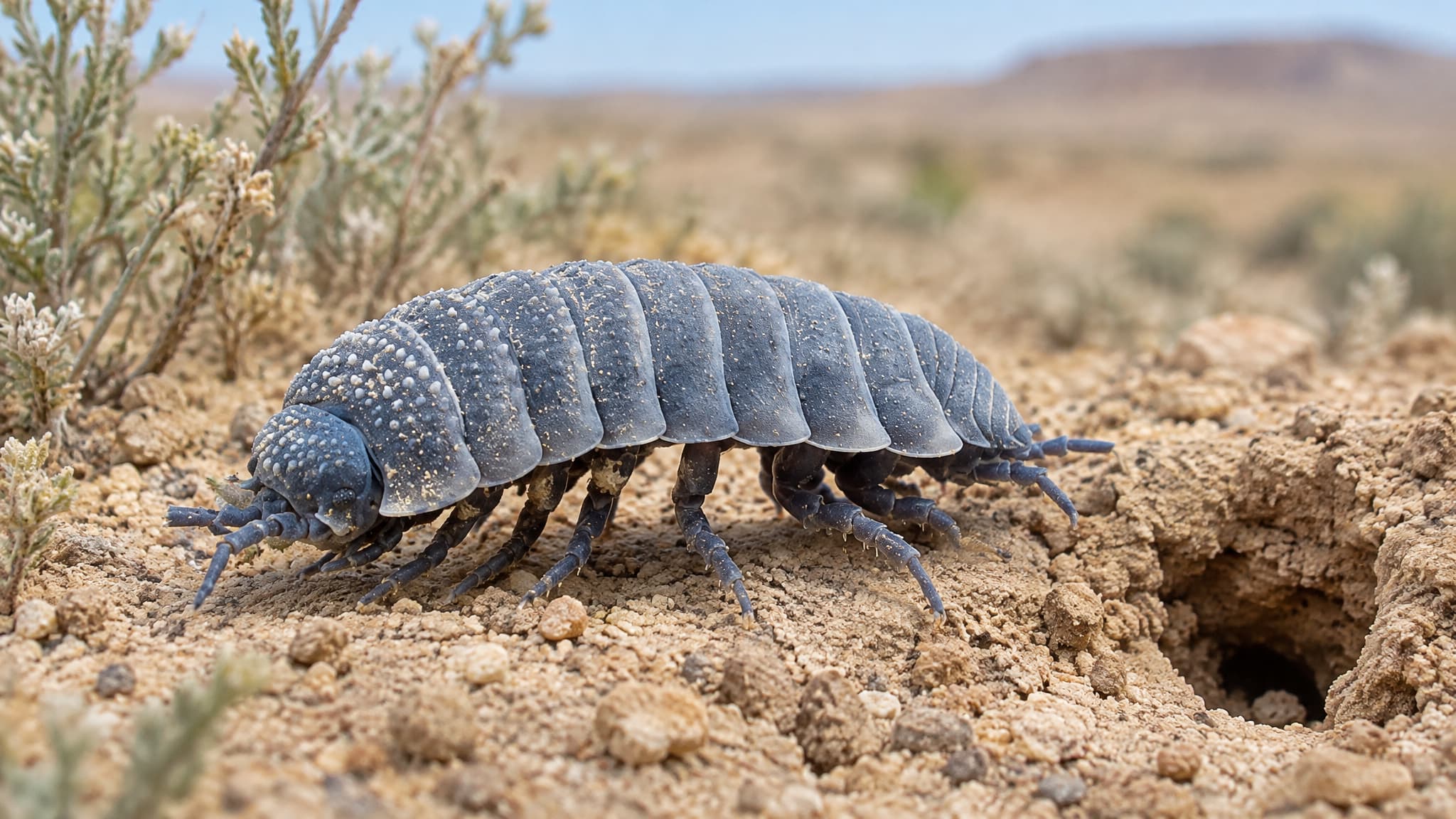
A blue-gray, heavily segmented woodlouse is shown in side profile walking across sandy, rocky ground beside sparse desert shrubs. Its domed plates, antennae, jointed legs, and small terminal appendages are clearly visible.
The desert woodlouse (Hemilepistus reaumurii) is a terrestrial isopod of North Africa and the Middle East, often cited as the crustacean that has conquered the driest habitat of any in its group. Adults reach about 22 mm in length and 9 to 12 mm in width, with seven pairs of legs and conspicuous antennae. Tubercles are confined to the head and the front of the thorax, and the animal walks with its body held unusually high above the hot ground.
It ranges across steppes, semideserts and deserts from eastern Algeria to western Syria, and is most strongly associated with loess soils in the Sahara and the Negev; it also turns up at the edges of salt lakes. Survival depends on vertical burrows 40 to 50 cm deep with a single narrow entrance, often dug beneath shrubs, where the air stays humid enough while the surface dries out. In good areas there can be around 20 burrows per square metre.
It feeds mainly on plant material, especially the leaves of the shrubs Artemisia herba-alba and Haloxylon scoparium, and studies in the Negev also describe it eating dead organic matter, microbes and soil particles. Most of its water comes from humid air and damp sand, and its gut reabsorbs water so that its droppings are drier than its food. Unlike many desert woodlice, it is active at dawn and dusk rather than at night.
Its social life is exceptional among isopods. Monogamous pairs share one burrow: one partner guards the entrance while the other forages, since digging a new burrow is slow and costly. Families recognise each other by chemical signals and mark their territory with banks of droppings. After a courtship that can last hours, the female gives birth to 50 to 100 live young, usually in May, and both parents feed them in the burrow for 10 to 20 days. Each pair raises a single brood, and adults typically live about 15 months.
Its ecological weight is large. Densities of up to 480,000 individuals per hectare have been recorded, and in the Negev its biomass exceeds that of other herbivores. By swallowing and excreting organic matter and soil, it moves tens of grams of soil per square metre each year and is thought to speed decomposition. It is the main prey of the scorpion Scorpio maurus, but is vulnerable mainly on the surface. No conservation assessment has been published for the species.