Domestic Silk Moth
Bombyx mori
 AI-generated
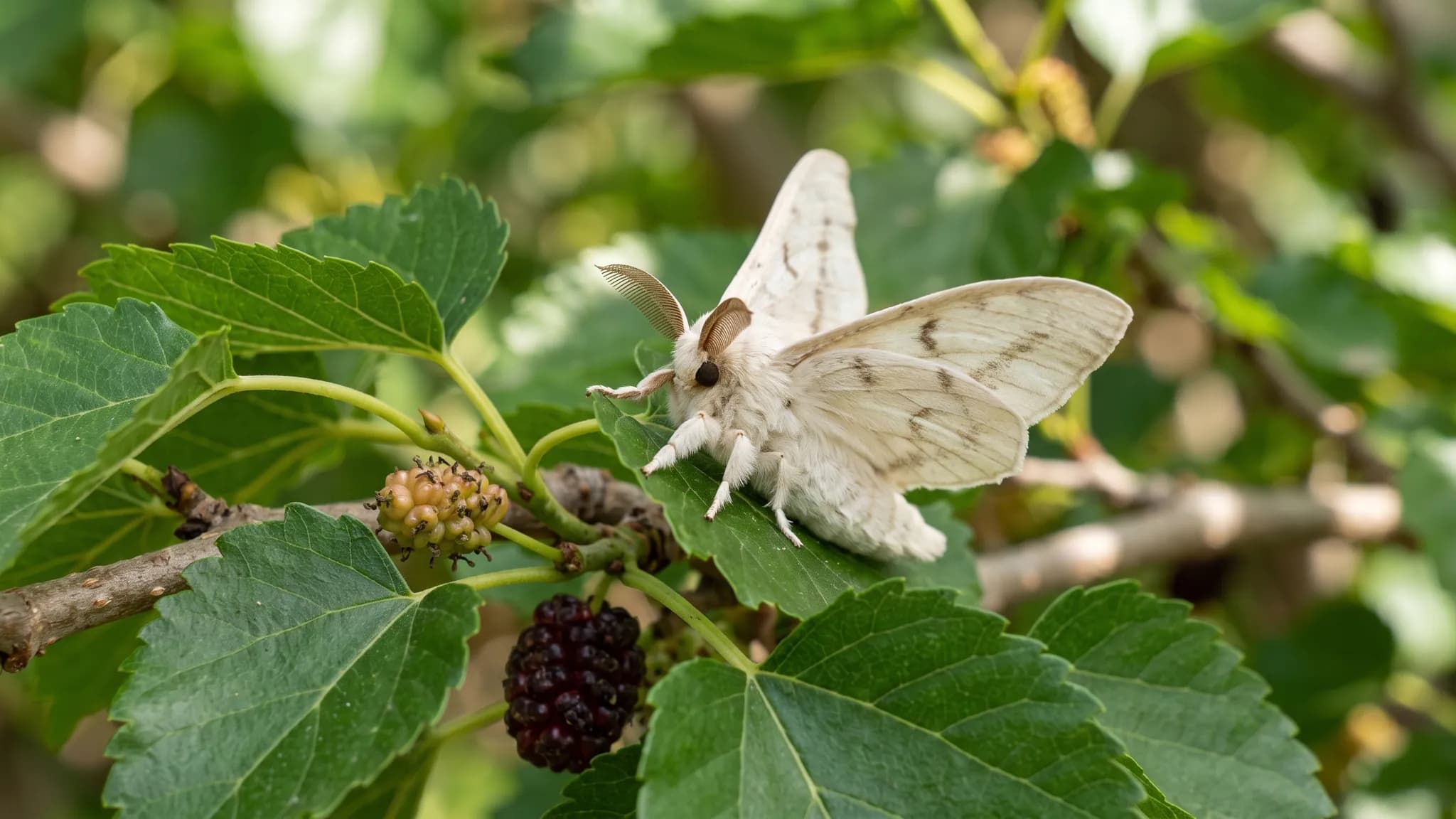
White domestic silk moth resting on a green leaf next to berries.
Bombyx mori, commonly known as the domestic silk moth, is an economically vital insect belonging to the order Lepidoptera and the family Bombycidae. As the world's primary producer of silk, this species has been intimately intertwined with human civilization for millennia. Due to intensive selective breeding by humans, B. mori is now a fully domesticated organism. It no longer exists in its natural wild state and is entirely dependent on human intervention and agricultural care for its survival and reproduction.
The domestication of Bombyx mori began approximately 5,000 years ago in China, bred from its wild ancestor, the wild silk moth (Bombyx mandarina). Over thousands of years, humans selectively bred the insect for highly specific economic traits, fundamentally altering its physiology and genome. Genomic research reveals that the insertion of a specific transposable element into the regulatory region of a key gene played a direct role in increasing the larva's body size and maximizing silk cocoon weight. However, these agricultural enhancements came at a biological cost: the adult domestic silk moth has lost the ability to fly, cannot evade predators, and is completely blind.
The lifecycle of Bombyx mori is tightly regulated and typically spans 45 to 55 days. It undergoes complete metamorphosis through four distinct stages: egg, larva, pupa, and adult. The cycle begins when a female moth lays between 300 and 500 tiny eggs. Upon hatching, the larvae (silkworms) undergo rapid growth separated by five distinct developmental phases (instars). During this stage, the silkworms feed voraciously and almost exclusively on the leaves of the white mulberry tree (Morus alba). Fed around the clock, silkworms can multiply their initial body weight by 10,000 times within a single month.
Once fully grown, the larva secretes a continuous filament of silk from its specialized salivary glands to spin a protective cocoon. Astoundingly, a single cocoon is constructed from a continuous thread of silk that can measure around 1,000 meters in length. Inside, the larva pupates and transforms into a mature moth, which secretes a chemical enzyme to dissolve the silk barrier and emerge. Lacking functional mouthparts, adult moths do not eat. Their sole purpose is reproduction; they mate, lay eggs, and naturally die within three to five days.
Sericulture—the commercial rearing of silkworms for silk—has shaped global economics and trade networks since antiquity, notably giving rise to the historic Silk Road. Today, sericulture remains a labor-intensive industry that supports the livelihoods of millions, including approximately 10 million people in India alone. Beyond luxury textiles, B. mori silk is widely utilized in medical applications, including surgical sutures and dressings, as well as industrial components. By-products of sericulture, such as mulberry leaves, excreta, and pupae, are efficiently repurposed into animal feed, biodiesel, organic fertilizers, and pharmaceutical sericin.