Fruit fly
Drosophila melanogaster
 AI-generated
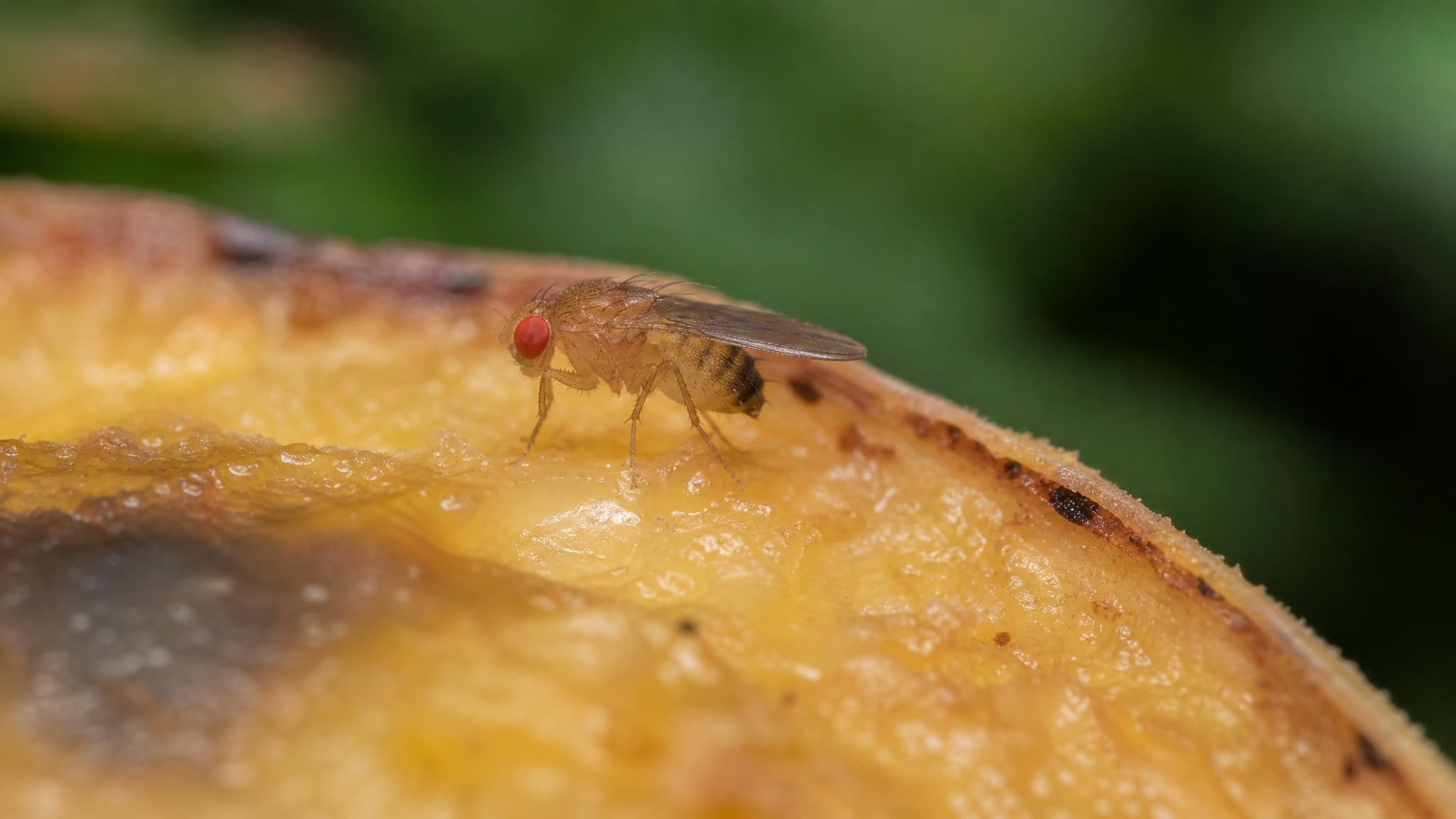
A fruit fly rests in side view on the moist surface of a cut fruit. Its red compound eye, translucent folded wings, slender legs, and banded abdomen are visible against a blurred green background.
Drosophila melanogaster, widely known as the fruit fly or vinegar fly, is a small insect characterized by its distinct red compound eyes. Its body is anatomically divided into a head, a thorax equipped with wings and halteres for flight balance, and an abdomen that exhibits varying coloration between males and females. Although it appears simple, it shares approximately 60% to 75% of known human disease-causing genes, making its genetic manipulation straightforward and profoundly important in scientific research.
Originating from tropical regions, this highly adaptable insect is now found globally. In everyday environments, it is commonly observed hovering around rotting fruit, fermenting beverages, and other organic matter. However, its most significant habitat is the modern laboratory, where it is bred in captivity around the world as one of the most critical model organisms in the biological sciences.
The fruit fly feeds primarily on the microorganisms that cause decay, particularly yeast found on fermenting fruit. Recent breakthrough research mapping the complete brain-to-body connectome—spanning approximately 160,000 neurons—revealed that many of its complex behaviors are controlled directly by local neural circuits within its body parts, rather than being strictly dictated by a central hub in the brain.
D. melanogaster possesses a highly efficient and rapid life cycle consisting of four distinct stages: egg, larva, pupa, and adult. Females are capable of laying hundreds of eggs at a time. At optimal temperatures of 20 to 25 °C, the insect completes its entire developmental cycle in roughly 10 to 12 days. This incredibly short generation time allows for rapid experimental turnover and large-scale genetic transmission studies.
Beyond its natural role in breaking down organic matter, its true legacy lies in science. Since American entomologist Charles W. Woodworth first bred the insect in captivity around 1900, it has shaped our understanding of genetics, embryology, and human disease. It was the first animal launched into space in 1946 and has been utilized in research awarded at least six Nobel Prizes. Today, it remains vital for modeling complex human conditions, including various cancers and neurodegenerative disorders like Parkinson's and ALS.