Dwarf Gourami
Trichogaster lalius
 AI-generated
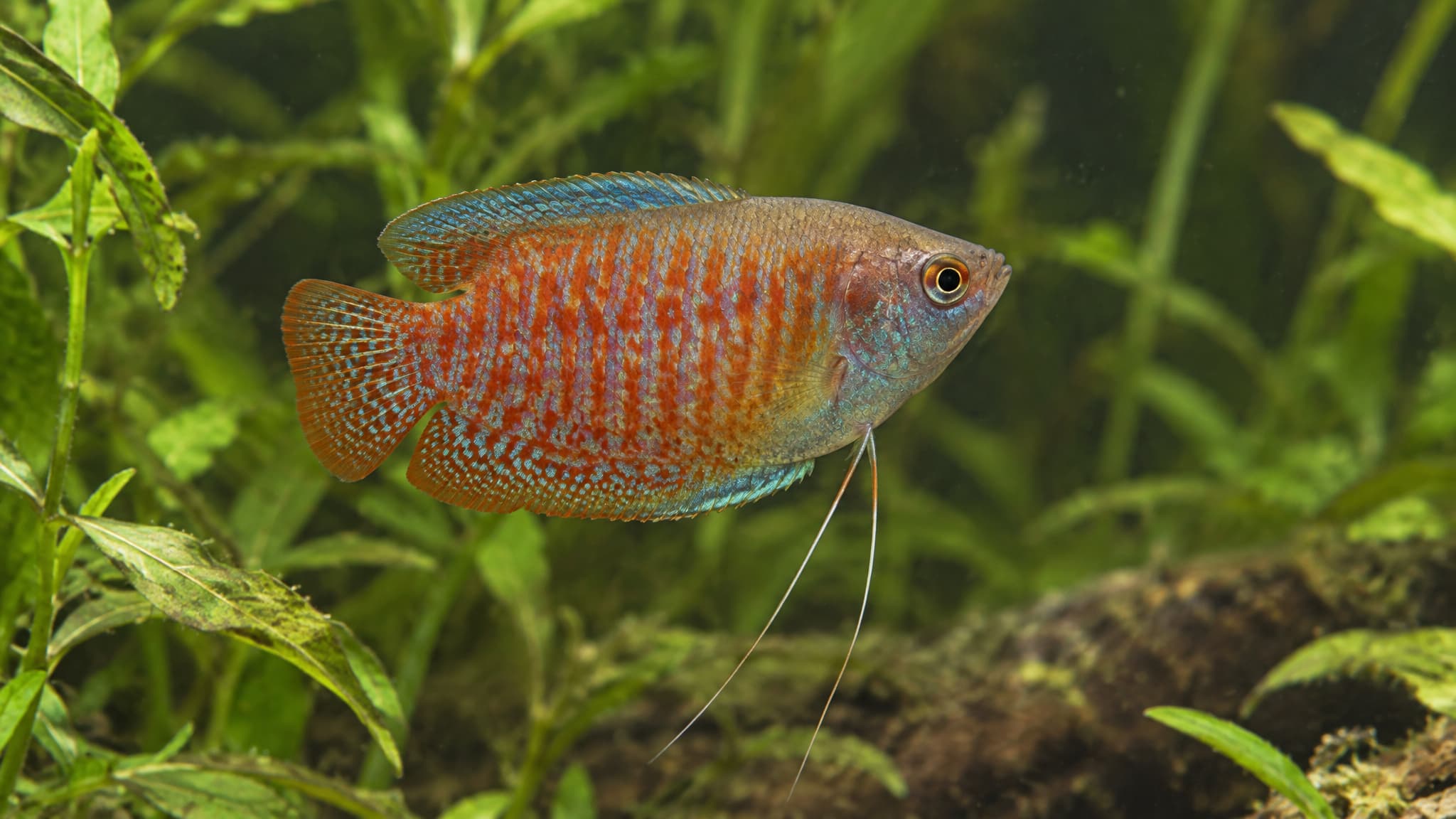
A Dwarf Gourami is shown in side profile, swimming among dense green aquarium plants. Its rounded body has vivid orange-red and blue patterning, with long thread-like pelvic fins extending beneath it.
The dwarf gourami (Trichogaster lalius) is a small labyrinth fish of the family Osphronemidae and one of the best-known gouramis in the aquarium trade. It usually reaches about 8.8 cm, and FishBase records a maximum of 9.5 cm total length. Wild males carry diagonal blue and red bands and grow longer dorsal and anal fins as they mature, while females are smaller, plainer and silvery. Captive breeding has produced flame red, powder blue and neon blue forms.
The species is native to Pakistan, India and Bangladesh. It lives in sluggish, heavily vegetated fresh water such as ponds, swamps, ditches, slow streams, lakes and irrigation canals. Like other gouramis it can breathe air at the surface, which helps it cope with warm, oxygen-poor water. Feral populations have been reported in Singapore, the United States and Colombia.
In the wild the dwarf gourami is omnivorous, feeding on small invertebrates, algae and aufwuchs, the film of tiny organisms that grows on submerged surfaces. It is shy and territorial: males defend space and can harass females or rival males, so it is usually kept as a pair in a planted tank.
Reproduction centres on the male, who builds a floating bubble nest held together with bits of plant. A spawning can yield around 600 eggs, which the male guards. The eggs hatch in 12 to 24 hours and the larvae swim freely after about three days. In aquariums most dwarf gouramis live about 4 to 6 years.
The IUCN lists the species as Least Concern. Its main problem in captivity is dwarf gourami iridovirus, a highly infectious virus with no known treatment; one study found it in 22% of dwarf gouramis exported from Singapore, and it can spread to other fish sharing the same water. The scientific name is also under discussion: the Catalog of Fishes now treats T. lalius as a synonym of Trichogaster fasciata, following a 2022 revision.
Ideal water
The water this fish does best in, as kept in aquariums.
- Water type
- Freshwater
- Temperature
- 25–28 °C
- pH
- 6.0–8.0
- acidic to alkaline
- General hardness
- 5–19 dGH