Hercules beetle
Dynastes hercules
 AI-generated
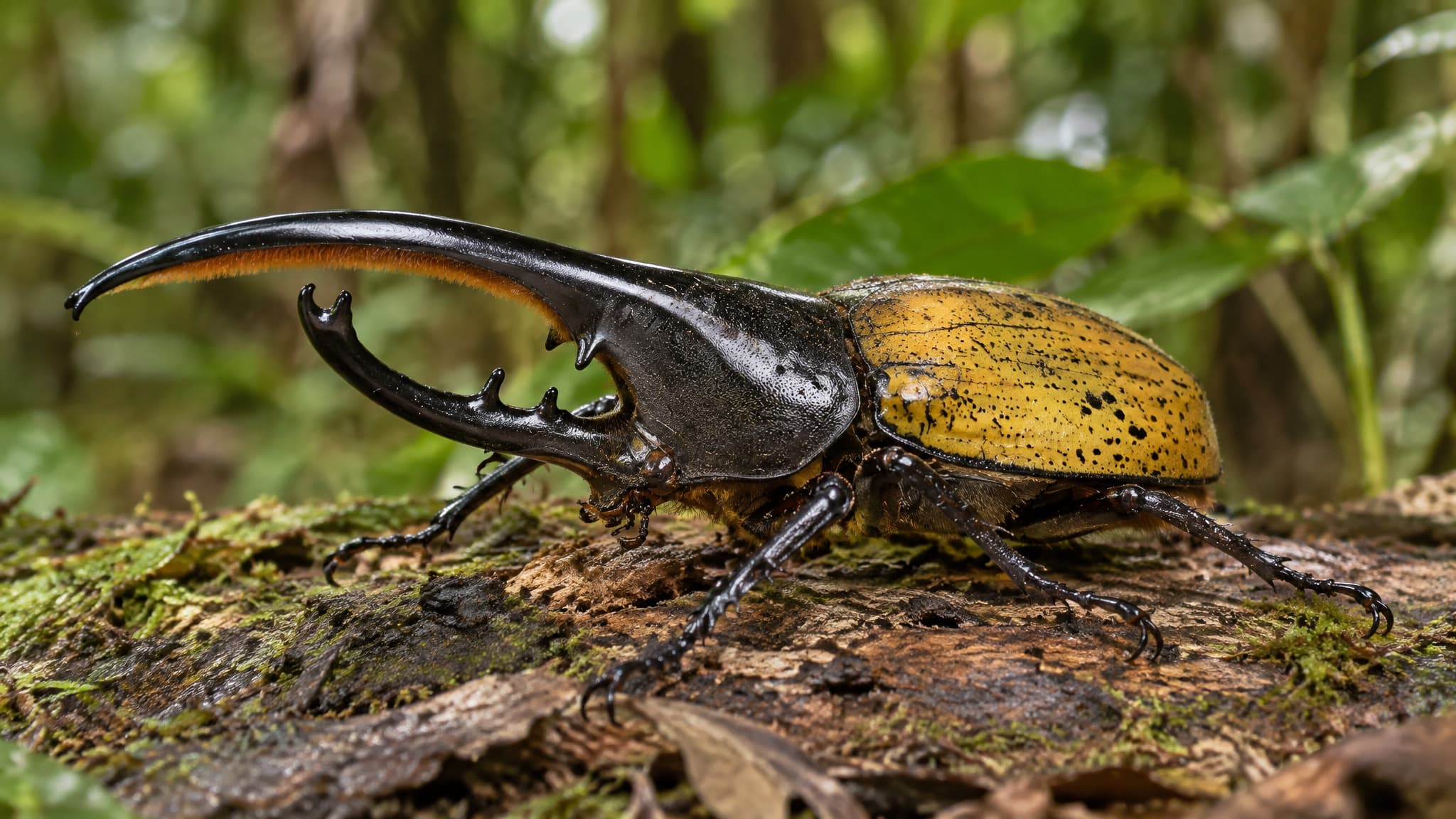
A male Hercules beetle rests in side profile on a moss-covered log in a forest setting. Its exceptionally long upper horn, forked lower horn, black thorax, and yellow-black speckled wing covers are clearly visible.
The Hercules beetle is a giant rhinoceros beetle of the American tropics and one of the longest beetles in the world when the horns are counted. Males carry two horns: a short one rising from the head and a much longer one projecting forward from the pronotum, and the largest males reach 173 mm including the horn. On average, males measure 78 mm and females 61.8 mm, and adults weigh between 11.5 and 37.5 g. Only males have horns. Males usually have olive-green to yellowish wing covers (elytra), while females have pitted elytra that are mostly black. The elytra change colour with humidity, looking yellow or olive when dry and turning black when wet.
In its broad, traditional sense, the species ranges from southern Mexico through Central America to west-central Bolivia, and from the Pacific side of the continent east into the Brazilian Amazon, with island populations on Guadeloupe and Dominica in the Lesser Antilles and on Trinidad. It lives in the understory of lowland and montane rainforests, where adults stay near the forest floor in moist places with fallen fruit. A 2017 revision by Jen-Pan Huang raised ten former subspecies to full species and restricted the name Dynastes hercules to the populations of Guadeloupe and Dominica, while major checklists such as the GBIF Backbone still treat those forms as subspecies.
Adults are nocturnal. They search for fallen, rotting fruit at night and hide in leaf litter during the day; they also take tree sap. When disturbed they produce a huffing sound by rubbing the abdomen against the elytra, probably as a warning to predators. Males use their horns as pincers in fights over females, grabbing a rival and slamming it to the ground. Although able to fly, the beetle is clumsy both in the air and on the ground.
Reproduction is sexual, with internal fertilization, and females attract males with pheromones. Eggs are laid in decaying wood and hatch after about a month. The larvae, which need fallen trees of good girth, feed on rotting wood for 12 to 18 months and can grow to more than 15 cm and 140 g. The pupal stage lasts 2 to 3 months, and adults then live 8 to 12 months, for a total life of about 34 months under captive conditions.
By feeding on dead wood and decaying fruit, the Hercules beetle likely helps break down organic matter and recycle nutrients in the forest. It is not an agricultural pest. The species has not been evaluated by the IUCN Red List, and its populations are poorly known. Deforestation and climate change threaten its rainforest habitat, and large specimens are prized in the pet beetle trade.