Two-colored oval frog
Elachistocleis bicolor
 AI-generated
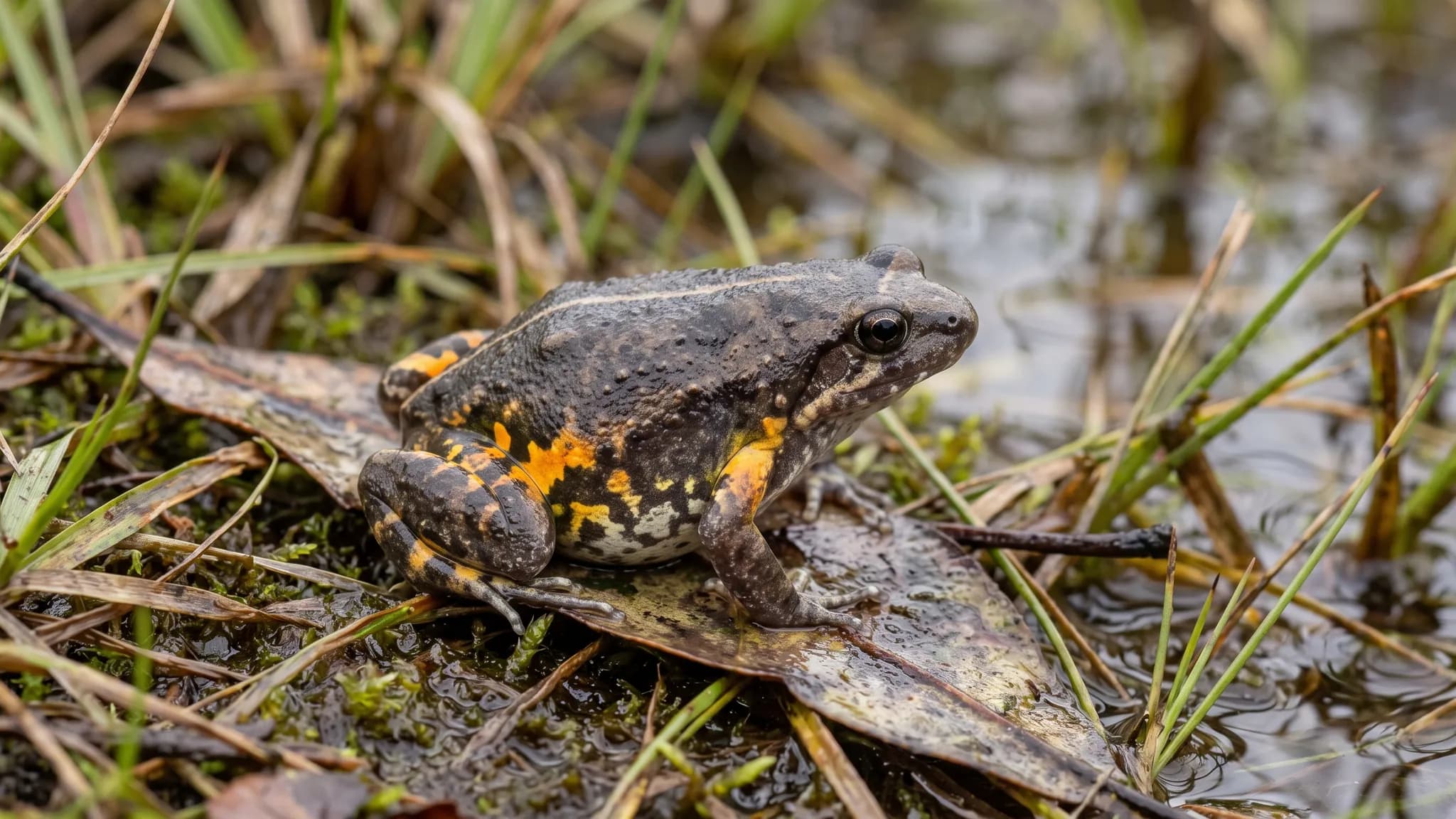
A frog with dark, bumpy skin, a thin pale mid-dorsal stripe, and bright yellow-orange markings on its sides and legs, resting on a dead leaf in shallow water.
Elachistocleis bicolor, commonly known as the two-colored oval frog, is a small amphibian species belonging to the microhylid family (Microhylidae). First described and classified by French entomologist Félix Édouard Guérin-Méneville in 1838, this species is widely distributed across the wetlands and forests of South America. It boasts stable populations in Argentina, Brazil, Paraguay, and Uruguay. Locally, it is known by a variety of vernacular names, including rana pinguino or sapito panza amarilla in Spanish-speaking regions, and rã-coxinha, sapinho-apito, or sapo-guarda-de-duas-cores in Brazil.
As its local Brazilian name rã-coxinha implies, Elachistocleis bicolor possesses a distinctly plump, ovoid (oval-shaped) body terminating in a small, sharply triangular head. The species exhibits slight sexual dimorphism in size: adult males typically range from 23 to 32 millimeters in length, whereas adult females are slightly larger, measuring between 27 and 36 millimeters. Its specific epithet, bicolor, highlights its striking two-toned appearance. The frog features a dark, brownish-gray dorsum (back) that contrasts sharply with an immaculate, spotless yellow venter (belly).
This frog species is highly adaptable and occupies a diverse array of terrestrial and semi-aquatic habitats. Its natural range includes seasonally flooded native grasslands, dry forests, and moist tropical forests. In Brazil, its distribution is notably widespread, extending from the Amazon basin in the north down through the southern states of Rio Grande do Sul and Santa Catarina. Elachistocleis bicolor demonstrates remarkable ecological resilience and is known to tolerate highly anthropized (human-altered) environments. It is frequently found in rural gardens, urban areas, and commercial agricultural zones, including non-native eucalyptus and pine forestry plantations.
Elachistocleis bicolor is primarily nocturnal and leads a semi-fossorial lifestyle, meaning it is adapted to digging and spends substantial time underground or beneath leaf litter. During periods of aestivation—typically warm, dry spells when standing water evaporates—it exhibits the fascinating behavior of sheltering directly inside subterranean ant and termite nests. Its diet is strictly myrmecophagous, consisting almost entirely of ants and termites actively foraged. Termites serve as a critical dietary staple during the dry, inactive season, while ants are heavily targeted during the active wet season. Researchers hypothesize that consuming these specific ants allows E. bicolor to secrete mildly toxic or unpalatable chemical compounds through its skin, granting the frog immunity from attacks when hiding inside ant nests.
Breeding is intrinsically linked to seasonal weather patterns. Elachistocleis bicolor is an explosive breeder that reproduces in temporary, semi-permanent, and permanent bodies of water. Its reproductive phase correlates directly with heavy, continuous rainfall and primarily takes place during the wet season, which runs from October to April. Upon hatching, the tadpoles are highly active foragers in the water column. According to the IUCN Red List and Brazil’s ICMBio, Elachistocleis bicolor is assessed as a species of "Least Concern" (LC). The overall population is considered abundant, widespread, and stable, facing no immediate threat of extinction.